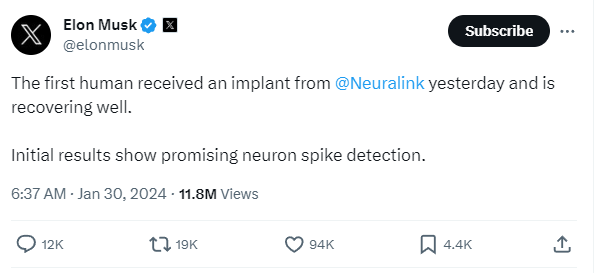
On January 30, Elon Musk announced on the social media platform X (formerly Twitter):Yesterday, the first human received a Neuralink implant and is recovering well; preliminary results indicate that neuronal spike detection is promising.
Since 2019, Musk has announced at least four times that Neuralink would begin human trials of its brain implants to treat severe conditions such as paralysis and blindness.Neuralink received FDA approval last May to conduct its first trial to test the company’s human implant.
Neuralink Announced Implant Trials in September. The company stated that during the study, its developed robot would surgically implant “ultra-thin” threads to help transmit signals in participants’ brains.
Who Is Neuralink?
Neuralink, founded in 2016, is a U.S. neurotechnology and brain-computer interface company established by Elon Musk and eight other co-founders.Responsible for the research and development of implantable brain-computer interface technology, the company's headquarters is in San Francisco.It is reported that,neuralinkCurrently, there are approximately 300Employee, brings togetherNeuroscientists, neurosurgeons, chip designers, biocompatible materials scientists,Brain-Computer InterfaceExperts, Microfabrication Engineers, and Other Specialists in Various Fields。Last year's financing situation shows that,Neuralink’s Valuation Has Reached $5 Billion(approximately RMB 35.9 billion).The company’s founding stems from a science fiction concept once discussed by Elon Musk—“neural lace”—which involves brain-machine interaction, envisioning that people could treat a range of conditions, from obesity, autism, depression, and schizophrenia to Alzheimer’s disease, through surgical implants.In April 2017, Wait But Why reported that Musk planned for Neuralink to develop devices in the short term to treat severe brain diseases and achieve human enhancement. In July 2019, Neuralink publicly announced a brain-computer interface system developed by the company.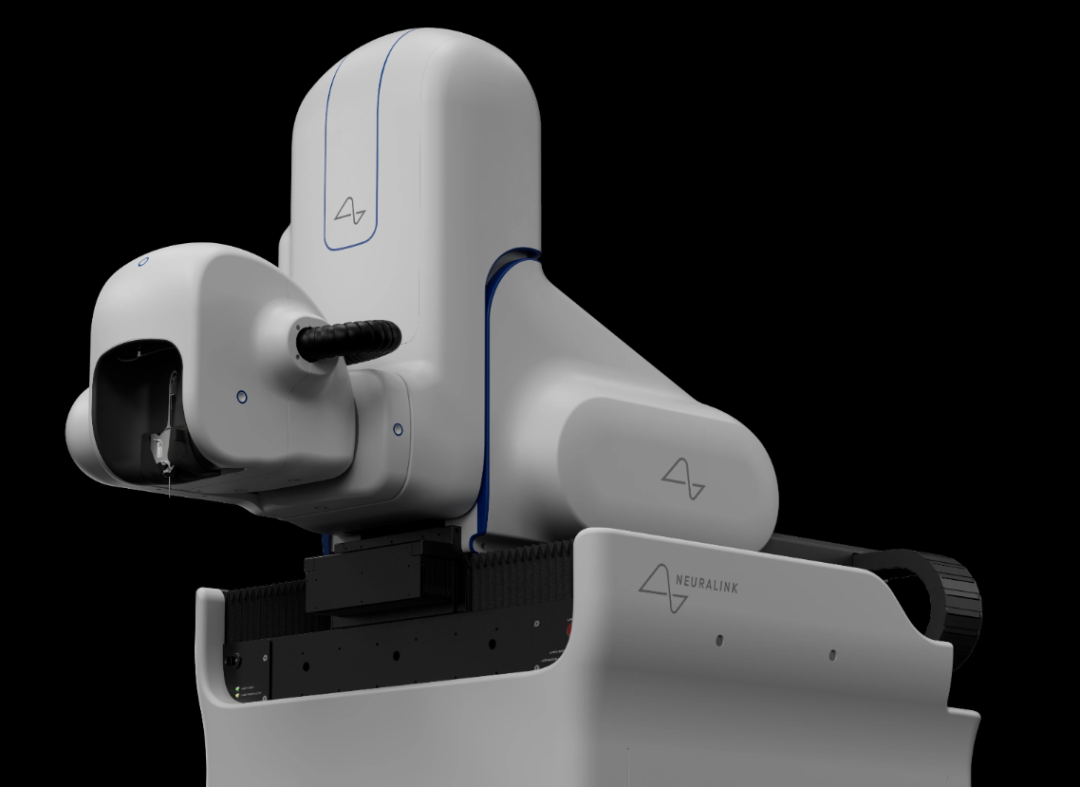
Figure: Neuralink Surgical Robot
According to Neuralink's official website, it is developing a brain-computer interface——implant, which can record and stimulate electrical activity in the user's brain, while a brain-computer interface (BCI) is a neural implant that connects the user's brain to external electronic devices.The N1 implant is sealed in a biocompatible housing that can withstand physiological conditions several times harsher than those of the human body. It is powered by a small battery that is wirelessly charged via a compact inductive charger, allowing for easy use anywhere.The N1 implant records neural activity via 1,024 electrodes distributed across 64 threads. These highly flexible, ultra-fine threads are key to minimizing damage during and after implantation. Neuralink’s surgical robot guides these threads through the user’s skull and into the brain, precisely inserting them into the targeted locations.This technology had previously been tested in animals. According to Elon Musk, “a monkey was able to control a computer with its brain.” Neuralink also demonstrated a pig implanted with a Neuralink device, which successfully read the animal’s brain activity.
Figure: Neuralink's brain-computer interface demonstrates a monkey playing ping pong
What Is a Brain-Computer Interface?
Brain-Computer Interface (BCI), also known as BMI or Intelligent Brain, refers to a direct connection established between the human or animal brain and external devices, enabling information exchange between the brain and the devices, thereby serving functions such as monitoring, replacement, improvement/restoration, enhancement, and supplementation.Brain-computer interfaces consist of three main components:
First, devices for measuring brain activity. Including headphones, caps, and embedded electrodes to detect and record signals from the brain.
Second, computers used to process and analyze recorded brain activity. The BCI software will attempt to interpret the user's intended actions from incoming brain activity using specialized processing methods and algorithms.
3. Applications/Devices to be ControlledOnce the computer “determines” what the user intends to do, it sends a signal to the application/device to execute that command, such as turning on a light.
Based on the distance between the electrodes and brain tissue, brain-computer interfaces can be classified into three major categories:- Non-invasive (EEG, MEG, EOG, MRI): Non-invasive BCI involves placing signal acquisition electrodes on the exterior of the scalp. Its advantages include the absence of surgical procedures and minimal trauma to the human body; however, its disadvantages stem from the greater distance between the electrodes and neurons, resulting in higher noise levels in the measured signals and imposing more stringent requirements for subsequent signal processing.
- Partially Invasive (ECoG and Endovascular): Partially invasive BCI devices are implanted within the skull, located inside the cranial cavity but outside the gray matter. Compared to fully invasive BCIs, they yield signals with better resolution than non-invasive BCIs.
- Invasive (Microelectrode Array):Invasive BCI requires surgical implantation of electrodes beneath the scalp to transmit brain signals.The advantage is the ability to provide more accurate readings, while the disadvantages include the susceptibility of implantation surgery to trigger immune responses and trauma, as well as the tendency for signal quality to degrade or even disappear after prolonged implantation.
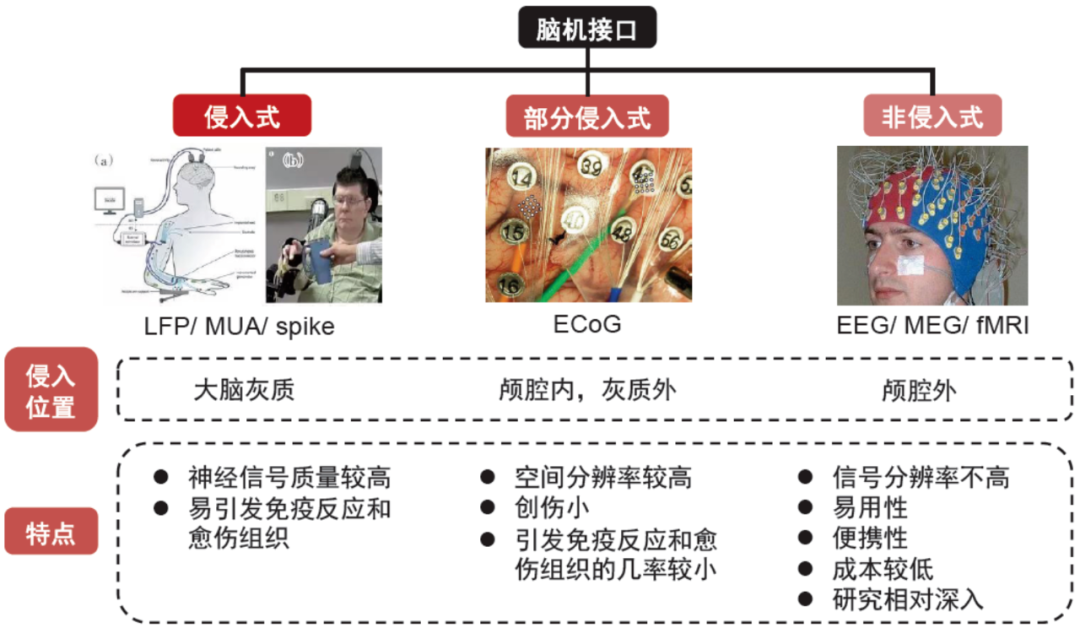
Source: Case Western Reserve University, CITIC Securities, and Gaohe Research Center
Latest Funding: $75 Million in Series CCompany Introduction:A leader in the field of implantable neural interface technology, the company’s neuroprosthetics have entered clinical trials for the treatment of paralysis, and it is developing the first endovascular implantable neuromodulation therapy. Future applications may include the potential to diagnose and treat neurological disorders such as Parkinson’s disease, epilepsy, depression, and hypertension, as well as non-medical solutions.Latest Financing: $10 Million in Equity InvestmentCompany Profile:Blackrock Neurotech is a global leader in brain-computer interface (BCI) technology platforms, dedicated to developing implantable solutions that improve human lives. Blackrock’s precision electrode technology lies at the core of brain-computer interfaces, enabling dozens of early users—known as “BCI Pioneers”—to walk, speak, see, and hear again through neural signal processing and stimulation.Company Introduction:Focused on research and product development in the field of interventional MRI. In 2003, MRI Interventions, Inc. shifted its focus to identifying and expanding commercial applications for the technologies developed in prior years. In February 2020, MRI Interventions, Inc. was renamed ClearPoint Neuro, Inc.Latest Funding: UndisclosedCompany Introduction:Focused on developing brain-computer interface (BCI) technology to restore communication, mobility, and independence for patients with neurological disorders, injuries, or limb loss. The research not only emphasizes enhancing the ability to operate computers but also aims to provide reliable and sustained environmental control for patients with ALS, spinal cord injuries, and stroke.Latest Funding: $6 million in Series A+Company Introduction: Neurable is a developer of brain-wearable devices, dedicated to providing a standard human-computer interaction platform that can be integrated into any hardware or software device. This enables users to control software and devices in their homes or offices through real-time brain activity and augmented reality systems, creating an unrestricted lifestyle for users, especially those with disabilities.