

China's Seven Ministries Promote Brain-Computer Interface Breakthroughs; XinDou Bio and PV MedTech Secure New Funding Rounds
PVmed
AI-Assisted Diagnosis Service Provider

Neuralink
Brain-Computer Interface System Developer

Synchron
Developer of implantable neural interface products
On January 29, the Ministry of Industry and Information Technology and six other departments issued the “Implementation Opinions on Promoting the Innovative Development of Future Industries” (hereinafter referred to as the “Opinions”). “Future Health” was listed as one of the six key industrial directions for prioritized advancement, with multiple provisions directly linked to the medical device industry.
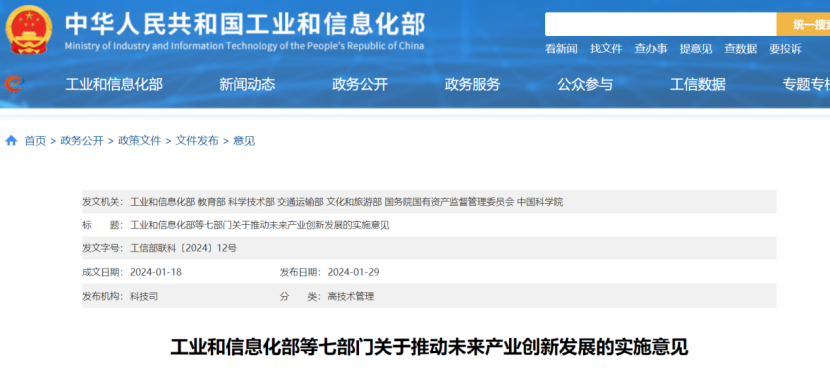
The "Opinions" propose key tasks such as comprehensively laying out future industries, accelerating technological innovation and industrialization, creating flagship products, strengthening industrial entities, enriching application scenarios, and optimizing the industrial support system. It emphasizes the need to strengthen forward-looking planning and deployment, grasp global trends in scientific and technological innovation and industrial development, and focus on advancingSix Major Industrial Directions: Future Manufacturing, Future Information, Future Materials, Future Energy, Future Space, and Future HealthDevelopment.
The “Future Health” initiatives outlined in the opinion include: accelerating the industrialization of cutting-edge technologies such as cell and gene therapy, synthetic biology, and biological breeding; leveraging technologies like 5G/6G, the metaverse, and artificial intelligence to empower new medical services; and developing high-end medical equipment and health products that integrate advanced technologies such as digital twins and brain-computer interfaces.
Among these, brain-computer interaction (BCI), as a cutting-edge multidisciplinary technology, has found significant application in the medical device sector. It has already spawned various innovative products and is widely used in the diagnosis, screening, monitoring, treatment, and rehabilitation of neurological and psychiatric disorders. China’s 14th Five-Year Plan has listed brain science and brain-inspired research as national strategic scientific and technological strengths, vigorously promoting breakthroughs in frontier brain-computer interface technologies.
Recent Breakthroughs in Brain-Computer Interface TechnologyOn January 30, Elon Musk announced on social media that Neuralink had completed the first human implantation of a brain-computer interface (BCI) device. On January 31, Tsinghua University’s official website also released news stating that a team from Tsinghua University and Xuanwu Hospital had successfully conducted the first clinical trial of a wireless minimally invasive BCI. Industry analysts pointed out that this achievement is expected to surpass Musk’s industrialization progress.
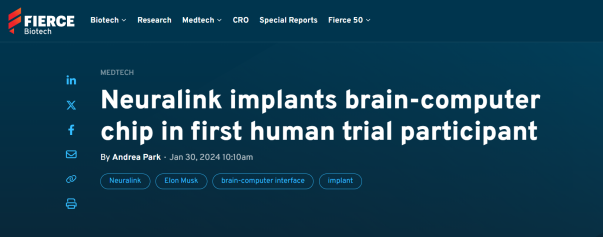
Clearly, the R&D competition in the field of brain-computer interface technology is accelerating across the board, and Synchron, Neuralink’s top competitor, has also made moves.
On February 1 local time, Synchron announced the acquisition of a minority stake in Acquandas, a German thin-film component technology company. As part of the deal, Synchron will secure exclusive rights to Acquandas’ layered medical device technology. Additionally, two executives from Synchron will join the board of directors at Acquandas.
It is reported that Synchron, founded in 2012, has developed a brain-computer interface (BCI) called the “Synchron Switch.” Implanted into the blood vessels on the surface of the brain’s motor cortex via minimally invasive surgery and connected to the brain through the jugular vein, this interface enables users with limited physical mobility to control smart home devices and other equipment using their thoughts.

What Other “Device” News in the Medical Device Sector Deserves Attention This Week? Insights into New Industry Policies, Observations on Corporate Developments, and a Review of Market Financing and Investment—Tracked and Reported by Pharmaceutical Economic News!
2023 Annual Report on the Management of Medical Device Standards in China Released
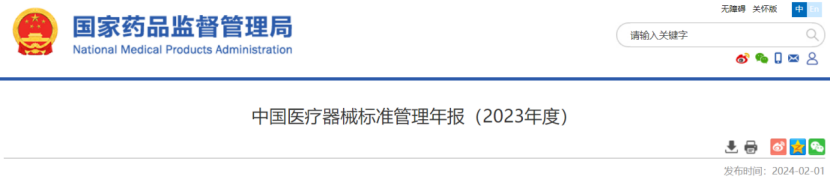
On February 1, the National Medical Products Administration released the "Annual Report on the Management of Chinese Medical Device Standards (2023)."
According to statistics, in 2023, the Standardization Administration of China approved and issued project plans for 52 national standards and 117 industry standards for medical devices; it also approved and published 28 national standards and 131 industry standards for medical devices. As of December 31, 2023, there were a total of 1,974 currently effective medical device standards, comprising 271 national standards and 1,703 industry standards.
“Measures for the Assessment of Quality Credit Ratings and Classified Supervision and Administration of Medical Device Manufacturing in Shaanxi Province” Released
On February 1, the Shaanxi Provincial Medical Products Administration released the "Measures for the Assessment of Quality Credit Ratings and Classified Supervision and Management of Medical Device Production in Shaanxi Province" via its official website. These Measures apply to the assessment of quality credit ratings and the classified supervision and management of medical device registrants, filers, and medical device manufacturing enterprises in Shaanxi Province.
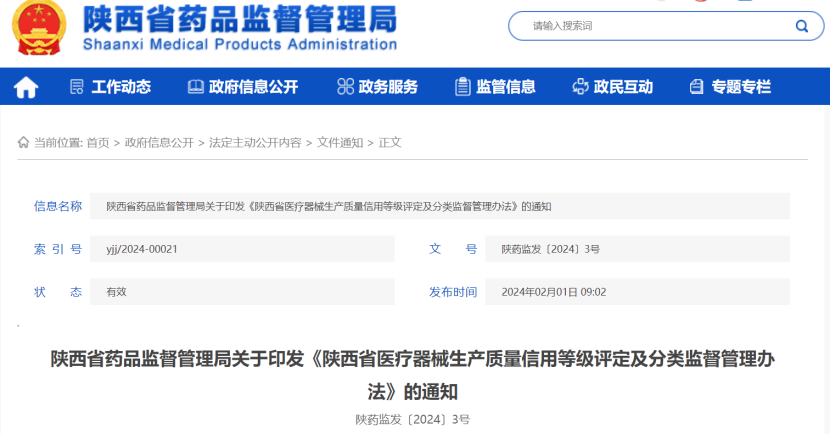
The Shaanxi Provincial Medical Products Administration organizes and implements the province-wide classified management of quality credit for medical device manufacturing, and is responsible for assessing the quality credit ratings and conducting classified supervision of medical device registrants and enterprises holding Class II and Class III medical device production licenses across the province. Municipal-level drug regulatory departments are responsible for assessing the quality credit ratings and conducting classified supervision of medical device filers and manufacturers of Class I filed medical devices within their respective jurisdictions.
The quality credit rating classification for medical device manufacturing is divided into four levels—A, B, C, and D, from highest to lowest—in accordance with the "General Rules for Classification of Enterprise Quality Credit Ratings" (GB/T 23791-2009), representing trustworthy, basically trustworthy, untrustworthy, and seriously untrustworthy, respectively.
Welllead Medical Obtains Medical Device Registration Certificate for Single-Use Visualized Double-Lumen Laryngeal Mask Airway
On January 31, Weili Medical issued an announcement stating that its wholly-owned subsidiary, Hainan Weili Medical Technology Development Co., Ltd., recently received the "Medical Device Registration Certificate of the People's Republic of China" issued by the Hainan Provincial Medical Products Administration. The product name is Disposable Visual Double-Lumen Laryngeal Mask.
Weili Medical is primarily engaged in the research and development, production, and sales of medical catheters for anesthesia, urology, respiratory care, hemodialysis, and other fields. Its products are widely used in clinical settings, including surgery, treatment, emergency care, and nursing. As one of the leading global suppliers of medical catheters, the company ranks among the top internationally and domestically in the production and sales of endotracheal tubes and indwelling urinary catheters.
Sino Medical's Subsidiary Product "Delivery Catheter" Receives Domestic Medical Device Registration Certificate
On February 1, Sino Medical announced that its subsidiary, Sino Shenchang Medical Technology Co., Ltd., had received the "Medical Device Registration Certificate of the People's Republic of China" issued by the National Medical Products Administration. The product is named delivery catheter, which is suitable for the introduction of interventional devices and assists in guiding interventional devices deep into peripheral, coronary, and intracranial vascular systems.
The delivery catheter that has obtained the “Medical Device Registration Certificate” is an access catheter product independently developed and manufactured by Sino Medical’s subsidiary, Sino Shenchang. Clinically, this product is suitable for the introduction of interventional devices, assisting them in penetrating deeper into the peripheral, coronary, and intracranial vascular systems to establish vascular access. This product features a large inner lumen of 0.088 inches, enabling compatibility with multiple device operations; its fully braided reinforcement structure and gradient outer layer material allow for better positioning and stronger support; the atraumatic tip and closed-loop marker design enhance the safety of product use.
Medical Device Company SoniVie Announces Completion of REDUCED-1 Pilot Study Using TIVUS™ Ultrasound Renal Denervation
On February 2, SoniVie, an Israeli company developing a novel proprietary Therapeutic Intravascular Ultrasound System (TIVUS™) for the treatment of various hypertensive disorders, announced that on January 8, 2024, the last patient received TIVUS™-guided renal denervation therapy as part of the REDUCED-1 pilot study for hypertension treatment, which was approved under an Investigational Device Exemption (IDE) by the U.S. Food and Drug Administration (FDA). Patient enrollment for the REDUCED-1 study was conducted in the United States and Israel under the same protocol. Of the total participants, 25 patients were enrolled in the United States and 15 in Israel. All patients (N=40) are currently in the follow-up phase of the study. The primary efficacy endpoint (change in daytime systolic blood pressure) will be analyzed at 3 months, while safety will be assessed at 1 month and 12 months of follow-up.
Xindou Biotechnology Completes Tens of Millions in Pre-A Financing Round
Xindou Biotechnology (Suzhou) Co., Ltd. Announces Completion of Tens of Millions in Pre-A FinancingRecently, Xindou Biotechnology (Suzhou) Co., Ltd. announced the completion of its Pre-A financing round, raising tens of millions of yuan. The funds from this round will help the company rapidly advance the clinical trials of its first drug pipeline featuring tumor-targeted fluorescent contrast agents, continue the development of other pipelines, and foster scientific research collaborations. This financing round was exclusively led by Gaobo Capital, with existing shareholder Shishangbai Venture Capital continuing to increase its investment.
Xindou Biotechnology (Suzhou) Co., Ltd. was established in February 2021 in Suzhou Industrial Park. The company focuses on the research, development, and industrialization of tumor-targeted fluorescent contrast agents. With the mission of “illuminating tumors for precise surgery,” it has built the RT-TFC™ R&D technology platform and developed various fluorescence-drug conjugates (FDCs) for fluorescence-guided surgery. These FDCs can “target/label tumors,” enable “intraoperative imaging,” and facilitate “precise identification of positive margins” based on specific markers of different solid tumors. The products offer advantages such as high sensitivity, strong specificity, and a favorable tumor-to-background ratio (TBR), assisting surgeons in clearly visualizing tumor boundaries, determining positive margins, and locating metastatic lymph nodes. Currently, the company’s lead candidate, DGPR1008, has completed preclinical studies and will soon submit an Investigational New Drug (IND) application.
RepiMed Completes Tens of Millions of Dollars in A++ Round Financing
Recently, Repolar Medical, a leading domestic manufacturer of micro-electromechanical RF technology, announced the completion of its tens-of-millions-of-dollars A++ round of financing. This round was led by Mifang Health Fund, with Puhua Leading as a co-investor, and Dianshi Capital continued to serve as the exclusive financial advisor. The funds raised in this round will be primarily used for the promotion of its internationally exclusive full-line micro-RF products and for the registration and certification of new products in the Middle East, the Americas, and Europe.
Repiga focuses on the development of biocompatible micro-electromechanical systems (MEMS) technology, dedicated to promoting its clinical applications in urology, dermatology, hepatology, and other fields. Founded by a core MEMS technology team from California, USA, the company has secured hundreds of millions of yuan in venture capital from both domestic and international sources, as well as tens of millions of US dollars in R&D project support.
PVmed Completes RMB 90 Million Series B Strategic Financing
Recently, PVmed announced the successful completion of its RMB 90 million Series B strategic financing, invested by Zhuji Xienoxingshi Venture Capital Partnership (Limited Partnership), with Zero2IPO CapitalServed as the exclusive financial advisor for this round.
The proceeds from this round of financing will be primarily used to further enhance and enrich the company’s product pipeline layout and innovation capabilities in the global multi-billion-dollar market for intelligent, precision oncology therapy; expand coverage in both domestic and international markets; and accelerate the research and development, production, and regulatory registration of integrated software-hardware solutions for intelligent, precision oncology therapy. Meanwhile, PVmed will establish its presence in the Zhejiang Zhuji “Ten Thousand Mu, Hundred Billion Yuan” New Industry Platform for Intelligent Vision, comprehensively advancing its strategic layout in East China and building up its R&D and production capabilities for intelligent, precision oncology surgical products.


www.yyjjb.com.cn
Insight into Industry Trends

"Pharmaceutical Economic News"
Academic Official Account
Focusing on the Frontier of Oncology Academia

Terminal Official Account