

Neuralink Achieves Breakthrough in Human Brain-Computer Interface Trials Amid Ongoing Controversies and Skepticism Over Therapeutic Potential

Neuralink
Brain-Computer Interface System Developer


Earlier this year, Elon Musk announced that his brain-computer interface company, Neuralink, had implanted a chip into a human brain for the first time (clickHereReview), less than a month later, the study participant had taken the first step in controlling a computer with their brain.
Recently, Tesla CEO Elon Musk stated on the social media platform X,The first patient implanted with a Neuralink brain chip appears to have fully recovered and can now use his thoughts toMouse Control。Musk also stated that Neuralink is currently attempting to obtain as many mouse-click commands as possible from patients.
Neuralink stated that this study used robotic surgery to implant a brain-computer interface into the region of the brain that controls movement intention, with the initial goal beingEnabling humans to control computer cursors or keyboards with their thoughts.
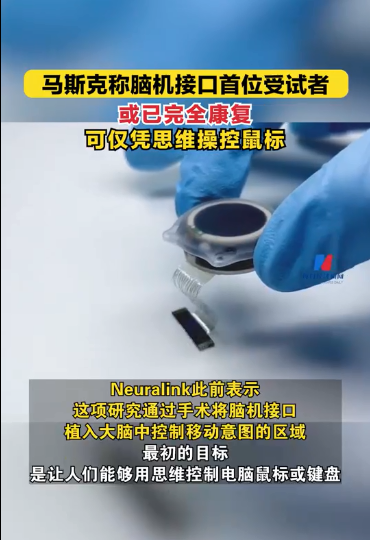
☝ Image source: Screenshot from National Business Daily video
Elon Musk has high hopes for the Neuralink project, aiming to use this approach toTreatment of diseases such as obesity, autism, depression, and schizophrenia. In 2023, Neuralink's valuation reached approximately$5 billion。
Neuralink Corp, founded by Musk in 2016, aims to help individuals suffering from paralysis and neurological disorders in the short term, while reducing the risks of artificial intelligence to humanity in the long run. The company’s mission is to develop brain-computer interfaces for treating various brain-related diseases, with the ultimate goal of creating a whole-brain interface that more closely connects biological organisms with artificial intelligence.
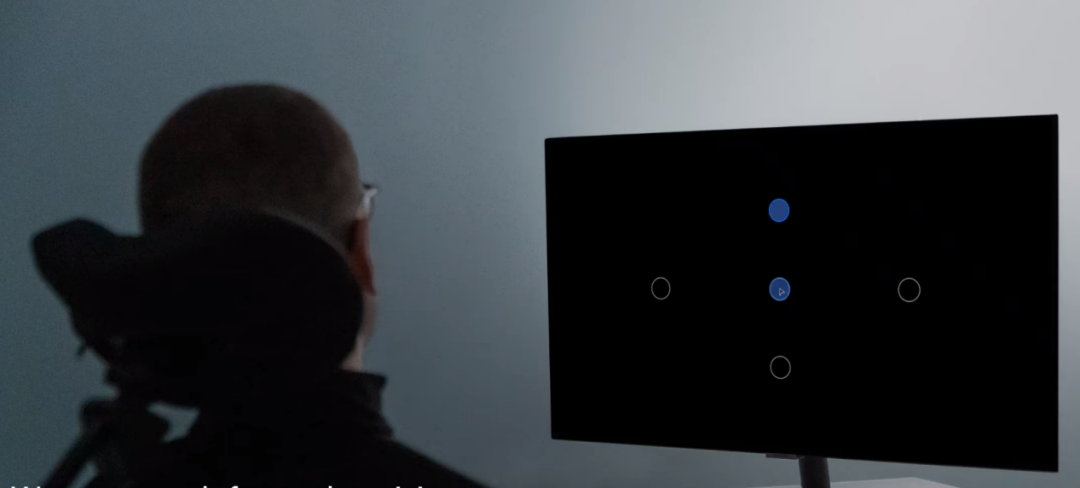
☝ Human Brain-Computer Interface Controls Electronic Devices
Brain-computer interface (BCI) technology is regarded as a cutting-edge field with immense medical potential. Coupled with the significant public attention drawn by Elon Musk, related developments have been highly anticipated since Neuralink received approval from the U.S. Food and Drug Administration (FDA) for clinical trials in 2023.
According to information revealed by biographer Ashley Vance in late 2023, thousands of people are currently queuing up in hopes of receiving brain implants from Neuralink, the brain-computer interface company owned by Elon Musk. It is reported that Neuralink Corp projects its annual revenue will reach as high as $100 million within five years. In 2023, the U.S. Food and Drug Administration (FDA) approved Neuralink’s device for human clinical trials, and by September 2023, the company had begun recruiting volunteers for its first-in-human trial.
But ALS fighter and former Vice President of JD.comCai Leiit is considered that brain-computer interfacesCannot save lives, can only increase communication,In an interview with reporters on September 23, 2023, he stated, “I personally do not have the time to participate in the trial at present.”
In recent years, a cohort of radical neuroscientists, with Elon Musk as their spiritual leader, has resolved to deploy a robot to implant coin-sized devices into human brains, aiming to create a new breed of superhumans with enhanced memory, digital immortality of the soul, and cyborg characteristics. However, this path is fraught with challenges.
According to reports, the concept of brain-computer interfaces originated from a proposal in 1973 by Jacques Vidal, a computer scientist at the University of California, Los Angeles (UCLA), who posited that real-time signals emitted by the brain could be detected via electrodes placed on the scalp, translated, and then used to control computers.
Neuralink, despite its current momentum, is not the industry leader. According to Walter Isaacson, the author of Elon Musk’s biography,Elon Musk’s Most Watched Rival Is Synchron, its clinical trial received approval earlier. It is reported that the company had already enabled six individuals with severe paralysis to perform simple digital device operations using the Synchron device in 2023, and this round of feasibility trials will conclude in August 2024.
Synchron also announced last Thursday,It has acquired a minority stake in the German manufacturer Acquandas., the company possesses a unique capability to delaminate metal components of brain-computer interface implants. Following the acquisition, Synchron willIncrease the Production of Brain-Computer Interfaces,Preparation for Business Needs, bringing the company closer to launching its devices on the market.
Faced with the rapid advances of competitors, according to biographer Walter Isaacson,Impatient, Musk has repeatedly urged Neuralink engineers to accelerate progress."Previous trials have shown,"The invasive nature of the device and the hasty actions of company employees pose serious safety hazards.“The Committee of Responsible Physicians criticized in its statement on January 30.”
In fact, the controversy surrounding Neuralink has not ceased in the past few years.
According to a Reuters report on January 26, the U.S. Department of Transportation fined Neuralink $2,480 for improper handling of hazardous materials, including the toxic gas xylene, following a complaint filed by the Committee for Responsible Physicians.
Another major controversy surrounding Neuralink is itsPreliminary animal experiments resulted in excessive animal mortality.Reuters and Wired magazine have conducted long-term investigative reporting on this issue. According to a Reuters report in December 2022, Neuralink Corp’s experiments resulted in the deaths of more than 1,500 animals. Employees wrote internal letters pointing out that the company’s rush to meet deadlines caused excessive stress and inadequate preparation among staff, thereby increasing unnecessary suffering and mortality in the animal subjects.
In November 2023, four U.S. lawmakers jointly called on the U.S. Securities and Exchange Commission to investigate whether Elon Musk had misrepresented the safety of his technologyMisled investors, as Musk stated on the X platform that “no monkeys died due to Neuralink’s implants.”
Beyond the ethical controversies surrounding animal research, many have also criticized Neuralink’s technological approach and Elon Musk’s grand vision. The Physicians Committee for Responsible Medicine argues that Musk’s goal is to use Neuralink’s technology “Achieving Symbiosis with Artificial Intelligence”, such a path, however, does notNot necessarily consistent with the optimal approach to patient care. Furthermore, non-invasive brain-computer interfaces have demonstrated progress in improving patient health,Neuralink's Craniotomy Implantation Method May Pose Unnecessary Risks.
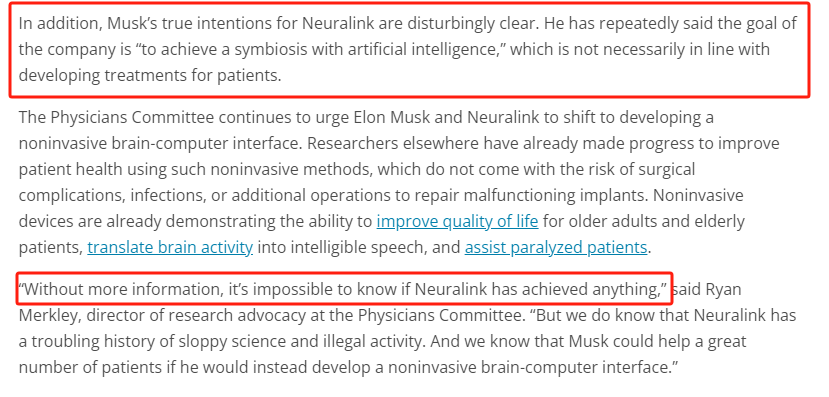
☝Screenshot of the Doctor Committee Statement
Miguel Nicolelis, a professor of neuroscience at Duke University School of Medicine in the United States and hailed as the “father of brain-computer interfaces,” has previously stated thatInvasive brain-computer interfaces are intended for scientific research and are not the optimal choice for patients; implantation should be reserved exclusively for the most severe cases.
JoinYaomo VIP Premium Resources Hub Get the Latest Premium Resources




Scan the QR code to follow us
Image and text: Internet
Layout: Yaomo