

First Human Recipient of Neuralink Brain-Computer Interface Reportedly Recovered; Company Files IPO Prospectus

Neuralink
Brain-Computer Interface System Developer
Elon Musk Claims First Brain-Computer Interface Implant Recipient May Have Recovered, Sending BCI Concept Stocks Soaring
According to multiple media reports, on February 20 (February 19 local time), Elon Musk, the well-known American entrepreneur and CEO of Tesla, announced that the first human patient to receive a brain implant from his brain-computer interface company, Neuralink, appears to have fully recovered with no adverse effects and is able to control a computer mouse using only their thoughts.
Elon Musk also stated that the company is currently attempting to enable him to control as many mouse actions as possible through thought, including moving the cursor up and down.
Just 20 days after the individual received a brain-computer interface (BCI) implant, the news sparked a surge in related sectors, sending BCI concept stocks soaring. That afternoon, Nanjing Panda Electronics hit the daily limit up, while Chuangxin Medical, Talking Tom, Zhongke Information, and Sanbo Brain Hospital followed with significant gains.
On February 21, Wind data showed that Chuangxin Medical hit the daily upper limit during trading, Sanbo Brain Hospital rose more than 15% intraday, Guanhao Biotech closed up 3.39%, Fudan Fuhua closed up 2.91%, and the Wind Brain-Computer Interface Concept Index surged as much as 3.83% during the session. On February 22, all 14 stocks in the human brain engineering sector closed higher, with Zhongke Information gaining nearly 7%.
In fact, as early as late January this year, when Musk announced on social media that Neuralink had completed the first human brain-computer interface implantation and stated that the volunteer was recovering well, it triggered a series of chain reactions in China’s stock market.
Affected by this, multiple brain-computer interface (BCI) concept stocks in China were active at the opening on that day, with some hitting the daily limit up. On January 31, Innovation Medical hit the limit up, while Sanbo Brain Hospital and Oriental Zhongke saw their share prices rise by more than 5%. At the close on February 1, Sanbo Brain Hospital hit the limit up, with its market capitalization approaching RMB 10 billion. Since the beginning of February, its share price has risen from RMB 53.6 to RMB 67.78 on the 26th.
As of the market close on February 26, Sanbo Brain Hospital closed at 67.78 yuan, up 2.23%, with a total market capitalization of 10.74 billion yuan. As an academic medical institution integrating medical care, education, and research, Sanbo Brain Hospital had previously stated that it would continue to monitor the application and development of brain-computer interface technology in the medical field and participate in relevant research and collaborations when appropriate.
Behind the Emergence of the First Person Implanted with a Brain-Computer Interface Device
It is understood that brain-computer interface (BCI) is a novel interdisciplinary technology that establishes an information channel between the brain and external devices, enabling direct information exchange between the two. Its applications primarily span healthcare, communication, and daily entertainment, with a particular focus on improving motor, communicative, and sensory functions in patients with neurological paralysis.
Based on communication technology pathways, brain-computer interface (BCI) technology is primarily categorized into three types: “non-invasive (extracranial),” “invasive,” and “semi-invasive (interventional),” which are currently the three mainstream approaches in the industry.
Among these, invasive brain-computer interfaces (BCIs) refer to BCI technologies that achieve high-throughput neural signal acquisition with precise localization by implanting signal-recording devices, such as electrodes, into specific brain regions via neurosurgical procedures. The invasive approach is adopted by Neuralink, the BCI company founded by Elon Musk.
Public records indicate that Neuralink, founded in 2016, specializes in the development of implantable brain-computer interface (BCI) devices. Unlike the other two mainstream approaches, Neuralink’s invasive strategy has faced a challenging path due to legal and ethical constraints.
Reportedly, as early as 2019, Musk claimed that monkeys had already been able to control computers using only their brains via implanted brain-computer interfaces (BCIs). In August of the following year, BCI devices were experimentally tested on pig brains. In April 2021, Neuralink successfully implanted a brain-computer interface into a monkey’s brain and demonstrated operations such as playing the video game Pong.
Reports indicate that before formally recruiting human volunteers for enrollment, Neuralink performed over 400 implantation surgeries in animals, including pigs and monkeys, and has already achieved successful outcomes in experimental pigs.
However, Neuralink’s initial application for human clinical trials was not approved by the FDA. Approval was only granted last year, enabling the launch of recruitment for its first-in-human study, with volunteer enrollment for the clinical trial commencing in September of the same year. Looking ahead, Musk plans to perform implant surgeries on 11 patients in 2024, and aims to have implanted more than 22,000 individuals by 2030.
Domestic Exploration Gains Prominence, Frontier Technologies Draw Widespread Attention
In China, exploratory efforts in brain-computer interfaces have also achieved phased progress.
For example, in 2020, Zhejiang University, in collaboration with the Department of Neurosurgery at the Second Affiliated Hospital of Zhejiang University School of Medicine, completed China’s first clinical study on implanted brain-computer interfaces. The patient used signals from the motor cortex to precisely control an external robotic arm and hand, enabling movement in three-dimensional space and performing actions such as shaking hands, picking up a beverage, and playing mahjong.
Last May, the world’s first interventional brain–computer interface trial in non-human primates, led by Professor Duan Feng’s team at Nankai University, was also successfully conducted in Beijing.
It is worth noting that on January 30 this year, the official website of Tsinghua University announced that its Medical School’s brain-computer interface (BCI) research team, in collaboration with Xuanwu Hospital of Capital Medical University, successfully conducted the world’s first clinical trial of a wireless minimally invasive BCI using semi-invasive minimally invasive technology on October 24, 2023, enabling paralyzed patients to drink water independently.
Brain-Computer Interface (BCI) technology, as a cutting-edge field, holds immense market potential. According to projections by the China Electronics Standardization Institute, the global BCI market size is expected to reach $3.7 billion by 2027. In terms of the domestic market, a special report by QbitAI suggests that by 2040, the comprehensive market size of China's BCI industry is poised to exceed 120 billion yuan, with the direct market size (primarily equipment) potentially surpassing 50 billion yuan.
This will undoubtedly attract a rush of capital to stake out positions. According to incomplete statistics, since the beginning of 2023, there have been more than 17 financing events in China’s brain-computer interface (BCI) industry, with the total disclosed funding amounting to nearly RMB 1 billion.
Brain-computer interfaces have also drawn policy attention. The “14th Five-Year Plan” and the Long-Range Objectives Through the Year 2035 list “brain science” as a national key frontier science and technology project. The Implementation Opinions on Promoting the Innovative Development of Future Industries, jointly issued by seven departments including the Ministry of Science and Technology, also calls for strengthening research and development in quantum computers, brain-computer interfaces, novel displays, and 6G network equipment.
In February 2024, the official website of the Ministry of Science and Technology released China’s first “Ethical Guidelines for Brain-Computer Interface Research.” These Guidelines were developed by the Artificial Intelligence Ethics Subcommittee of the National Committee for Science and Technology Ethics. They stipulate that brain-computer interface research must ensure social value, focus primarily on restorative brain-computer interface technologies, and emphasize serving public health needs through technological advancement.
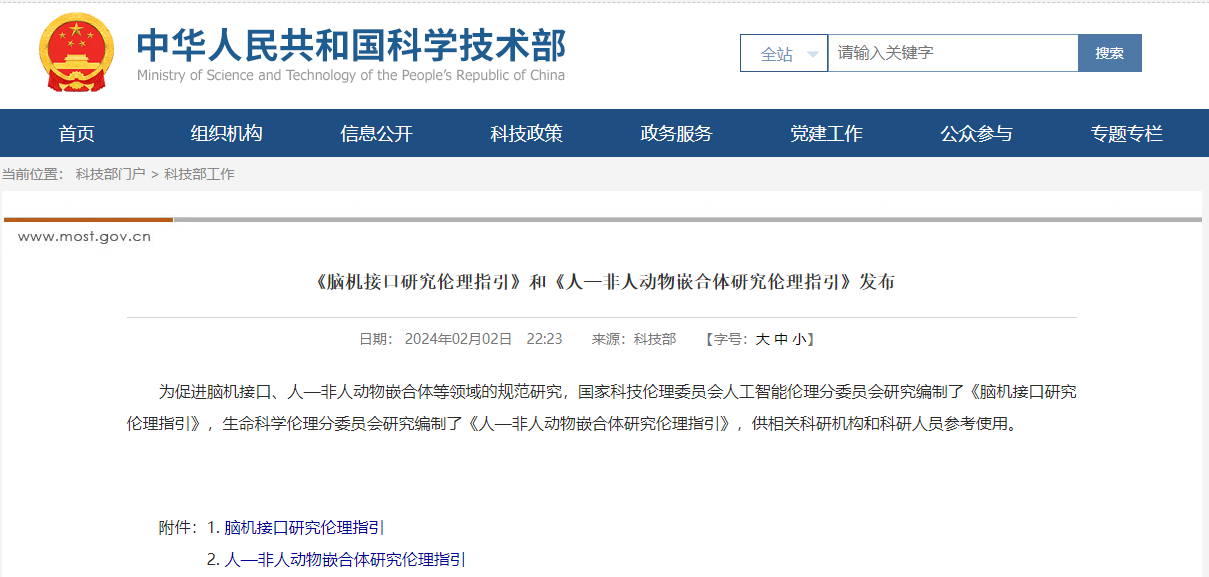
This also establishes the “red lines” and “bottom lines” for the development of brain-computer interfaces (BCIs), which have gained significant prominence recently, with the aim of promoting standardized research in the BCI field and fostering its healthy and orderly development.
“Currently, countries around the world are in the initial expansion phase regarding core technologies and market applications of brain-computer interfaces (BCIs). China possesses certain advantages in the design of core components and, with policy support, resource allocation, and concerted efforts from all parties, is poised to achieve leapfrog development in specific areas. Overall, there is a need in China to cultivate a cohort of large-scale enterprises with independent intellectual property rights to participate in market competition and to accelerate industry-university-research collaboration. Listed companies are expected to become the main force driving industry development,” stated Wang Lei, Secretary-General of the Shanghai Artificial Intelligence Society, in an interview with Securities Daily.
- 【Bookmark This Page】 【Copy Link】 【Print】