

Reach Neuro Files IPO Prospectus: Avantis System, Backed by Top Universities and Nature-Published Research, Aims to Transform Post-Stroke Motor Rehabilitation

Reach Neuro
Developer of Implantable Neurostimulation Systems
Amidst the intensifying global aging trend and the growing demand for improved quality of life, the neuromodulation sector is witnessing unprecedented development opportunities.
From deep brain stimulation for Parkinson’s disease to spinal cord stimulation for chronic pain relief, and further to vagus nerve stimulation achieving breakthroughs in treatment-resistant depression, neuromodulation technologies are bringing new hope to numerous disease areas that are difficult to address with conventional medicine, leveraging their unique therapeutic mechanisms.
AsMotor Rehabilitation After Stroke, has always been a direction of significant interest. Previously, various rehabilitation approaches have emerged in this field, such as acupuncture stimulation and rehabilitation robotics. These methods not only require years of treatment but also yield uncertain outcomes in terms of recovery efficacy.
In 2024, startup neurotechnology companiesReach NeuroAnnouncement,Avantis System Receives FDA Breakthrough Device Designation, the system utilizes small electrical pulses delivered to the spinal cord to help patients with motor impairments caused by chronic stroke regain movement in their shoulders, arms, and hands.This technology could transform the current landscape of post-stroke motor rehabilitation.
Spinal Cord Stimulation Enables Paralyzed Patients to "Stand" Within a Day
The latest report on the global burden of stroke and its risk factors published in The Lancet Neurology in 2021 shows that,Globally, one in four adults over the age of 25 will experience a stroke in their lifetime, with 75% of them suffering from long-term deficits in motor control of the arm and hand.This will severely affect the patient's normal life.
Since 2014,Marco Capogrosso, Ph.D., Director of the Spinal Cord Stimulation Laboratory at the University of Pittsburghand the research team at Carnegie Mellon University has been dedicated to helping stroke-induced paralysis patients recover through spinal cord stimulation.
Dr. Marco Capogrosso focuses on computational frameworks that support the design of peripheral and central neural interfaces for sensory and motor applications. He has contributed to the development of brain-spinal interfaces capable of restoring autonomous motor control in animals and humans with spinal cord injuries.In 2016, Marco Capogrosso’s team developed the first wireless brain and spinal cord implants, enabling monkeys with spinal cord injuries to regain control over their paralyzed limbs and walk again.This lays the foundation for subsequent research on exercise rehabilitation.
After six years, wireless brain and spinal cord implants have been further upgraded and passed safety tests. The team then began attempting to apply the devices to humans.
Notably, Marco Capogrosso’s team has added two key members: Dr. Jocelyne Bloch and Dr. Grégoire Courtine from the École Polytechnique Fédérale de Lausanne (EPFL) in Switzerland. These two researchers previously developed an electrical stimulation device that successfully enabled patients with quadriplegia to naturally control leg movements during standing, walking, stair climbing, and even traversal of complex terrains.
Through collaborative efforts, they integrated implanted electrical stimulation devices with artificial intelligence, ultimately achievingEpidural Electrical Stimulation Helps Completely Paralyzed Patients with Spinal Cord Injury Regain Mobility Within a Day.
The success of this technology has provided a new strategy for motor rehabilitation after paralysis. Dr. Jocelyne Bloch and Dr. Gregoire Courtine have now established a company and are working to commercialize this technology and promote its clinical application.
Two Top Universities Join Forces to Incubate Solutions for Paralysis in 7.5 Million Stroke Patients
To date, Marco Capogrosso’s research has focused primarily on lower-limb rehabilitation. However, upper-limb paralysis in stroke patients is a more prevalent and complex issue. In daily life, hand and arm movements require greater finesse and stronger coordination than leg movements to function normally and meet everyday needs.This requires more personalized and precise stimulation of the nerves to achieve.
Following the successful epidural electrical stimulation trials, Marco Capogrosso shifted his focus to the restoration of upper limb motor function. His research revealed that stroke patients commonly suffer from impaired upper limb mobility, primarily due to damage to the corticospinal tract, which disrupts the connections between the cortex and the cervical spinal circuits controlling arm and hand movements.
However, in most cases, not all corticospinal tracts are completely impaired in patients; some neural pathways remain functional but are often overlooked due to the inability to effectively control muscle movement. Seizing this opportunity, Marco Capogrosso sought to restore patients’ voluntary movement by enhancing the capabilities of the remaining corticospinal tracts.
In 2022, the team further refined spinal cord stimulation technology and distilled aConnecting Healthy Nerves Between the Brain and Spinal Cordtechnology. By leveraging this technology, the team achieved control of arm muscles via external electrical stimulation and restored partial motor function in the paralyzed arms of three monkeys. These groundbreaking findings were published in a renowned academic journal《Nature Neuroscience》Above.
The study findings indicate that electrical stimulation of healthy spinal cord nerves can effectively enhance motor strength and quality, paving the way for future clinical applications. Subsequently, the team shifted its research focus to clinical motor rehabilitation, aiming to help more paralyzed patients regain motor function through electrical stimulation.
2023,Marco Capogrosso’s Team Announces Successful Application of Spinal Cord Stimulation Technology in HumansData show that this technology can immediately improve arm and hand mobility in stroke patients. Even after the implanted stimulation device is removed, the neuromodulatory effects persist, enabling individuals affected by moderate to severe stroke to perform normal daily activities more easily.
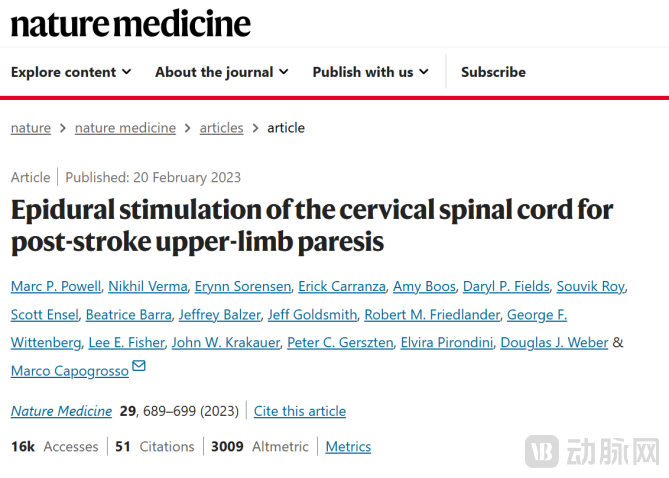 Paper on Epidural Cervical Spinal Cord Stimulation for Treating Upper Limb Paralysis After Stroke (Image source: Nature Medicine)
Incubated jointly by the University of Pittsburgh and Carnegie Mellon University, Marco Capogrosso’s team founded Reach Neuro and commercialized spinal cord electrical stimulation technology.Named Avantis。
Avantis consists solely of two leads and a stimulator. By placing the leads on the surface of the spinal cord to deliver electrical pulses, it activates nerve cells within the spinal cord, thereby restoring motor function in patients' upper limbs. In April 2023, Avantis received FDA Breakthrough Device Designation, enabling its rapid entry into clinical use.According to FDA estimates, Avantis can address the issue of disability caused by stroke in nearly 7.5 million Americans.
Major Medical Device Giants Enter the Neuromodulation Arena
Since 2019, neuromodulation has emerged as a hotly contested sector, with major medical device giants vying to establish their presence.Medtronic, Abbott, Boston Scientific, LivaNova, Nevro, Nuvectra, NeuroPace...have virtually monopolized a significant share of the neuromodulation market.
The technical approaches to neuromodulation are mainly categorized into three types, namelySpinal Cord Stimulation, Deep Brain Stimulation, and Vagus Nerve Stimulation, the covered indications includeGastric Disorders, Bladder Dysfunction, Motor Dysfunction, Epilepsy, Psychogenic Disordersand more than ten other types.
The broad application prospects of neuromodulation technology, coupled with its continuous innovation, have kept it in the spotlight today. According to statistical data, the market size in this sector is projected to reach $6.12 billion in 2024 and grow to $9.26 billion by 2029.
Meanwhile, the field of neuromodulation in China has also been developing rapidly. Taking motor rehabilitation, a key focus area of Reach Neuro, as an example, currentlyPINS MedicalandJingyu MedicalProducts using deep brain stimulation to treat movement disorders such as Parkinson’s disease are already available,Approved as a Class III Medical Device by the NMPA。
In the field of research, domestic researchers have mainly focused on stimulating cranial nerves, innovatively developing multi-target area magnetic stimulation technology, transcranial electrical stimulation technology, and transcranial magnetic stimulation methods. Some domestically produced neural stimulation products have already entered international markets and gained recognition overseas. For example, the M series transcranial magnetic stimulator independently developed by Yingzhi Technology received in 2023FDA Class II Clearance, used for the treatment of major depressive disorder, becomingThe first domestically produced transcranial magnetic stimulation (TMS) device brand to receive U.S. FDA approval.
It is undeniable that neurostimulation technology is becoming a hot spot in the healthcare industry. In the future, as related technologies continue to mature and their applications expand, this technology is expected to achieve more breakthroughs and provide patients with more treatment options.