Neuralink Submits IPO Prospectus Following FDA Breakthrough Device Designation for Blindsight Visual Restoration System

Neuralink
Brain-Computer Interface System Developer

Recently, Neuralink, the brain-computer interface company founded by Tesla CEO Elon Musk, announced that it has received Breakthrough Device Designation from the U.S. FDA for its “Blindsight” project, which aims to help blind individuals restore their vision. According to the FDA’s webpage on the “Breakthrough Devices Program,” the FDA will support the entire process of Blindsight, from development and research to patient use. This support will also include premarket approval and 510(k) clearance to ensure the product’s safety and efficacy in medical applications and procedures.

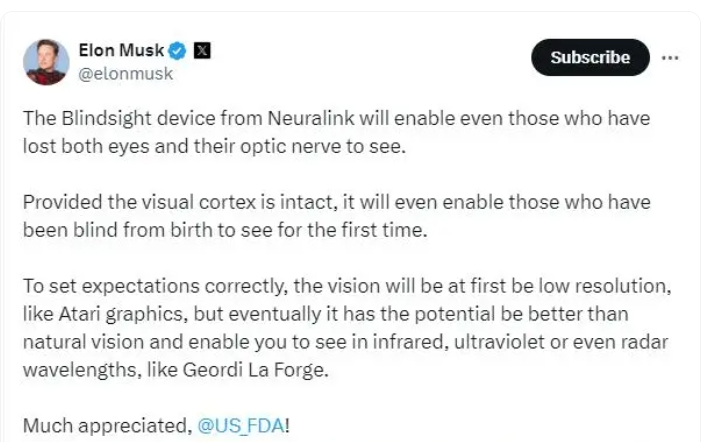
In a post on X, Musk stated that the experimental device, named “Blindsight,” could restore vision to individuals who have lost both their eyes and optic nerves. He even claimed that as long as the brain’s visual cortex remains intact, the device could enable those born blind to see for the first time. However, the initial resolution of this vision would be very low, akin to early Nintendo graphics. In March of this year, Musk also revealed that the “Blindsight” implant technology had already proven effective in monkeys, adding that no monkeys had died or suffered serious injuries due to Neuralink devices.
Neuralink, founded in 2016, primarily focuses on brain-computer interface (BCI) research, which involves connecting the human brain with electronic devices and using electrical currents to facilitate “interaction” between computers and neurons. The ultimate goals are to restore motor function in paralyzed patients, treat neurological disorders such as Parkinson’s disease and Alzheimer’s disease, and help restore vision in blind patients.
In January this year, Elon Musk announced on his social media platform X that the first human had received a Neuralink implant and was recovering well. This also marked Neuralink’s first product, named “Telepathy.” In May, Neuralink reported that the first subject implanted with the brain-computer interface (BCI) device experienced partial malfunction of the brain implant, resulting in reduced data capture from his brain. However, the issue has since been resolved, and the subject’s current use of the BCI remains stable. In August, Neuralink announced the successful implantation of its BCI device in a second human patient, stating that the subject was able to control a cursor using only his thoughts within five minutes of connecting to a computer. His ability to play video games continues to improve, and he has begun learning how to use computer-aided design (CAD) software to create three-dimensional object models.
In recent years, the brain-computer interface (BCI) sector has gained significant momentum. A McKinsey estimate suggests that the potential global market size for medical applications of BCI could reach $40 billion by 2030 and $145 billion by 2040. Leading companies currently at the forefront of BCI technology include Neuralink, Synchron, Blackrock Neurotech, ClearPoint Neuro, BrainGate, Neurable, Snap, and Axoft. In China, tech giants such as Huawei and iFlytek have already begun deploying BCI technologies, while innovative enterprises like Siyi Intelligence, OYMotion, BrainCo, BrainLand, Huiche Technology, HuiNao Intelligence, South China Brain Control, and Rouling Technology are also highly active in this field.

Shanghai Rehabilitation Assistive Devices Industrial Park, Pudong New Area Smart Elderly Care Industrial Park
Welcome
Recommended Reading




For advertising placement, conference collaborations, corporate communications, and other inquiries, please contact 400-689-7892.