

Elon Musk's Neuralink Enters Medical Device Arena with FDA-Cleared 'Blindsight' to Restore Vision in the Blind

Neuralink
Brain-Computer Interface System Developer
 Figure | Shetuwang
Elon Musk's Neuralink Brain-Computer Interface Device ReceivesFDA Certification

Neuralink is a company founded by Elon Musk, located in Fremont, a suburb of San Francisco, California, USA. Established in 2016, it focuses on the research and development of brain-computer interface technology.
"Blindsight," which has received FDA clearance, is Neuralink's second product.Musk stated on social media that,This experimental device, known as "blindsight," will enable individuals who have lost both their eyes and optic nerves to regain vision. If the visual cortex remains intact, it may even allow those born blind to see for the first time.。
As one of the frontier technologies that have garnered the most attention from the investment community in recent years, the potential of brain-computer interfaces (BCIs) in the medical field has been preliminarily validated. According to McKinsey’s estimates,The potential market size for global medical applications of brain-computer interfaces is expected to reach $40 billion by 2030, and is projected to surpass the $145 billion mark by 2040.。
In May 2023, Neuralink officially received FDA approval to conduct clinical research on its implantable brain-computer interface device in humans. In September of the same year, Neuralink began recruiting participants globally for its first human trial.Last year's financing situation shows that,Neuralink’s valuation has reached as high as $5 billion (approximately RMB 35.3 billion)。
According to the “Research Report on the Development and Application of Brain-Computer Interface Technology (2023)” published by the China Academy of Information and Communications Technology, as of the first quarter of 2023, there were more than 500 representative brain-computer interface companies worldwide, distributed across over 40 countries,Among them, the number of enterprises in the United States and China has exceeded 100, ranking in the first tier globally in terms of quantity.。
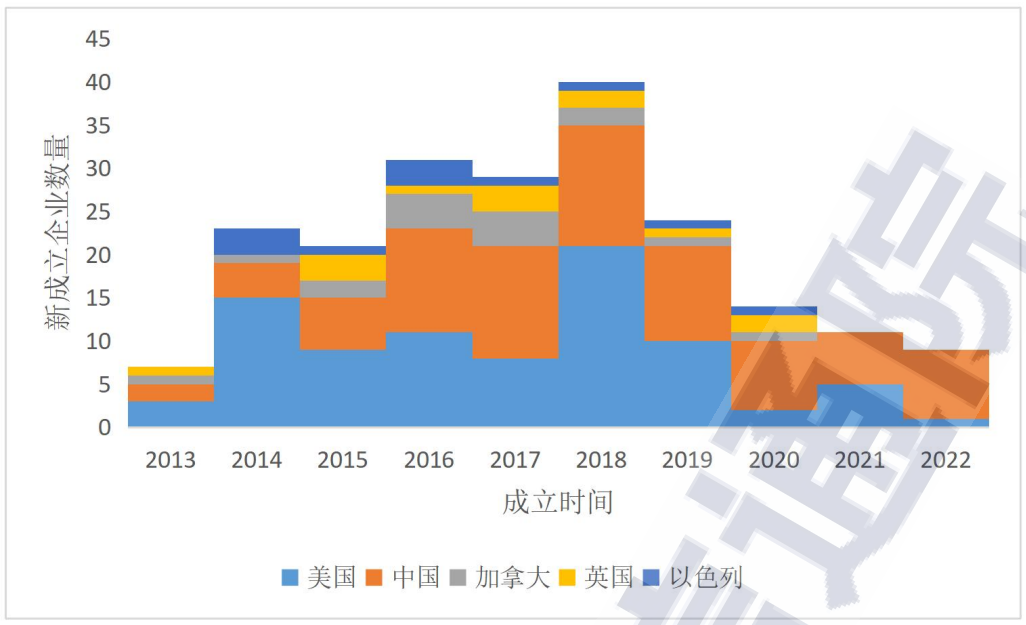 Source:China Academy of Information and Communications Technology
Apart from Neuralink, the U.S. company Synchron is another industry leader. Unlike Neuralink’s product, Synchron’s brain-computer interface does not require drilling holes in the patient’s skull for implantation,Instead, signal-collecting interfaces are implanted into the blood vessels on the surface of the brain’s motor cortex via the jugular vein, with data transmitted wirelessly through a device located on the chest.。
Recently, Synchron announced that it had successfully connected its brain-computer interface system with Apple’s Vision Pro headset. The company is currently attempting to integrate ChatGPT into its brain-computer system.
Although China started relatively late in the field of brain-computer interfaces, it has achieved frequent breakthroughs in both clinical research and commercial translation.
In January this year, Tsinghua University announced that its School of Medicine’s brain-computer interface research team, in collaboration with Xuanwu Hospital of Capital Medical University, jointly conducted research in 2023On October 24, the world’s first clinical trial of a wireless minimally invasive brain-computer interface was successfully conducted.
In August, the Fudan University Center for Neuromodulation and Brain-Computer Interfaces was officially unveiled, dedicated to exploring the principles of neuromodulation and brain-computer interfaces, achieving breakthroughs in disruptive technologies, and advancing healthcare applications.
In terms of industry, domestic companies such as Chengyitong, Xiangyu Medical, Sanbo Brain Hospital, and Yanshan Technology are all making in-depth layouts around brain-computer interfaces.
Policy Tailwinds, but Risks Remain
Driven by its application potential across multiple fields, brain-computer interfaces have received strong policy support in China.
On January 18, the Chinese government website released the “Implementation Opinions of the Ministry of Industry and Information Technology and Six Other Departments on Promoting the Innovative Development of Future Industries,” clearly stating thatDevelopment of High-End Medical Equipment Integrating Advanced Technologies Such as Digital Twin and Brain-Computer Interaction
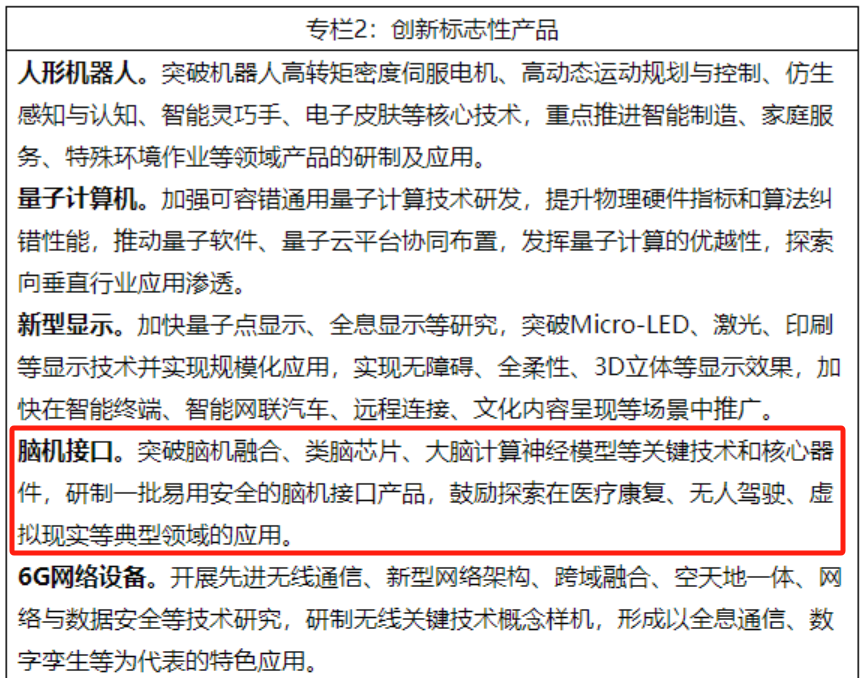
June 13,The National Development and Reform Commission, the Ministry of Commerce, and three other departments jointly issued the “Measures on Creating New Consumption Scenarios and Cultivating New Growth Points for Consumption,” proposingPromoting the Development of Health Consumption, IncludingR&D of medical equipment and health products integrating technologies such as digital twins and brain-computer interaction。
Financial support is also being intensively advanced, for exampleThe "Beijing Action Plan for Accelerating Collaborative Innovation in Medicine and Health (2024-2026)" mentions that,By 2026, the total scale of the pharmaceutical and health industry will reach RMB 1.25 trillion, with annual fixed-asset investment exceeding RMB 10 billion.Among them areAccelerate fields such as brain-computer interfacesoutput of results.
Furthermore, in the absence of objective standards and regulations, the early stages of frontier technology development may be plagued by chaotic, unregulated growth.
In 2023, the Artificial Intelligence Ethics Subcommittee of the National Science and Technology Ethics Committee compiled the "Ethical Guidelines for Brain-Computer Interface Research,"Research on Non-invasive Restorative Brain-Computer Interfaces, Invasive Restorative Brain-Computer Interfaces, Interventional Brain-Computer Interfaces, Augmentative Brain-Computer Interfaces, and Animal Brain-Computer InterfacesEthical guidelines were specified for each of the five study types.
According to the current provisions of China's "Medical Device Classification Catalog," devices related to brain-computer interfaces are primarily classified as Class II and Class III, as detailed below:
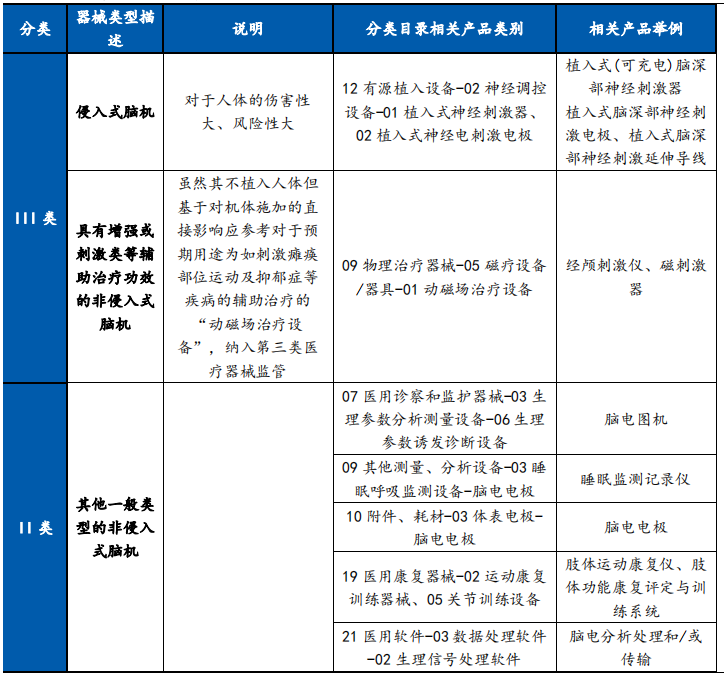 Source:Northeast Securities
From a clinical perspective,InvasiveBrain-computer interface devices carry risks of surgical failure and infection, including rejection and electrode encapsulation defects.In additionUnauthorized access may expose patients' brain signal data to the risk of leakage, inThere is no consensus on the socio-ethical level.
According to a research report by Northeast Securities,80% of China's brain-computer interface companies have chosen the non-invasive data acquisition technology route, the vast majority of invasive brain-computer interface devices are still in the stages of clinical research and animal experimentation.
However, from a technical and market perspective,Invasive brain-computer interfaces target a broader range of medical applications, enabling the treatment of certain clinically intractable conditions.Provide treatment plans for clinical challenges.
At the 2024 Zhongguancun Forum Annual Conference, “Beinao No. 2,” a domestically developed system, made its debut, filling the gap in China’s high-performance invasive brain-computer interface technology and achieving, for the first time internationally, dexterous brain-controlled manipulation of a two-dimensional motion cursor by macaques.
At the current stage, the integration of brain-computer interfaces (BCIs) with clinical practice remains in its early phases. While uncertainties persist regarding large-scale adoption and the ultimate form of final products, the disruptive potential of this technology on existing healthcare systems is already evident. The possibility of it creating a phenomenon-level market makes it impossible for the medical device sector to ignore.
- END -
Author: Yue Qing
WeChat ID: zcxujingmin
Responsible Editor: Qin Jiu
WeChat ID: nrzx0321