Neuralink's 'Blindsight' Receives FDA Breakthrough Device Designation, Paving the Way for Vision Restoration in the Blind

Neuralink
Brain-Computer Interface System Developer

01
What Is "Blindsight"?
“Blindsight” is a revolutionary technology developed by Neuralink, designed to help blind individuals restore their vision through implanted brain-computer interface devices.This device restores patients' visual function by implanting a microelectrode array into the brain's visual cortex to directly stimulate neurons, thereby bypassing damaged eyes and optic nerves.Elon Musk, Founder and CEO of Neuralink, stated: “The ‘Blindsight’ project represents a significant step toward our vision of achieving deep integration between humans and machines. We hope this technology will open a new window for those who have lost their sight, enabling them to regain vision. As the technology continues to advance, the resolution of future generations of devices will steadily improve, potentially even allowing perception of electromagnetic spectra beyond natural human capabilities, such as infrared and ultraviolet light.”
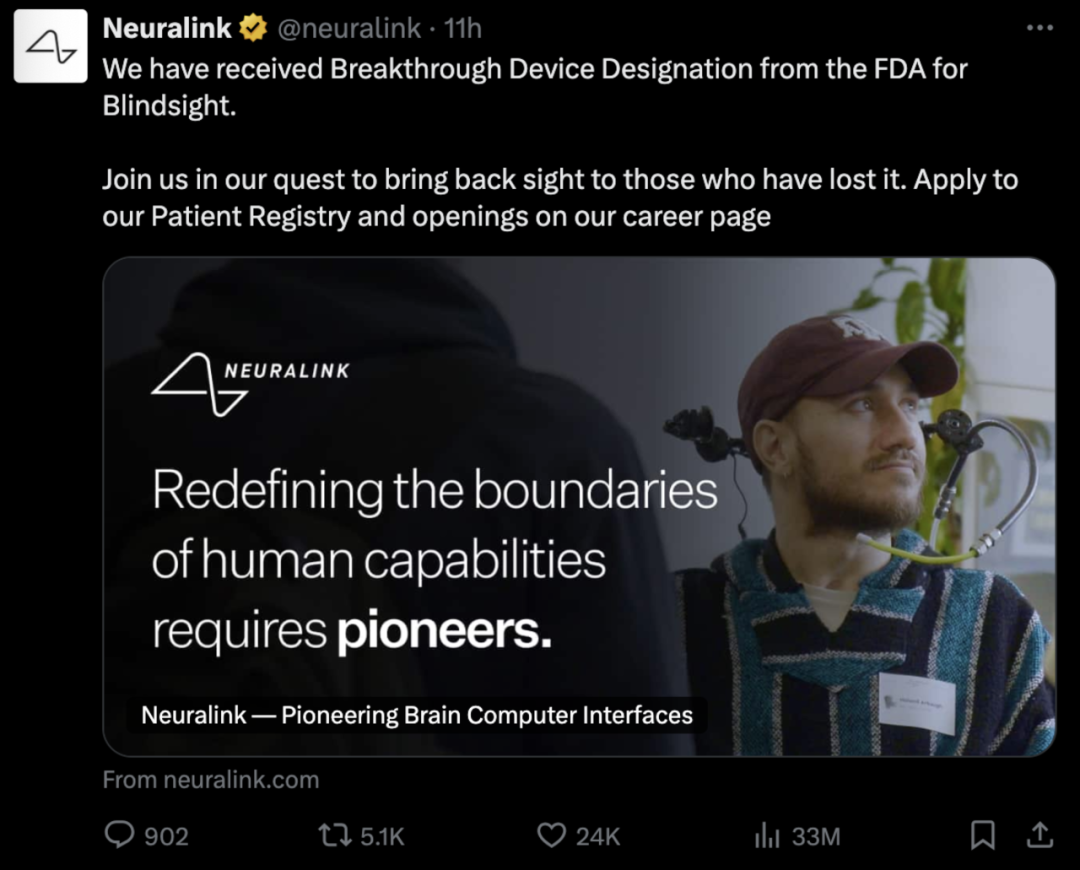
Neuralink Corp., Elon Musk’s brain-computer interface company, announced on Tuesday
02
FDA "Breakthrough Device" Designation
The FDA’s “Breakthrough Device” designation is a special recognition for medical devices with the potential to provide significant clinical advantages.Devices that receive this certification will benefit from priority review and accelerated approval processes, enabling faster market entry and patient access.。Specifically, this determination typically requires meeting the following key criteria:
1. Original Technologies Worldwide:The device or technology must be a global first or possess significant innovativeness.
2. Significant Advantages:Compared with existing approved or alternative options, the device or technology must demonstrate significant advantages, enabling more effective treatment or diagnosis of the relevant diseases or conditions.
3. In the Best Interests of the Patient:The development and use of devices or technologies must align with the best interests of patients, significantly improving their quality of life or extending their lifespan.
The U.S. Food and Drug Administration’s “Breakthrough Device Designation” represents the pinnacle of global medical device innovation, while the “Blindsight” device aims to restore vision in individuals who have lost both eyes and optic nerves, potentially even providing visual experiences for those born blind who have never had sight.This March, Musk revealed that the “blindsight” implant technology has already worked in monkeys.Neuralink has successfully implanted its self-developed brain-computer interface devices in two patients and plans to provide implants for eight additional patients within this year, thereby completing a clinical trial involving a total of 10 brain-computer interface patient implants.
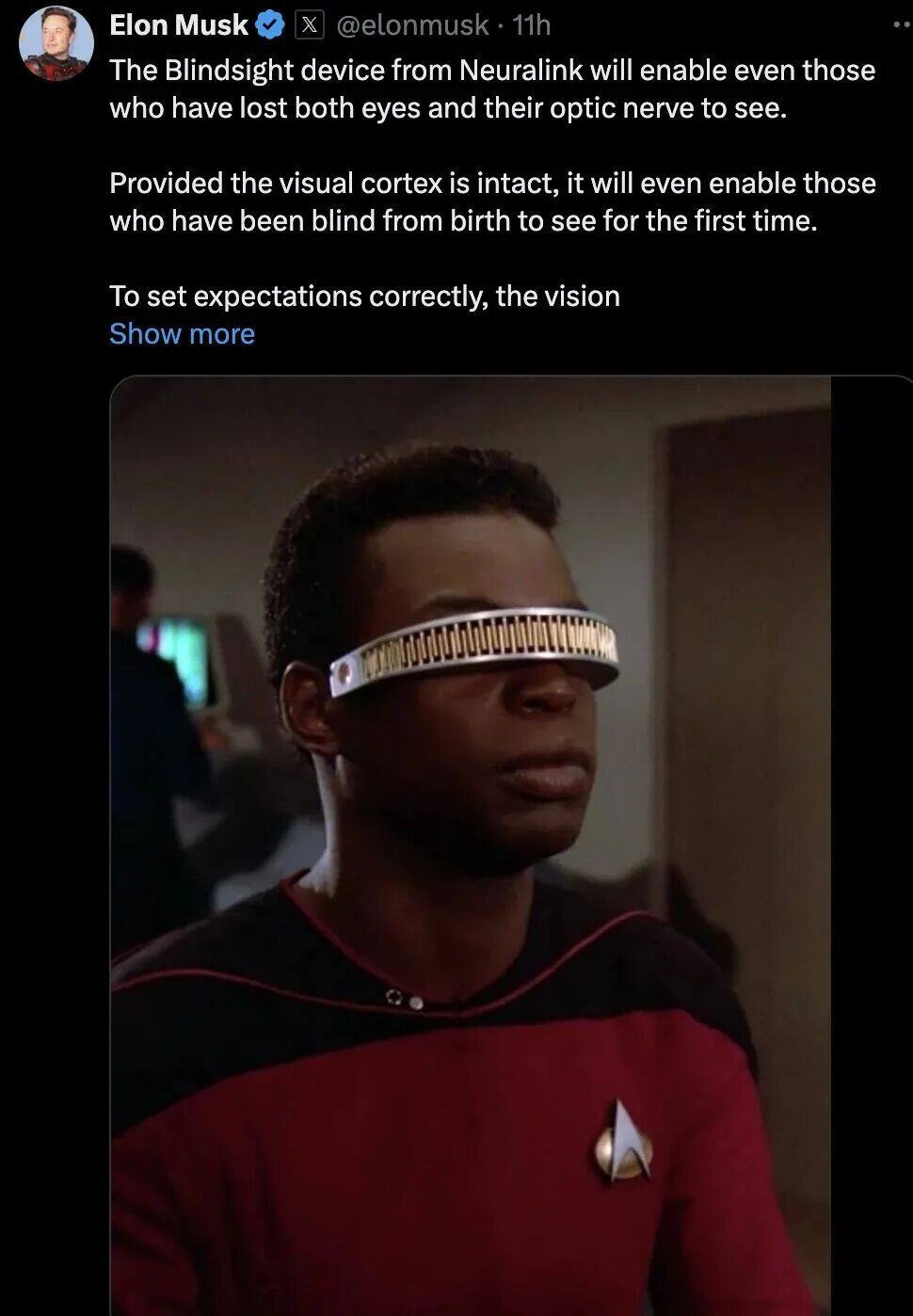
A post by Musk on social media platform X
In a post on the social media platform X, Musk stated that this device will help individuals who have lost both their eyes and optic nerves to regain vision. If the visual cortex remains intact, it could even enable those born blind to see for the first time.
03
Principles of Science, Technology, and Innovation
The core technology of the “Blindsight” device lies in its highly precise electrode array and advanced signal processing algorithms. The electrode array consists of thousands of microscopic electrodes, each with a diameter of only a few micrometers, capable of precisely stimulating specific regions of the brain’s visual cortex. These electrodes are connected to an external controller via wireless transmission technology. The controller is responsible for receiving and processing image signals from cameras or other visual sensors, converting them into electrical signals, and transmitting them to the brain.
To ensure the safety and efficacy of the electrode array, Neuralink’s R&D team conducted extensive animal experiments and computer simulations. They found that optimizing electrode arrangement and stimulation parameters could significantly enhance the clarity and stability of visual signals. Furthermore, Neuralink developed an intelligent algorithm capable of dynamically adjusting electrode stimulation patterns based on individual patient differences and visual needs, thereby achieving personalized visual restoration.
04
Clinical Trials and Future Perspectives
Despite the initial success of the “Blindsight” device, Neuralink’s research team is well aware that there is still a long way to go to achieve comprehensive visual restoration. Currently, Neuralink is recruiting more patients for larger-scale clinical trials to further validate the safety and efficacy of the device. Meanwhile, the company is actively developing the next-generation “Blindsight” device, aiming to improve resolution, extend battery life, and simplify the implantation procedure.
Musk stated, “We believe that with continuous technological advancements, the ‘Blindsight’ device will help more blind individuals restore their vision, and even achieve superhuman visual capabilities. In the future, we also plan to apply this technology to other neurological disorders, such as Parkinson’s disease and Alzheimer’s disease, bringing greater benefits to patients.”
05
Social Impact and Ethical Considerations
As a disruptive innovative application, brain-computer interface (BCI) technology has not only brought new hope to blind patients but also sparked widespread attention across society. Ensuring the safety, efficacy, and ethical legitimacy of this technology has become a significant challenge facing all stakeholders.
For the “Blindsight” project, the greatest ethical challenge lies in ensuring patients’ autonomy and privacy during use. After all, once the human brain is connected to a machine, an individual’s thoughts, emotions, and even privacy face unprecedented risks of exposure. Furthermore, technological immaturity may lead to unforeseen side effects, such as cognitive impairment and emotional dysregulation, which require heightened attention and strict regulatory oversight throughout the research and development process.
From a societal perspective, the development of brain-computer interface (BCI) technology will profoundly transform human lifestyles and social structures. On one hand, it will provide individuals with disabilities with unprecedented opportunities for rehabilitation, thereby promoting social equity and inclusion; on the other hand, the misuse of this technology may exacerbate social stratification and create new digital divides. Consequently, balancing technological advancement with social justice has become a shared challenge facing the industry.
It is understood that to address numerous challenges, Neuralink has established close collaborations with multiple medical and research institutions to jointly explore the ethical and legal frameworks for brain-computer interface technology. The company has also set up an independent ethics committee responsible for overseeing and evaluating all ethical issues related to the “Blindsight” project.
06
Summary
In summary, the FDA’s Breakthrough Device designation for Neuralink’s “Blindsight” project marks another shining moment where technology converges with human aspiration. This achievement not only brings hope for vision restoration to blind patients but also paves new avenues for the future development of brain-computer interface (BCI) technology. However, while celebrating this milestone, we must remain acutely aware that technological progress should not come at the expense of ethics and social values.
In the future, as brain-computer interface (BCI) technology continues to mature and its applications expand, we have reason to believe that humanity will be better equipped to leverage this technology to address more medical challenges, improve quality of life, and promote comprehensive social progress. Meanwhile, it is essential to strengthen international cooperation and regulation to ensure the safety, efficacy, and ethical integrity of these technologies, thereby enabling science and technology to truly serve as a powerful driving force for human societal development and achieving harmonious coexistence between technology and human values.
❤ Further Reading ❤
In recent years, the brain-computer interface (BCI) sector has remained highly active. According to a McKinsey estimate, the potential global market size for medical applications of BCI is expected to reach $40 billion by 2030 and $145 billion by 2040. Leading companies currently at the forefront of BCI technology include Neuralink, Synchron, Blackrock Neurotech, ClearPoint Neuro, BrainGate, Neurable, Snap, and Axoft. In China, tech giants such as Huawei and iFlytek have already started deploying BCI technologies, while innovative enterprises like Siyi Intelligence, Aoyi Technology, BrainCo, BrainLand, Huiche Technology, HuiNao Intelligence, South China Brain Control, and Rouling Technology are also very active.
END