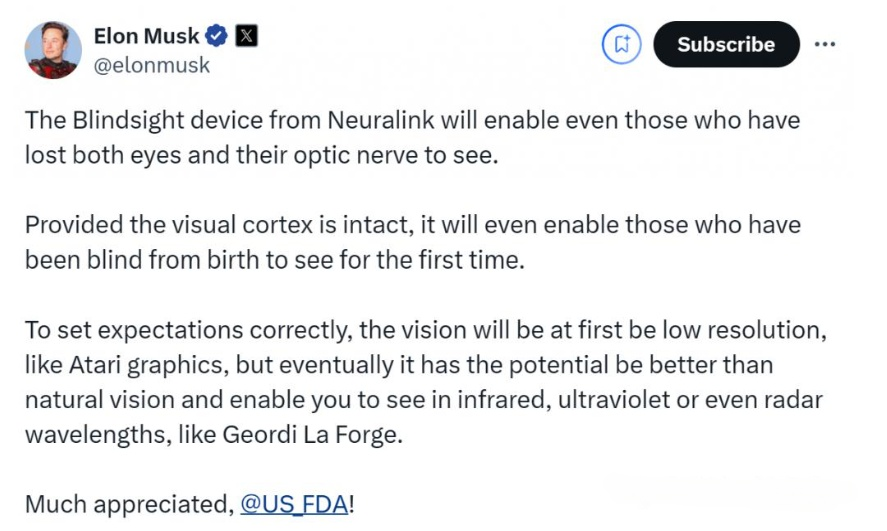

Recently, Neuralink, the brain-computer interface company under Elon Musk, announced that its experimental brain implant chip, Blindsight, has officially received the FDA’s Breakthrough Device Designation.
This project aims to help blind individuals restore their vision and regain sight.Medical devices granted “Breakthrough Designation” can receive FDA support at an earlier stage, thereby accelerating their research and development as well as the market approval process. These devices are typically used to treat or diagnose life-threatening conditions.
On social media, Musk stated that the experimental device known as Blindsight “will enable individuals who have lost both their eyes and optic nerves to see. If the visual cortex is intact, it could even allow those born blind to see for the first time.”
Elon Musk explained the two-phase objectives set for Blindsight on social media:
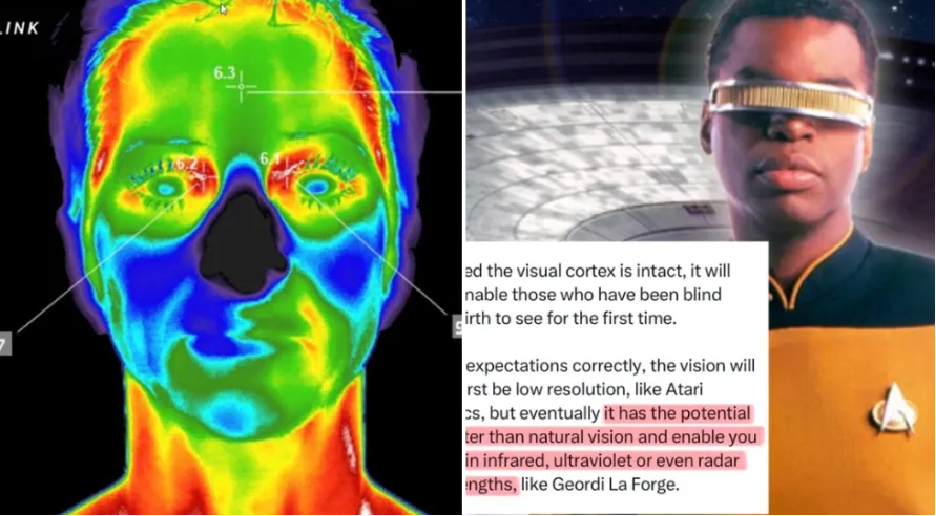
First, the vision will be low-resolution, resembling a pixelated style.
In the second phase, one would be able to see in infrared, ultraviolet, and even radar wavelengths, akin to a superhero.
Musk stated: If the visual cortex is intact, the Blindsight brain implant can restore sight to the blind.Currently, the Blindsight implant has proven effective in monkeys.。
The principle of ocular imaging involves light entering the eye, passing through the cornea and lens, and focusing on the retina. The light signals are then converted into electrical signals, which are transmitted via the optic nerve to the brain, where they are interpreted as images. In contrast, Blindsight employs an invasive approach by implanting a device into the brain to directly stimulate the visual cortex with external electrical signals, thereby generating neural activity.
The Blindsight implant bypasses the eyes and optic nerve, sending information directly to the brain; thus, as long as the visual cortex remains intact, even individuals with congenital blindness can be “cured.”
Neuralink was founded in 2016 with the aim of establishing a communication channel between the human brain and external devices. This is achieved by implanting ultra-fine threads into the brain, which are connected to a custom-designed chip containing electrodes capable of reading information from groups of neurons. Although this technology has several decades of history, the company’s innovation lies in making the implant wireless and increasing the number of implanted electrodes. Currently, such devices are primarily used in patients with paralysis.
However, Musk had previously stated that Neuralink’s short-term goal is to help paralyzed individuals achieve mind-controlled typing, with future capabilities enabling paralyzed people to walk and blind individuals to regain sight, ultimately realizing a “human-machine symbiont.” He hinted at the time that the device might have the ability to restore vision. He pointed out, “Blindsight is the next product after telepathy.”
Technology Remains Immature; Brain-Computer Interface Industry Awaits Commercialization Opportunities
Neuralink’s inaugural product, the N1 Link, is a brain-computer interface (BCI) device similar to Blindsight. Previously, Elon Musk has repeatedly promoted the therapeutic efficacy of the N1 Link on social media platforms and at various public events, further stating that subsequent versions will continue to be upgraded to achieve signal diversion from the brain to neural connections, thereby enabling paralyzed patients to walk again.Unfortunately, these promotional efforts have had no substantive impact; two years on, Neuralink’s commercialization remains shrouded in uncertainty.The commercialization hurdles facing Neuralink and the broader brain-computer interface (BCI) industry are not complex: high costs and limited application scenarios are constraining the technology’s adoption.Brain-computer interface (BCI) technology presents exceptionally high barriers to entry, requiring substantial capital investment across the entire industry chain—from upstream chips and algorithms to midstream R&D and manufacturing of interface devices. All enterprises and research institutions, including Neuralink, are still in the critical phase of overcoming technical challenges, allowing them to focus on technological advancement without immediate concern for returns. However, cost-effectiveness becomes an imperative consideration when pursuing commercialization.The report by IMARC Group also points out that the global brain-computer interface market size will be approximately $3.2 billion by 2027, which is even less than the valuation of Neuralink alone; however, the medical application segment accounts for as much as 70% of the total market.Nevertheless, despite the appeal of brain-computer interface (BCI) technology to patients with brain injuries and the willingness of medical institutions to participate in its research and development, significant skepticism remains regarding the safety of this technology. Furthermore, while there is a large population of patients suffering from paralysis and nerve damage, few can afford the high costs associated with such advanced treatments. Consequently, safety, cost, and application scenarios have formed a deadlock; only by resolving all these issues can the commercialization and widespread adoption of BCI technology be ensured.Soaring Valuation, First Clinical Trial Approved
However, compared with other companies under Musk, Neuralink is not active in the capital market.In 2019, Neuralink unveiled its first implantable brain-computer interface device, which can implant 1,024 electrode wires into the brain to collect signals and then transmit them wirelessly to terminal devices.In 2020, Neuralink unveiled its N1 chip implantation plan, with Musk personally demonstrating signals recorded from a pig’s brain at the launch event. In the following years, Neuralink continued to refine the N1 chip, striving to enhance its safety.In 2021, Neuralink’s trials finally made progress, successfully decoding the brain signals of a monkey named “Mind Pond” to control its hand movements. Subsequently, human clinical trials were scheduled. Elon Musk emphasized that most documents had been submitted to the FDA, with the first human trials expected to commence within the next six months.According to data from Hithink RoyalFlush, within two trading days after Neuralink officially announced the approval of its clinical trial application, the A-share brain-computer interface sector saw a cumulative increase of 20%, with multiple stocks such as Zhongke Information and Sanbo Brain Hospital rising by more than 10%.China’s brain-computer interface (BCI) industry has also made significant progress in recent years, although it still lags behind the United States. With Neuralink entering clinical trials, the widespread adoption and commercial application of BCI technology are set to accelerate. Time is running out for domestic entrepreneurs, and catching up with industry leaders such as Neuralink remains an immensely challenging task.Compared with the United States, China’s brain-computer interface (BCI) industry started later and remains in an exploratory phase, with few standout companies having emerged. On a positive note, relevant authorities strongly support the development of the BCI industry, and capital investment is highly enthusiastic.We look forward to continued good news from Chinese scientists and engineers as they tackle key challenges in this technology, hailed as a “beacon of hope for people with disabilities,” and we applaud such “technology with warmth.”