

Chinese Medical Enterprises Navigate Trust Barriers: Transitioning from Product Export to Global Brand Building
Currently, global expansion is closely tied to the development of healthcare enterprises.
To promote the global expansion of Chinese pharmaceutical and medical device companies, asMedicineGlobal Medical Product Collaboration Platform (GMPC)As a permanent secretariat unit, VCBeat has specially launched the [Going Global ING] column to publish a series of reports on leading domestic healthcare companies, aiming to provide insights for Chinese healthcare enterprises expanding into overseas markets.
At VCBeat’s 10th Annual 2026 Top 100 Future Healthcare and Pharmaceutical Companies Conference,Cai Xiaodan, General Manager of the China Marketing Solutions Division at LinkedInInvited to attend, engaged in in-depth discussions with fellow panelists on the roundtable topic “From Product Export to Brand Globalization: How Chinese Medical Enterprises Can Build Professional Trust and Market Recognition,” focusing on the pain points and breakthrough strategies in the international expansion of China’s healthcare industry.
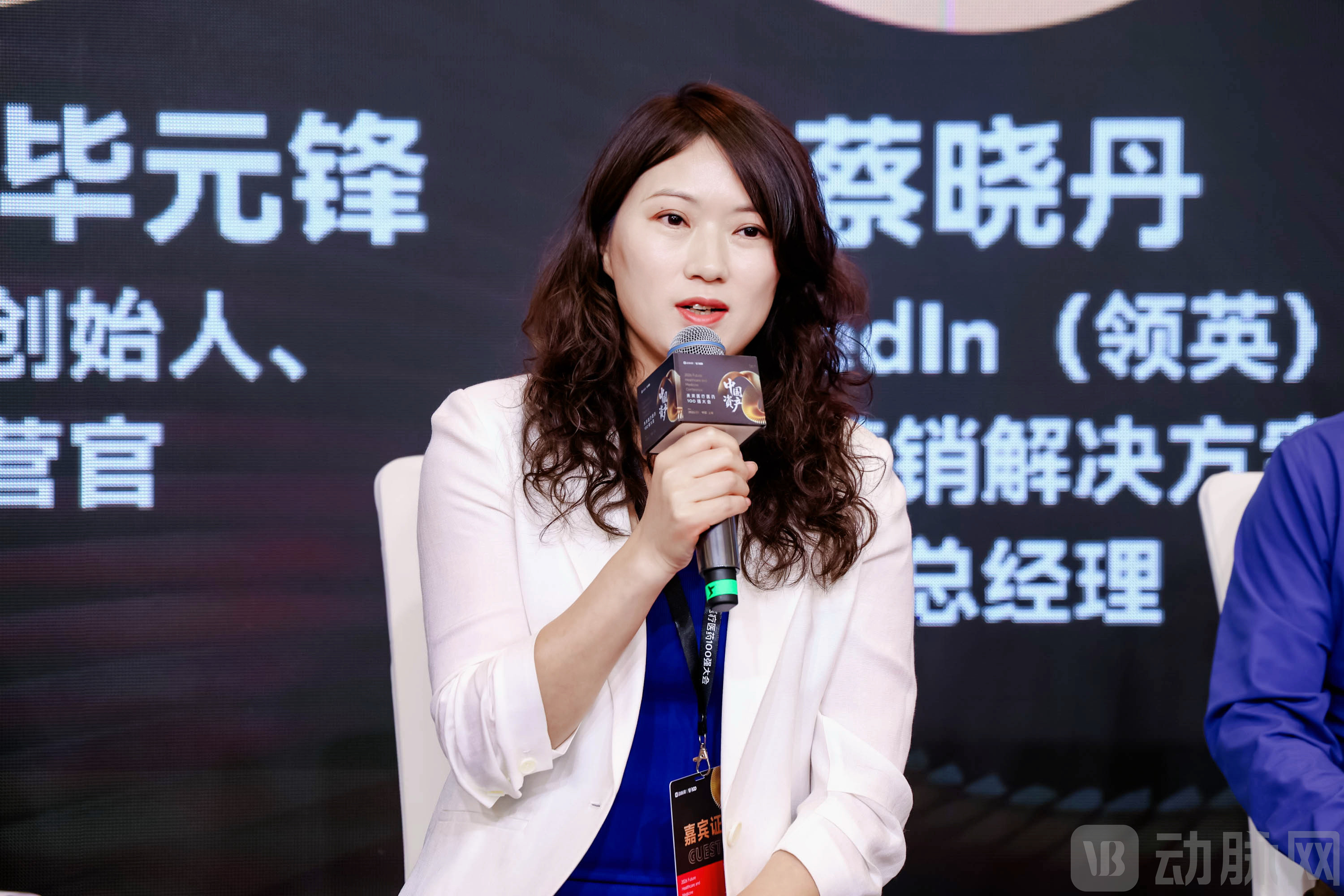 Cai Xiaodan, General Manager of LinkedIn China's Marketing Solutions Division
Taking this opportunity, we interviewed LinkedIn China—
LinkedIn was founded in Silicon Valley, United States, in 2003 and entered the Chinese market in 2014, committed to helping Chinese enterprises establish and develop international business. Currently, as many as 76% of the top 100 Chinese companies going global have established close partnerships with LinkedIn. Leveraging its global platform with over 1.3 billion members and a strong growth momentum of seven new members every minute, LinkedIn is further assisting Chinese enterprises in shaping their international brand image.
The following content is compiled from a conversation between VCBeat and Cai Xiaodan, General Manager of LinkedIn China’s Marketing Solutions Division. The text has been slightly edited for clarity without altering its original meaning.
VCBeat: Hello, Mr. Cai. To begin, could you please provide a brief introduction to LinkedIn China’s Marketing Solutions division, as well as LinkedIn’s core positioning and value proposition in the field of Chinese healthcare companies expanding overseas?
Cai Xiaodan:LinkedIn China’s Marketing Solutions Division focuses on the end-to-end global marketing needs of Chinese enterprises. Leveraging LinkedIn’s global professional ecosystem and data capabilities, it employs an integrated marketing framework of “professional content + precise reach + data closed-loop” to help companies achieve a complete cycle from brand exposure and trust-building to lead conversion and business growth.
In the highly specialized and heavily regulated industry of healthcare globalization, LinkedIn serves as “brand and trust infrastructure.” The core challenge for healthcare enterprises in overseas markets is often not whether they have products, but whether they can gain trust and integrate into local procurement systems. Relying solely on traditional sales channels and trade shows for customer acquisition makes it difficult to establish long-term competitiveness.
LinkedIn’s core advantage lies in its global, structured professional data foundation. The platform brings together over 1.3 billion professionals and 62 million business decision-makers, including more than 61 million members from the healthcare industry (among whom are over 10 million healthcare professionals, including key groups such as physicians). It also aggregates 2.2 million health-sector influencers along with government and investment decision-making communities. This data is not “generic traffic,” but rather rooted in authentic professional identities, enabling precise identification and outreach to hospital administrators, procurement heads, clinicians, and policy-making stakeholders. This gives LinkedIn unique reach and penetration capabilities in the healthcare industry, where “multi-stakeholder decision-making” is the norm. Meanwhile, the healthcare ecosystem on the platform continues to thrive and grow. For instance, discussions on healthcare-related topics increased by over 20% in the past year, user trust in corporate content exceeded 50%, and a growing number of healthcare companies are leveraging thought leadership content to connect with their target audiences. Through its integrated marketing system, LinkedIn is helping enterprises enhance brand awareness, continuously accumulate high-quality business opportunities, and achieve long-term value through “trust-driven growth.”
VCBeat: This roundtable focuses on the theme “From Product Export to Brand Export.” How do you view the current development stage of Chinese medical companies going global?
Cai Xiaodan:I believe that the global expansion of China’s healthcare industry is at a critical structural inflection point—specifically, the mid-stage of transitioning from “product export” to “brand export.” Over the past decade, companies have relied more on cost advantages and supply chain capabilities to enter overseas markets. However, as global healthcare systems raise their requirements for compliance, clinical value, and long-term partnerships, products alone are no longer sufficient to sustain continuous growth. Meanwhile, the industry itself is evolving; for instance, sectors such as in vitro diagnostics (IVD) are shifting from single-product sales to integrated solutions encompassing “equipment + reagents + services + digitalization.” This means that companies must leverage branding as the vehicle to convey trust and value. According to blue books and industry surveys, a large number of Chinese enterprises remain in the early stages of internationalization, driven primarily by products and distribution channels. Therefore, the true watershed in the future will lie in whether companies can successfully achieve brand building and establish a global system of trust.
VCBeat: What is the biggest bottleneck facing the industry in transitioning from exporting products to building global brands?
Cai Xiaodan:In the process of expanding Chinese healthcare services and products overseas, the biggest bottleneck is not technical capability, but rather “trust-building capacity.” On one hand, overseas markets still harbor stereotypes about Chinese medical products, perceiving them as “low-priced but not necessarily high-quality,” a perception that directly influences procurement decisions. On the other hand, procurement in the healthcare industry relies heavily on expert endorsements, clinical data, and long-term validation, rather than short-term marketing outreach. In this context, competing solely on price or relying on channel distribution makes it difficult to truly penetrate high-value markets. In practice, we have observed that many companies, despite possessing excellent technology, fail to convert their technological advantages into commercial success due to a lack of systematic brand building and content strategies. LinkedIn helps companies transition from being mere “product suppliers” to “trusted sources of information” through thought leadership content, expert voices, and advertising amplification mechanisms, which is key to breaking through trust barriers.
VCBeat: Many companies report a common dilemma in overseas expansion: “the market is visible, but key decision-makers remain out of reach.” How do you view this issue?
Cai Xiaodan:Companies often lament, “We can see the market, but we cannot reach the customers,” which essentially means they have failed to enter the true decision-making network of the healthcare industry. Healthcare procurement is not a unilateral decision; it involves multiple stakeholders, such as clinicians, procurement departments, finance teams, and hospital administration. Furthermore, many key influencers, including experts, scholars, and even policymakers, are often absent from traditional sales channels. Therefore, relying solely on distributors or trade shows typically allows companies to reach only parts of the supply chain, making it difficult to penetrate the core decision-making circle. LinkedIn’s core advantage lies in its authentic professional data, which enables precise engagement with the entire healthcare decision-making chain based on job titles, functions, industries, and seniority. Meanwhile, continuous influence over these key stakeholders is maintained through content and interaction. This ability to “enter the network” is the key to solving the customer access challenge.
VCBeat: Currently, some medical device manufacturers expanding overseas are engaging in practices such as "price wars." What do you believe are the underlying causes of this phenomenon?
Cai Xiaodan:Chinese medical enterprises remain stuck in a phase of price competition, a situation fundamentally rooted in path dependence. For many years, Chinese medical companies primarily entered overseas markets through OEM, ODM, or distribution models, approaches that inherently emphasize cost advantages over brand value. Furthermore, in terms of strategic perception, some enterprises still equate “technical capability” simply with “market competitiveness,” overlooking the global healthcare system’s demands for brand reputation, regulatory compliance, and trust. In the long run, this trajectory confines companies to the lower end of the value chain; even with technological advantages, they struggle to secure pricing power. As the industry enters a new stage—marked by centralized procurement, price pressures, and intensifying global competition—medical enterprises are transitioning from being “price-driven” to “value-driven.” In this context, branding serves as the key vehicle for capturing value premiums.
VCBeat: Although healthcare companies are actively expanding overseas, there is still a lack of awareness of Chinese healthcare brands in international markets. In your view, what specific challenges do these companies face?
Cai Xiaodan:Insufficient Overseas Recognition of Chinese Medical Brands,This is primarily attributable to three dimensions: cognition, trust, and market access capability. First, at the cognitive level, many enterprises lack consistent and stable international communication, making it difficult for them to be included in mainstream procurement lists. Second, at the trust level, the absence of systematic clinical data, expert endorsements, and long-term content accumulation prevents the establishment of an authoritative image. Third, regarding market access capability, the lack of connections with academic systems, expert networks, and industry ecosystems makes it challenging to participate in genuine decision-making discussions. In contrast, companies that consistently publish professional content on LinkedIn can gradually build thought leadership through scientists’ perspectives, research findings, and customer case studies, thereby transitioning from “unknown vendors” to “trusted partners.”
VCBeat: In the past, you have repeatedly mentioned that “trust is shifting from brand self-promotion to interpersonal trust.” In the highly regulated and highly specialized field of healthcare, what exactly does “interpersonal trust” refer to? How should companies build it?
Cai Xiaodan:In the healthcare industry, “interpersonal trust” is essentially a professional trust network composed of experts, physicians, scientists, and industry practitioners. Unlike traditional brand communication, companies no longer rely solely on advertising to convey their value; instead, they build credibility through the voices of authentic individuals. Data shows that 90% of B2B decision-makers are more likely to be influenced by insights from trusted individuals, meaning that “who says it” matters more than “what is said.” On LinkedIn, thought leadership ads, employee advocacy, and expert content are key tools for transforming “organizational trust” into “interpersonal trust,” enabling companies to achieve greater authenticity and influence throughout the decision-making chain.
VCBeat: LinkedIn notes that 87% of B2B buyers place greater trust in industry experts/KOLs, and 63% of purchasing decisions rely on short-form video. How should healthcare companies leverage these trends to build a marketing advantage?
Cai Xiaodan:Medical marketing is shifting from a product-centric approach to one focused on “people and content.” On LinkedIn, content featuring emotional expression and personal stories can boost engagement rates by 25%, click-through rates by 13%, and lead conversion rates by over 30%, indicating that users resonate more strongly with human-centric content. Meanwhile, short-form video is becoming a critical touchpoint in decision-making, with 63% of B2B buyers stating that video content influences their purchasing decisions. In practice, we observe many enterprises continuously building professional influence through scientist stories, webinars, and industry events, rather than relying on one-off advertising campaigns.
VCBeat: For enterprises expanding overseas, it is essential to balance long-term brand building with short-term lead conversion. How do you think this relationship can be better balanced?
Cai Xiaodan:Long-term brand building and short-term customer acquisition are not mutually exclusive; rather, they can be unified through full-funnel marketing. A case in point involves a Chinese CRO company that integrated branded content with targeted advertising on LinkedIn, generating over 900 high-quality leads within one year and ultimately converting them into 95 orders, achieving an ROI of more than three times. This case demonstrates that once brand trust is established, lead conversion efficiency actually increases. The key lies in constructing a complete funnel of “awareness–engagement–conversion,” enabling branded content to provide sustained support for sales conversions.
VCBeat: LinkedIn positions itself as a “service platform for Chinese enterprises going global.” In the realm of healthcare internationalization, what are the core value and differentiated advantages of LinkedIn’s marketing solutions?
Cai Xiaodan:In practice, the core value of LinkedIn for Chinese healthcare companies expanding overseas lies not in isolated marketing capabilities, but in providing an end-to-end solution that spans “from trust-building to business conversion.” Its differentiated advantages are primarily reflected in three aspects:
First is the authenticity and depth of data. The healthcare industry is inherently a typical “human-driven decision-making” sector, and LinkedIn accumulates global, real-world professional identity data, enabling precise outreach to hospital presidents, procurement heads, department physicians, and policy-making stakeholders—a capability that other platforms find difficult to replicate.
Next is the high-trust nature of the content environment. On LinkedIn, users expect to access professional and reference-worthy information rather than entertainment-oriented content, making it easier for healthcare companies to establish authority and trust through white papers, clinical data, expert opinions, and other materials. Data shows that approximately 37% of users explicitly state that they trust corporate content seen on LinkedIn, providing a natural foundation for trust-building in healthcare branding.
Next is the capability to create a closed-loop marketing ecosystem. LinkedIn not only offers multiple engagement channels—such as Feed Ads, Thought Leader Ads, and InMail—but also integrates with clients’ websites and CRM systems. This enables end-to-end management across the entire customer journey, from brand exposure and user engagement to lead accumulation and final conversion. In practical cases, some healthcare companies have achieved approximately a 5x return on ad spend (ROAS) through LinkedIn, driving nearly 100 order conversions. This validates that its business value is reflected not only at the brand level but also directly in tangible business outcomes.
Overall, LinkedIn’s distinction lies not in “traffic scale,” but in its ability to consistently convert “trust” into “business.”
VCBeat: LinkedIn boasts over 1.3 billion authentic professional users worldwide. What do these data signify for the healthcare industry? How can they help enterprises precisely reach global healthcare decision-makers?
Cai Xiaodan:LinkedIn boasts over 1.3 billion professional users. Its most significant value to the healthcare industry lies in its coverage of the complete decision-making and influence chain, rather than just a single demographic. The platform aggregates a large number of physicians, healthcare administrators, procurement leaders, and policy-related stakeholders, while a considerable proportion of healthcare decision-makers are not active on other social media platforms. Consequently, enterprises can reach “individuals inaccessible through other channels” via LinkedIn. Through job targeting, account-based marketing, and content engagement, LinkedIn helps companies penetrate and continuously influence healthcare decision-making networks, a capability that holds unique value in global marketing.
VCBeat: AI is currently a hot topic in the industry. What pain points can LinkedIn’s AI marketing tools address in the context of healthcare companies expanding overseas, and what tangible results can they deliver?
Cai Xiaodan:In the context of healthcare companies expanding globally, AI primarily addresses three key pain points: content production, precise audience targeting, and performance optimization. First, AI helps enterprises generate structured, compliant, and data-backed content, thereby improving content efficiency and reducing risks. Second, by integrating with LinkedIn data, AI continuously refines audience targeting to make marketing more precise. Third, in terms of performance, AI enables end-to-end analysis and continuous optimization from impression to conversion. Data shows that by leveraging AI optimization and thought leader advertising, enterprises can achieve significant increases in click-through rates, reduced costs, and higher conversion rates, demonstrating that AI is shifting marketing from experience-driven to data-driven.
VCBeat: You mentioned “creating creative content, influencing influential people, and expanding scalable trends.” How does LinkedIn help healthcare companies build a professional, compliant, and credible content system?
Cai Xiaodan:In the healthcare industry, the core of content is not creativity, but credibility. LinkedIn helps enterprises build a content system, focusing on three key aspects: First, content must have a clear structure and be supported by data to adapt to information dissemination in the AI era. Second, credibility should be strengthened by leveraging experts, clinical data, and case studies to enhance authority. Third, diverse formats—including videos, articles, events, and whitepapers—should be employed to meet the needs of audiences at different stages. Industry data shows that currently, only a few companies’ thought leadership content is considered high-quality, indicating significant room for improvement in content development.
VCBeat: LinkedIn’s LMS emphasizes a “creator + employee + expert” trust matrix. How can healthcare companies leverage employees, experts, and industry KOLs to build an authentic and credible brand persona?
Cai Xiaodan:Brand trust in healthcare enterprises is, in essence, the result of collaborative construction by multiple stakeholders. Through multi-dimensional advocacy from experts, key opinion leaders (KOLs), corporate executives, and employees, companies can cultivate a more authentic and comprehensive brand image.
In real-world cases, scientist stories, customer testimonials, and employee-generated content often significantly boost engagement rates and trust. This "people-driven content" approach transforms brands from abstract entities into tangible, relatable presences, making them more readily accepted by target audiences.
Building on this foundation, LinkedIn further amplifies the value of such “multi-voice engagement.” Through its professional network and creator collaboration ecosystem (Thought Leadership Partners), enterprises can deliver high-quality native content from employees, industry experts, and KOLs to their target audiences with greater precision and efficiency.
This not only breaks through the communication boundaries of official corporate accounts but also makes collaboration between brands and “key opinion leaders” (KOLs) more natural and efficient. Compared to the past reliance on a single corporate voice, companies can now leverage the influence of these authentic individuals to continuously amplify content credibility through multi-dimensional networks, thereby gradually accumulating high-trust brand assets.
VCBeat: What do you believe are the core reasons leading top healthcare companies to choose LinkedIn?
Cai Xiaodan:Leading healthcare enterprises choose LinkedIn primarily because it enables simultaneous brand building and business conversion. On one hand, the platform provides access to key global decision-makers; on the other, its content and data capabilities deliver high-ROI marketing outcomes. For instance, data shows that more than half of the world’s top healthcare companies are already running marketing campaigns on LinkedIn, indicating that it has become an industry-recognized core channel. Essentially, by choosing LinkedIn, companies are selecting a platform that sustainably builds trust and converts it into business growth.
VCBeat: What do you consider the key inflection point for the globalization of Chinese healthcare brands? How can enterprises leverage the “Intelligent Manufacturing in China/Innovation in China” label to establish differentiated advantages?
Cai Xiaodan:The Key Inflection Point for the Globalization of Chinese Medical Brands Lies in Shifting from “Manufacturing Export” to “Trust Export.” Future Competition Will No Longer Be Solely About Product Performance, but Rather a Comprehensive Reflection of Brand, Standards, and Service Capabilities. Chinese Enterprises Should Upgrade “Made in China” to “Innovated in China,” While Integrating International Compliance Standards and Localized Services to Build Differentiated Advantages. Only When a Brand Becomes a Vehicle for Trust Can Enterprises Truly Enter the Core of the Global Healthcare System.
VCBeat: AI is reshaping the entire industry. In your view, what fundamental changes will occur in healthcare overseas marketing in the AI era? Which capabilities will become crucial?
Cai Xiaodan:AI Is Profoundly Reshaping the Underlying Logic of Healthcare Marketing. On one hand, as information acquisition shifts from search to AI-driven recommendations, brands must become content sources that are “AI-citable.” On the other hand, marketing is transitioning from competition for traffic to competition for trust, where only high-quality content can sustain ongoing recommendation. In this environment, enterprises must possess the capability to continuously produce structured, credible content, rather than relying solely on traditional communication methods.
VCBeat: How will LinkedIn continue to support Chinese healthcare companies in the future, helping them transition from exporting products to building global brands?
Cai Xiaodan:In the future, LinkedIn will serve not merely as a marketing platform, but as a long-term partner for Chinese healthcare enterprises in their globalization journey. By connecting global decision-making networks, accumulating trust assets, and integrating AI capabilities, LinkedIn will continue to help companies transition from exporting products to building global brands. The ultimate goal is to enable Chinese healthcare enterprises not only to enter global markets but also to establish long-term trust and influence worldwide.
On the Global Medical Products Collaboration Platform (GMPC)
Since 2022, VCBeat has continuously focused on the global expansion of Chinese pharmaceutical and medical device products. VCBeat, GHWP (China) Academy, LinkedIn China, PwC China, and the Ferryman Supply Chain Management Club jointly launched the Global Medical Product Collaboration Platform (GMPC), a practical industrial collaboration network for the globalization of Chinese pharmaceutical and medical device enterprises. VCBeat serves as the permanent secretariat. GMPC is not a traditional resource platform but a global market expansion and conversion system for Chinese pharmaceutical and medical device products. Rooted in China’s pharmaceutical and medical device supply chain and aligned with global commercial channels and compliance standards, it helps enterprises systematically address core gaps in market assessment, regulatory compliance, channel partnerships, brand trust, and sustained conversion through organized connectivity, enabling a leap from “opportunity-driven” growth to “systematic competition.” During its preparatory phase, the platform received strong support from relevant organizations, including the China Chamber of Commerce for Import and Export of Medicines and Health Products, the Global Health Economics Branch of the Chinese Society of Health Economics, and the Bill & Melinda Gates Foundation.