

Neuralink Enrolls First Participant in PRIMARY Study, Demonstrates Mind-Controlled Assistive Robotics

Neuralink
Brain-Computer Interface System Developer

IT Home, February 6 – Neuralink announced that its CONVOY research project has welcomed its first participant. This study aims to test the feasibility of controlling assistive robotic devices through brain-computer interface (BCI) technology.
Additionally, Neuralink today provided updates on the status of three participants in its PRIMARY study—Noland, Alex, and Brad—all of whom used the “Link,” a brain-computer interface device developed by Neuralink.

Alex was the first participant in the CONVOY study. It is reported that the PRIMARY study primarily tested the basic functionalities of the Link device, while the CONVOY study further explored the potential of Link in controlling assistive devices, such as the Assistive Robotic Arm (ARA).
Neuralink stated, “ARA control technology extends autonomy beyond smart devices, holding promise to help paralyzed patients perform tasks in daily life, such as eating independently and manipulating objects.”
Elon Musk has previously mentioned on multiple occasions the possibility of integrating Neuralink’s Link technology with Tesla’s humanoid robot, Optimus. IT Home noted that during Tesla’s recent earnings call, Musk also highlighted the company’s progress in developing Optimus’s robotic hands with human-level precision. He stated that Tesla’s robotic hands are now capable not only of playing the piano but also of threading a needle.

According to reports, Alex enjoyed designing and manufacturing automotive parts, but due to an unforeseen accident—a car crash that left him paralyzed from the neck down—he lost his ability to create.
With the help of Neuralink’s Link device, Alex is able to control a computer using his thoughts, design 3D models with CAD software, and create drawings in Adobe Illustrator. Reportedly, he has recently been learning Arduino programming, demonstrating his profound passion for life.
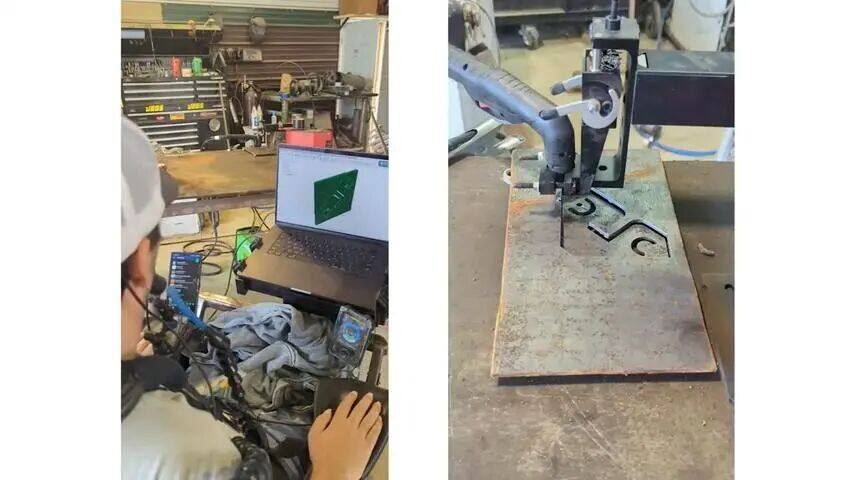
▲ Alex designed and fabricated a new latch (for his farm gate) using CAD.
Alex stated, “It feels amazing to start with a concept and ultimately create a device that perfectly meets my needs. I hope everyone, whether disabled or able-bodied, can have the desire to create new things. Perhaps my experience can inspire others and bring positive changes to their lives.”
▼ Controlling a Robotic Arm to Write via Mind Control (CONVOY)

Source: IT Home
For academic sharing only. If there is any infringement, please leave a message and it will be deleted immediately!


Join Community
Welcome to the Brain-Computer Interface Community Group Chat,
Exploring Topics in the Field of Brain-Computer Interfaces: Real-Time Tracking of Frontiers in Brain-Computer Interfaces
Join WeChat Group:
Add WeChat: RoseBCI [Note: Name + Industry/Profession].
Join QQ Group: 913607986
Call for Papers
1. Submissions are welcome. For submission inquiries, please contact us via WeChat: RoseBCI
Click to Submit:Submission Guidelines for Academic News in the Brain-Computer Interface Community
2. To join the community as a part-time creator, please contact us on WeChat: RoseBCI

One-click Triple Action: “Share,” “Like,” and “Watch”
Stay Ahead of Every Breakthrough in Brain-Computer Interface Technology