

BCI Advancements Update: Inclusion in National Healthcare Reimbursement and Continuous Breakthroughs

Neuralink
Brain-Computer Interface System Developer

Computer
Update on Brain-Computer Interface Progress
Inclusion in Medical Insurance, Continuous Breakthroughs
Investment Highlights
The National Healthcare Security Administration has established a separate project for new brain-computer interface technologies.Recently, the General Office of the CPC Central Committee and the General Office of the State Council issued the "Action Plan for Boosting Consumption," which explicitly identified brain-computer interfaces (BCIs) as a high-growth emerging consumer sector. On March 12, 2025, the National Healthcare Security Administration released the "Guidelines for Establishing Pricing Items for Nervous System Medical Services," creating separate pricing items specifically for new BCI technologies. Addressing the need for continuous device calibration in non-invasive BCIs, the Guidelines added a pricing item for "Non-Invasive BCI Adaptation Fees." For invasive BCIs, the Guidelines established specific pricing items such as "Invasive BCI Implantation Fees" and "Invasive BCI Removal Fees." This signifies that once BCI technology matures, the reimbursement pathway for its rapid clinical application is already in place.
Invasive Systems Enter the Clinical Translation Phase:Neuralink has implanted its brain-computer interface (BCI) device in a third patient, with Elon Musk announcing plans to perform approximately 20 to 30 additional implants in 2025. In September 2024, Neuralink’s next-generation product, “Blindsight,” achieved significant progress by receiving Breakthrough Device Designation from the U.S. Food and Drug Administration (FDA), a move expected to accelerate its research, development, and market approval processes. In February 2025, Jieti Medical completed a Series B financing round of RMB 350 million, marking the largest funding event in the history of China’s invasive brain-computer interface industry. Jieti Medical plans to initiate China’s first prospective first-in-man (FIM) clinical trial for long-term implantation of an invasive BCI in 2025, and to establish the country’s first medical-grade MEMS production base for brain-computer interfaces, thereby achieving a closed-loop system encompassing “R&D, production, and quality inspection.” In 2026, the company will further advance large-scale clinical trials to pave the way for product registration and commercial launch, representing a significant step forward in the clinical translation of invasive BCI systems.
Dual Breakthroughs in Non-Invasive Medical and Consumer-Grade Products:Meisheng Medical’s wrist-worn low-frequency therapeutic device has entered the special review channel for Class II innovative medical devices in Shanghai. We anticipate that it generally takes 1–3 years to develop non-invasive medical devices before applying for registration certification. In February 2025, a joint team from Tianjin University and Tsinghua University successfully developed a novel non-invasive evolutionary brain-computer interface (BCI) system based on memristor-based neuromorphic devices, achieving efficient four-degree-of-freedom control of drones by the human brain. In the consumer product sector, Meta released the Orion glasses in 2024. The accompanying electromyography (EMG) wristband employs advanced EMG technology to precisely detect wrist muscle activity, thereby tracking subtle finger movements. Combined with eye-tracking capabilities, Orion enables users to interact more naturally with the virtual world; for instance, using gaze as a pointer and pinching fingers to execute click commands. According to Meta CTO Andrew Bosworth, the consumer version of Orion is expected to launch before 2030, with the price dropping to approximately $1,500. Commercial application scenarios for non-invasive brain-computer interfaces are further expanding.
Frontier Exploration: Biocomputers.Cortical Labs: The Australian startup Cortical Labs has recently launched CL1, the world’s first commercial biological computer based on neurons cultured from human stem cells. CL1 is scheduled to hit the market by the end of 2025, with a price tag of approximately $35,000. Cortical Labs also offers Wetware-as-a-Service (WaaS), enabling remote access to its biological computers for application development.
Investment Recommendations:Continuous breakthroughs in invasive technologies will drive greater awareness of brain-computer interface (BCI) technology in the consumer and medical rehabilitation markets. Further advancements are expected in 2025, accelerating the commercial deployment of non-invasive BCI products. Investors are advised to focus on companies, or their equity affiliates, that have established a leading position in BCI technology, including Thale Medical, Yanshan Technology, Sanbo Brain Hospital, Chengyitong, Innovation Medical, and Dinake.
Risk Warning:Policy implementation falls short of expectations, intensifying industry competition.
(Analyst Wang Zijing)

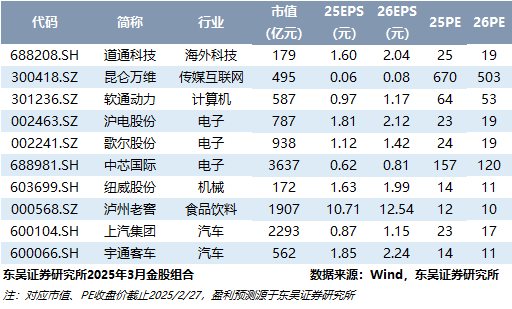
Latest Golden Stock Portfolio

Soochow Securities Research Institute Institutional Sales Contact List



Legal Disclaimer
This official subscription account (WeChat ID: scsresearch) is legally established and independently operated by the Research Institute of Soochow Securities Co., Ltd. (hereinafter referred to as “Soochow Securities”). This subscription account is not a platform for releasing research findings from Soochow Securities’ Research Institute. All content excerpted in this account is derived from research reports officially published by Soochow Securities’ Research Institute. For detailed securities research information, please refer to the complete reports issued by Soochow Securities’ Research Institute. Under no circumstances shall the content excerpted in this account constitute investment advice to any individual, nor shall Soochow Securities or its Research Institute bear any liability for any losses incurred by any person resulting from the use of such content. The copyright of all content excerpted in this subscription account belongs solely to Soochow Securities’ Research Institute, and Soochow Securities and its Research Institute reserve all legal rights regarding this subscription account. Subscribers are prohibited from reproducing or reposting any content (including text, images, videos, etc.) published on this subscription account without written permission. Any authorized reproduction or reposting must clearly attribute the source as “Soochow Securities Research Institute” and must not involve any citation, abridgment, or modification that distorts the original intent of the content.