

Neuralink Secures $600M Funding Round, Valuation Soars to $9B Amid Brain-Computer Interface Breakthroughs

Neuralink
Brain-Computer Interface System Developer

Siyu Annual Event Review:The First Global Ophthalmology Conference | The 1st Global Orthopedics Congress | The 1st Global Cardiovascular Conference
Upcoming:
June 12, 2025, The First Global Medical Aesthetics Technology Conference
July 17, 2025, The 2nd Global Medical Technology Conference
September 4–5, 2025, The 3rd Global Surgical Robotics Conference
On May 29, 2025, according to foreign media reports, Neuralink, the brain-computer interface company under Elon Musk, recentlyCompleted a New Round$600 million(approximately RMB 4.3 billion) in financing, with a pre-money valuation reaching$9 billion(approximately RMB 65 billion). This funding round was disclosed by insiders; while no official announcement has been made, its size has significantly exceeded the previously rumored fundraising target of $500 million.
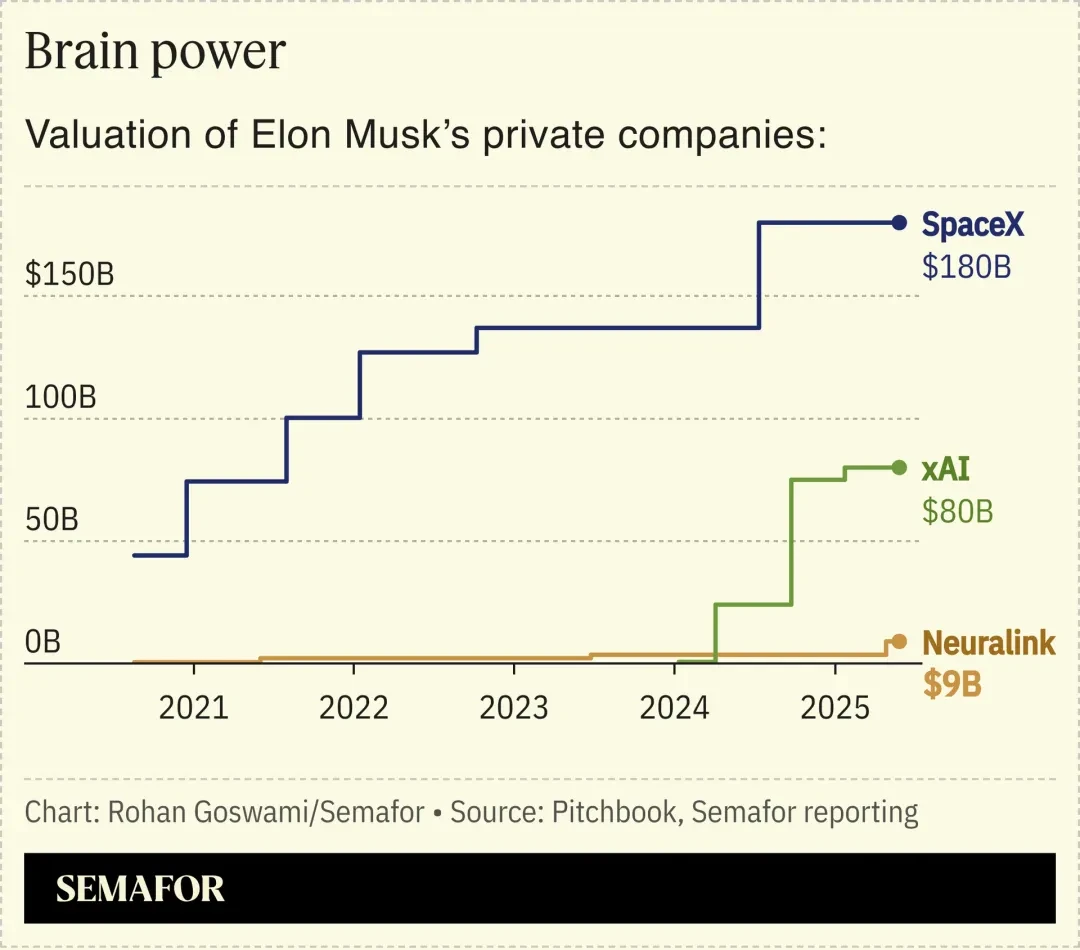
Image source: semafor.com
This company, which specializes in invasive brain-computer interface (BCI) technology, has accelerated its fundraising pace since 2023. After announcing a $280 million funding round in August 2023, Neuralink secured an additional $43 million in follow-on financing just a few months later. With the completion of this latest round, the company’s cumulative valuation has nearly doubled within a year, maintaining its position as the global leader in the BCI sector.
'%20fill='%23FFFFFF'%3E%3Crect%20x='249'%20y='126'%20width='1'%20height='1'%3E%3C/rect%3E%3C/g%3E%3C/g%3E%3C/svg%3E)
# Micro-Implants × Surgical Robots: Neuralink Builds a Closed-Loop Neural Interface Platform
The core of Neuralink’s technology consists of two key components:N1 ImplantandR1 Surgical Robot, the two components form a closed, automated system for neural signal acquisition and processing, with the goal of enabling “mind-controlled” interaction between patients and external devices.
N1 System: 1024 electrodes, wireless charging, biocompatible
N1 is a miniature implantable device, measuring only 23 mm × 8 mm, with a coin-like shape. Its structural encapsulation employsBiocompatible Materials, can be implanted in the human body for long-term use without triggering immune rejection or inflammatory responses. No external open interface is required, equipped withWireless Charging Module, powered by an external device for the built-in battery, avoiding repeated craniotomies.
N1 Internal Integration1,024 electrode contacts, distributed across 64 ultra-fine flexible threads (each thread approximately half the diameter of a human hair), which can be implanted into specific regions of the cerebral cortex to densely acquire neuronal firing signals. This structure significantly enhances the acquisition density of neural signals, representing a generational leap over traditional Utah electrode arrays or Neuropixels probes in terms of channel count, flexibility, and tissue compatibility.
Each thread exhibits high flexibility, allowing it to freely conform to the three-dimensional structure within brain tissue,Minimize tissue damage or signal interference caused by electrode movement to the greatest extent possible, enabling more stable data acquisition and long-term implantation.
Neural Signal Decoding Pipeline: Low Power + AI Algorithms
N1 System IncludesLow-Power Processing Chip, which can perform preliminary filtering and encoding of the signal, and transmit neural signals in real time to the Neuralink application via a wireless module. The application integrates proprietary neural decoding algorithms capable of converting neural electrical activityConvert into “action intent” or “control signals”, applied to external terminals, such as computers, robotic arms, wheelchairs, etc.
The current system has implemented controls for cursor movement, web browsing, and interactive mini-games, with the future goal of expanding to full-function peripheral device control and multi-modal human-computer interaction.
R1 Robot: Achieving Millimeter-Level Precision Implantation
To address the challenge of ultra-fine threads that are difficult to handle manually, Neuralink has developedR1 Surgical Robot, designed to perform the automated implantation task for N1. R1 is equipped with five camera modules and an OCT (Optical Coherence Tomography) system, capable of real-time imaging of brain tissue structures to achieve intraoperative localization and layered tissue identification.
The R1 implantation needle is refined to the micron scale and features high-frequency vibration control, enabling the precise insertion of individual threads into the superficial cerebral cortex while avoiding blood vessels. The entire implantation process is program-driven, ensuring controllability over the angle, depth, and position of each thread, thereby significantly enhancing implantation efficiency and safety.
Blindsight Visual Implant System: Bypassing the Eye to Directly Target the Visual Cortex
In addition to motor control, Neuralink is also advancing BCI research and development in the area of visual restoration.Blindsight"The system received the U.S. FDA 'Breakthrough Device' designation in October 2024, targeting patients who have lost their vision due to retinal or optic nerve damage."
The system stimulates the visual cortex via electrodes, bypassing traditional visual pathways to restore basic visual perception in patients. The initial version can induce the perception of phosphenes (points of light) within the visual field, while subsequent iterations will further enhance stimulation resolution, with the potential to enable the recognition of simple shapes and even contours. Elon Musk has publicly stated that the long-term goal is not only to help patients “restore vision” but also to “expand perceptual dimensions,” allowing them to perceive wavelengths beyond human capability, such as infrared and ultraviolet light.
Exploring Multidimensional Application Pathways: Beyond Motor Control
In addition to its use by patients with quadriplegia, Neuralink is also exploring the potential of brain-computer interfaces (BCIs) in human-machine collaboration and cognitive enhancement. The company’s engineering team is developing silent speech algorithms that enable users to input text or convey intent solely through brain activity, potentially replacing certain typing or voice-input scenarios.
Meanwhile, research is also underway to translate EEG-based intentions into smart home control commands (such as turning lights on/off and adjusting temperature), thereby constructing a “brain-controlled environmental perception system” to enable greater independence for individuals with severe disabilities.
# Multinational Clinical Trials Advance in Parallel, Early Patient Feedback Shows Promising Results
In January 2024, Neuralink completed the world's first human implantation surgery.Post-implantation, Noland Arbaugh controlled the computer cursor with his thoughts, completing various tasks such as playing chess online and using a laptop. Compared to his pre-surgery reliance on a mouth stick to operate a tablet, he achieved autonomous interaction in a supine position for the first time after surgery, marking a significant improvement.
As of February 2025,Three Patients Have Completed Implantation in the U.S. PRIME Study, with a cumulative usage time exceeding 4,900 hours and total implantation duration surpassing 670 days. In November 2024, Health Canada approved Neuralink to initiate the international version of the CAN-PRIME study, marking its formal expansion into the North American clinical landscape.
Currently, Neuralink is primarily focused on individuals with neuromotor disorders such as high-level paraplegia and ALS, while also exploring broader application scenarios like brain-controlled smart homes and silent communication.
# Capital Surge, Regulatory Breakthrough: Brain-Computer Interface Sector Heats Up
Brain-computer interfaces are becoming one of the most prominent innovation tracks in the global medical technology sector. Morgan Stanley predicts that this field will achieve commercialization for medical applications within five years. Third-party reports, such as those from PatentVest, also highlight that the U.S. BCI market has a potential value of up to $400 billion, with approximately one-quarter focused on neuromotor disorders like high-level paraplegia and ALS, while the remainder addresses broader indications including mental illnesses and cognitive impairments.
In China, the medical insurance sector took the lead in breaking through in 2025. In March,The National Healthcare Security Administration issued the "Guidelines for Project Establishment of Pricing Items for Neurological Medical Services," which separately established pricing items for new brain-computer interface technologies, setting up“Implantation Fee for Invasive Brain-Computer Interface” “Removal Fee for Invasive Brain-Computer Interface” etc.Pricing Items: Medical Charges for Brain-Computer Interfaces Will Be Regulated
On March 31, Hubei Province took the lead nationwide in implementing pricing items for “invasive brain-computer interface implantation fees,” “invasive brain-computer interface removal fees,” and “non-invasive brain-computer interface adaptation fees,” establishing government-guided prices as follows:6,552 yuan/session, 3,139 yuan/session, 966 yuan/session. The project price is the highest price limit in the province, which cannot be increased, but there is no limit to the decrease.The integration of medical insurance pricing pathways is regarded by the industry as a critical milestone for BCI’s advancement toward large-scale clinical application.
# Conclusion
$600 million in funding, a $9 billion valuation, and a globally leading product roadmap... Neuralink is undoubtedly one of the most symbolic projects in the current BCI field. However, its true breakthrough lies not merely in “raising capital,” but in having gradually established a “Closed-Loop Nervous System Platform”: Features capabilities in automated implantation, stable signal acquisition, real-time decoding, multimodal interaction, and long-term validation, while covering multidimensional pathways including vision, motor function, and cognition.
This “systemic product capability” is becoming the core competitive threshold in the new phase of the BCI sector. For emerging Chinese companies, Neuralink’s model has become a key reference framework for benchmarking and observation, whether in terms of product architecture, algorithmic pathways, clinical progress, or policy alignment.
Future BCIs are not merely connections between the brain and devices, but rather systems engineering endeavors involving multi-axis collaboration across research, engineering, clinical practice, market, and policy domains.
Welcome enterprises to actively participate in the conference organized by Siyu↓
June 12, 2025, The First Global Medical Aesthetics Technology Conference
July 17, 2025, the Second Global Medical Technology Conference
September 4–5, 2025, The 3rd Global Surgical Robotics Conference