

New Proposal Calls for No-Fault Compensation System for Patients Harmed by High-Risk Brain Implants

Neuralink
Brain-Computer Interface System Developer

As companies such as Neuralink advance high-risk human clinical trials of brain implant devices, the U.S. academic community has recently called for major reforms in how injury incidents are handled.
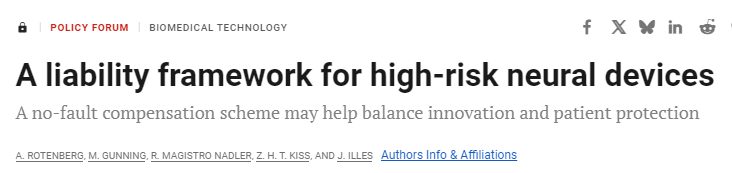
An article published in Science proposes the establishment of a “no-fault” compensation scheme for patients who may suffer harm from devices such as brain-computer interfaces (BCIs). This mechanism would allow patients to receive compensation without pursuing any legal liability.
Such devices are often used to treat severe conditions such as epilepsy and paralysis, offering potentially transformative therapeutic benefits, but they also carry significant risks, including seizures, stroke, and even death. Currently, patients who experience device malfunctions or accidental injuries often struggle to obtain legal remedies or financial compensation.
“Individuals who receive these devices are typically left with no other options. They are courageous and hopeful, and if the outcomes do not meet expectations, they deserve protection,” said Dr. Judy Illes, Professor of Neurology at the University of British Columbia (UBC) and senior author of the proposal. She co-authored the recommendations with Dr. Zelma Kiss, a neuroscientist at the University of Calgary.
Legal Gaps: Difficulty in Safeguarding Rights for High-Risk Medical Devices
The root of the problem can be traced back to a 2008 U.S. Supreme Court ruling: if a device has received FDA approval, patients cannot sue the manufacturer. This decision in *Riegel v. Medtronic* effectively granted manufacturers immunity protection.
Subsequently, the majority of lawsuits involving injuries caused by high-risk medical devices were dismissed. Studies indicate that only 12% of cases resulted in judgments favorable to patients, meaning that most victims had to bear the consequences themselves and received little to no compensation.
'%20fill='%23FFFFFF'%3E%3Crect%20x='249'%20y='126'%20width='1'%20height='1'%3E%3C/rect%3E%3C/g%3E%3C/g%3E%3C/svg%3E)
Proposed "No-Fault" Compensation System
To address this dilemma, researchers recommend establishing a no-fault compensation mechanism that allows patients to receive reasonable compensation—including medical expenses and lost wages—without having to prove negligence on the part of manufacturers or hospitals.
This model is similar to the existing Vaccine Injury Compensation Program (VICP) in the United States and also resembles New Zealand’s national medical injury compensation system, with the aim of enhancing efficiency and fairness while reducing the legal burden on patients.
“Patients no longer need to navigate protracted legal proceedings to protect their rights, allowing them to focus their energy on recovery,” Dr. Eilers pointed out. “Companies can also continue to drive technological innovation without bearing the litigation risks associated with unintended consequences.”
Institutional Design and Operational Mechanisms
The proposal suggests that the compensation fund be primarily funded by device manufacturers, with the government providing financial support to small and medium-sized enterprises. Patients would automatically qualify for compensation in cases of long-term severe injuries resulting from accidents during device migration, infection, or implantation.
Furthermore, an expert panel will be established to handle complex cases. Unlike the vaccine compensation mechanism, this system will preserve patients’ right to pursue legal remedies.
Driving a Win-Win for Technological Advancement and Patient Protection
Researchers stated that the core of this proposal lies in balancing the drive for innovation with the protection of patient rights. It not only provides psychological safeguards for clinical trial volunteers but also offers institutional support for the safe promotion of emerging technologies.
“People have high hopes for cutting-edge technologies such as brain-computer interfaces,” said Dr. Kiss, “but we cannot ignore the potential risks. When issues arise, we must ensure that every patient receives proper care.”
As companies such as Neuralink and Synchron successively advance the clinical application of human brain implants, establishing a fair and transparent patient protection mechanism has become more urgent than ever before.
For academic sharing only. If there is any infringement, please leave a message and it will be deleted immediately!
Join the Community
Welcome to the Brain-Computer Interface Community Exchange Group,
Explore topics in the field of brain-computer interfaces and track the latest advancements in real time.
Join WeChat Group:
Add WeChat: RoseBCI [Note: Name + Industry/Profession].
Join QQ Group: 913607986
Call for Papers
1. Submissions are welcome. For submission inquiries, please contact us via WeChat: RoseBCI
Click to Submit:Guidelines for Submitting Academic News to the Brain-Computer Interface Community
2. To join the community as a part-time creator, please contact us on WeChat: RoseBCI
One-Click Triple Action: “Share,” “Like,” and “Watch”
Stay Ahead of Every Breakthrough in Brain-Computer Interface Technology