

"When Can I Stop Taking Medication?" – A Long-Standing Question for Hepatitis B Patients Is Finally Being Answered

GSK
Pharmaceutical R&D Manufacturer

Ionis Pharmaceuticals
RNA Drug Developer
For many patients with chronic hepatitis B (CHB), the issue that has troubled them for years is not “whether the medication is effective,” but rather “when can I stop taking the medication.”
Taking medication on time every day, undergoing regular follow-up examinations, monitoring whether hepatitis B virus (HBV) DNA remains undetectable, and worrying about fluctuations in liver function indicators... With current treatment options, many patients can achieve long-term control of viral replication through nucleos(t)ide analogs, significantly reducing the risk of disease progression. However, behind the "stable condition," a practical issue still persists:Can the medication be discontinued? Will the virus rebound after stopping the medication? Does this treatment need to continue for many years, or even a lifetime?
Image source: 123RF
This has long been a core challenge in the field of chronic hepatitis B treatment. For many years, the primary goal of hepatitis B therapy was “long-term control”—reducing the risk of disease progression, cirrhosis, and hepatocellular carcinoma through sustained suppression of HBV DNA. Today, this goal remains critically important. However, with the continuous advancement of novel therapies, the industry is now pursuing a higher-level objective: functional cure.
So-calledFunctional cure typically refers to the sustained loss of hepatitis B surface antigen (HBsAg) and undetectable HBV DNA after discontinuation of all therapy.This does not equate to the complete eradication of all hepatitis B virus (HBV) genetic material from the body, but it signifies that the human immune system can continue to control the disease after discontinuation of therapy. For patients, this represents a shift in treatment goals from “daily viral suppression” to “achieving durable control after a finite course of treatment.”
This goal is important not only because it may reduce the long-term burden of medication, but also because HBsAg loss is associated with better long-term clinical outcomes. In other words, a functional cure shifts the focus of hepatitis B treatment from merely suppressing viral replication to further reducing viral antigens, restoring immune control, and maintaining disease stability even after discontinuation of therapy.
Recently, a key advancement announced by GSK has once again brought this goal into the industry spotlight.
“Unprecedented” Functional Cure Rate: Bepirovirsen Delivers Breakthrough in Phase 3 Clinical Study
Today, GSK announced that bepirovirsen, an investigational hepatitis B therapy co-developed with Ionis Pharmaceuticals, achieved positive results in two pivotal Phase 3 B-Well studies.GSK described its functional cure rate as “unprecedented” in the press release.

Bepirovirsen is an antisense oligonucleotide (ASO) therapy designed to target hepatitis B virus RNA, reducing viral RNA and viral protein expression, particularly lowering HBsAg levels.By reducing the persistent viral antigen load, these therapies are expected to help the body’s immune system regain control over HBV infection. Bepirovirsen has received Breakthrough Therapy designation from the U.S. FDA and is currently under FDA review.
In the pooled data from the two global Phase 3 studies, B-Well 1 and B-Well 2,Among patients with chronic hepatitis B (CHB) who received 6 months of bepirovirsen treatment, a functional cure rate of 19% was achieved in the overall study population; in the subgroup with baseline HBsAg ≤1000 IU/mL and lower viral activity, the functional cure rate reached 26%.In contrast, the functional cure rate in the standard-of-care control group was 0%. Furthermore, exploratory analyses showed that nearly half of the patients treated with bepirovirsen achieved HBsAg levels ≤100 IU/mL one year after completion of treatment. The results of these two studies were also published simultaneously in the New England Journal of Medicine.
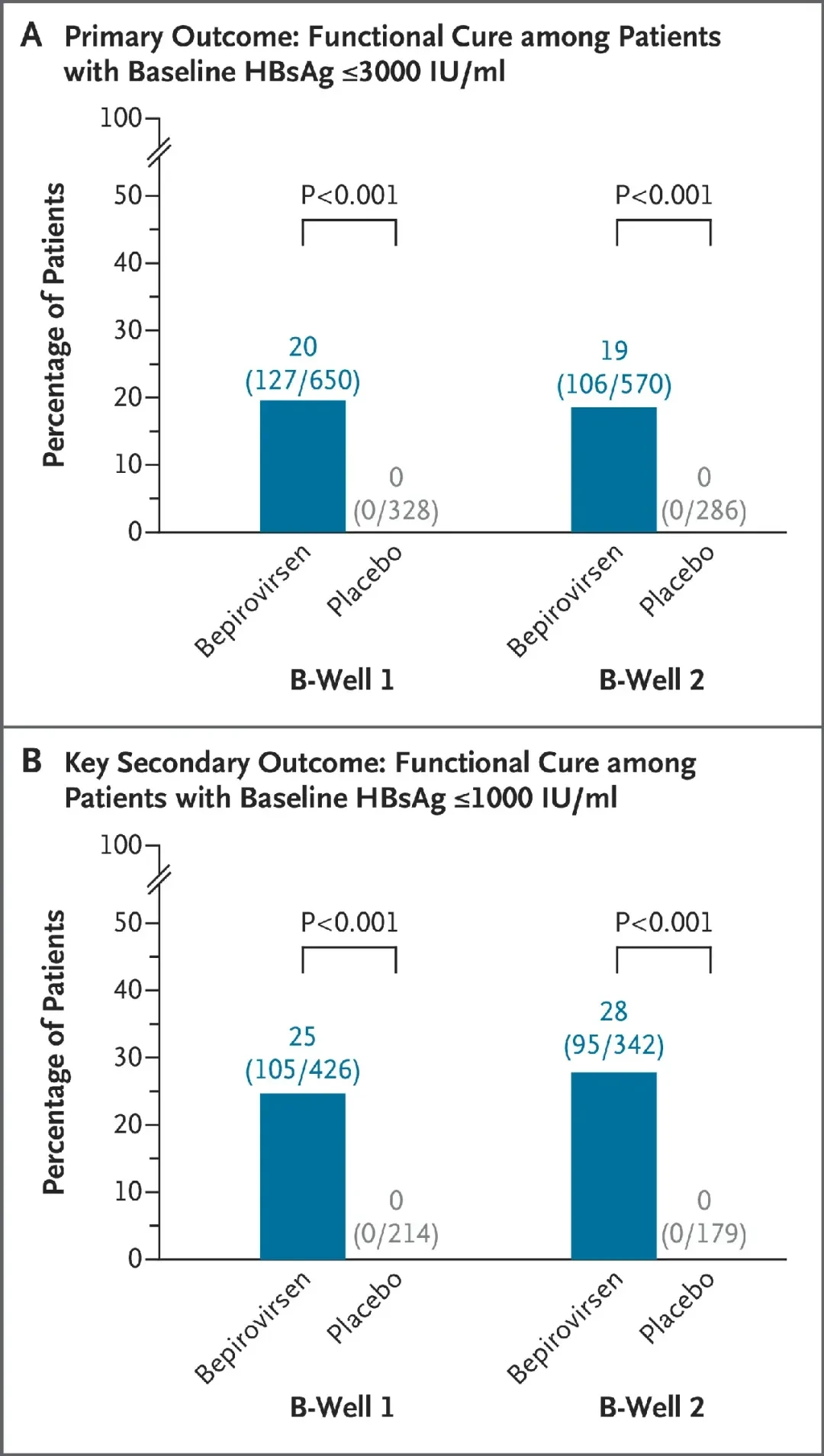
▲Functional Cure Rates from the Global Phase 3 B-Well 1 and B-Well 2 Studies (Image source: Reference [2])
The significance of these data lies not only in the “cure rate” figures themselves, but also in the fact that they derive from two pivotal Phase 3 studies. Functional cure of chronic hepatitis B (CHB) has long been considered highly challenging; although current standard-of-care therapies can effectively suppress viral replication, functional cure rates are typically very low.Data from bepirovirsen suggest that oligonucleotide therapies targeting HBV RNA and viral antigen expression may open new avenues for finite-duration treatment.
Why Have Oligonucleotide Therapies Become a Key Direction for the Functional Cure of Hepatitis B?
To understand this trend, it is necessary to revisit the core challenges in the treatment of chronic hepatitis B (CHB).
After HBV enters hepatocytes, it can form covalently closed circular DNA (cccDNA) within the nucleus and integrate portions of viral DNA into the host genome. These viral genetic materials persistently produce viral RNA and proteins, with the prolonged presence of HBsAg considered closely associated with immune tolerance, immune exhaustion, and the difficulty in achieving a functional cure.
Traditional nucleos(t)ide analogues primarily inhibit viral replication and are highly effective in reducing HBV DNA levels, but have limited efficacy in clearing HBsAg. This is why many patients still find it difficult to truly discontinue treatment, even when HBV DNA remains undetectable for a prolonged period.
Oligonucleotide therapies target the critical level of viral RNA.Antisense oligonucleotides (ASOs), small interfering RNA (siRNA), and other technologies can target HBV RNA through different mechanisms, reduce viral protein production, and lower HBsAg burden at the source.With the maturation of liver-targeted delivery technologies such as GalNAc conjugation, the application scope of oligonucleotide drugs like siRNA in liver diseases continues to expand.

Based on the multiple advancements disclosed at this year’s annual meeting of the European Association for the Study of the Liver (EASL), bepirovirsen is not an isolated case. Around reducing HBsAg, maintaining post-treatment response, and deeper interventions targeting viral reservoirs, an increasing number of oligonucleotide and nucleic acid-related therapies are forming a richer landscape for functional cure research and development.
Multiple Pipelines Unveiled at EASL: Functional Cure Strategies Become More Diverse
In the ASO space, AusperBio’s AHB-137 is another candidate therapy drawing significant attention. Data from the EASL Congress show thatAHB-137 Monotherapy Demonstrates Potent HBV DNA Suppression and HBsAg Reduction in Treatment-Naïve Chronic Hepatitis B Patients. Study results showed that 24 weeks after treatment cessation, 32% of patients in the overall population achieved functional cure.Among patients with baseline HBsAg levels of 100 to 1000 IU/mL, the functional cure rate was 70%.
This result further demonstrates that a profound reduction in HBsAg may be one of the key steps toward achieving a functional cure.
In the siRNA field, HepaThera Biopharmaceutical’s (Xingyao Kunze) study on the combination of HT-101 and HT-102 demonstrates an alternative combinatorial approach.HT-101 is a GalNAc-conjugated siRNA designed to silence HBV RNA via the RNA interference mechanism. HT-102 is a fully human anti-HBsAg monoclonal antibody. This combination reduces HBsAg production through the siRNA component while facilitating the clearance of circulating HBsAg via the antibody.
This combination strategy of “reducing production + promoting clearance” reflects a shift in the development of functional cures for hepatitis B from single-mechanism approaches to multi-mechanistic synergy. For patients who are HBeAg-negative and have achieved viral suppression following nucleos(t)ide analogue therapy, further achieving and maintaining HBsAg loss holds promise for approaching the goal of sustained control after treatment discontinuation.
Image source: 123RF
Argo Biopharma’s BW-20507 is also a GalNAc-conjugated siRNA. In studies presented at the EASL Congress, long-term treatment with BW-20507 demonstrated favorable tolerability and significant reductions in HBsAg levels. Data showed that by day 197 of treatment, the mean maximum reduction in HBsAg reached 2.85 log10 IU/mL, with all participants achieving HBsAg levels <3 IU/mL, and nearly half of the patients achieving HBsAg clearance at least once during follow-up.
These data indicate that,GalNAc-siRNA remains one of the key technological approaches in the development of a functional cure for hepatitis B.With prolonged treatment duration, optimized discontinuation criteria, and exploration of combination regimens, there remains substantial scope for research into siRNA therapies in reducing antigen load and improving the immune response environment.
Unlike ASOs and siRNAs,Precision BioSciences’ PBGENE-HBV represents an exploration in the field of gene editing. This therapy aims to intervene at a source closer to the root of viral persistence by editing cccDNA and integrated HBV DNA.Liver biopsy data presented at the EASL Congress provided early evidence of cccDNA elimination or inactivation in patients, with observed antiviral activity signals including the disappearance of pgRNA transcribed from cccDNA and a decline in HBsAg levels.
Although PBGENE-HBV is still in the early clinical stages, it has offered the industry another potential pathway to curing hepatitis B: from reducing viral antigens to directly targeting viral reservoirs, the concept of a “cure” for hepatitis B is continuously being expanded.
From Scientific Breakthroughs to Patient Benefits: A Robust R&D and Manufacturing System Is Still Required
As R&D for the functional cure of chronic hepatitis B (CHB) enters a new phase in which oligonucleotide- and nucleic acid–based therapies constitute key components, the challenges in development have accordingly escalated.
Complex nucleic acid-related therapies, such as ASOs, siRNAs, and GalNAc-conjugated molecules, often require systematic coordination across sequence design, chemical modifications, delivery systems, analytical methods, GMP manufacturing, and formulation development.
WuXi TIDES, the CRDMO platform under WuXi AppTec focused on oligonucleotides, peptides, and related chemically conjugated drugs, provides integrated services from drug discovery to commercial manufacturing for oligonucleotide active pharmaceutical ingredients (APIs) and formulations, including RNAi and ASOs. Its oligonucleotide discovery and synthesis services support high-throughput library synthesis and custom synthesis, covering all types of oligonucleotides as well as their monomers, linkers, ligands, and conjugates.
Leveraging ample production capacity and mature commercialization expertise, our teams ensure seamless integration to rapidly scale up manufacturing to any level, meeting diverse needs from preclinical and clinical stages through to commercialization. WuXi TIDES also provides formulation development and manufacturing services for various dosage forms and filling formats. Operating under a unified quality system, the platform offers integrated analytical support for both drug substances and drug products, along with comprehensive CMC regulatory submission writing services, helping customers accelerate the market launch of their oligonucleotide therapeutics.
With the rapid development of oligonucleotide therapeutics in the fields of genetic diseases, metabolic disorders, and oncology, these molecules exhibit significant differences from traditional small-molecule drugs in terms of structural properties, delivery methods, and in vivo metabolic mechanisms, thereby posing new challenges for drug metabolism and pharmacokinetics (DMPK) studies. To address the R&D needs of this novel class of therapeutics, WuXi AppTec’s Drug Metabolism and Pharmacokinetics (DMPK) department has established a systematic strategy and experimental models for in vitro oligonucleotide metabolism research, providing comprehensive support to partners from early-stage research through to the preclinical phase.
From a methodological perspective, the team has established various in vitro study models, including liver homogenate metabolic stability assays and plasma stability assays, based on the metabolic characteristics of oligonucleotides, which are primarily degraded by endonucleases and exonucleases. These models simulate the metabolic processes of drugs in tissues and the circulatory system in vivo, enabling a systematic evaluation of their stability and degradation profiles. Relevant studies have demonstrated that these in vitro models effectively reflect the in vivo metabolic trends of oligonucleotides, providing important references for subsequent in vivo studies. Meanwhile, through systematic optimization of key experimental conditions (such as incubation buffer pH, homogenate concentration, and reaction termination methods), WuXi AppTec DMPK has further enhanced the stability and reproducibility of in vitro metabolic assays, thereby allowing for more accurate elucidation of the metabolic pathways and degradation product profiles of oligonucleotide therapeutics. Leveraging its mature experimental platform and extensive project experience, WuXi AppTec DMP helps partners gain a deeper understanding of the metabolic behavior of oligonucleotide drugs, providing critical data support for the optimized design of candidate molecules and subsequent pharmacokinetic studies, thus accelerating the development of innovative oligonucleotide therapies.
From Long-Term Medication to Functional Cure: CHB Treatment Enters a New PhaseThe treatment of chronic hepatitis B (CHB) is entering a new phase, shifting from long-term medication to functional cure. Although this goal has not yet been fully realized, recent progress has made it increasingly attainable. In the future, as oligonucleotide therapies, immunomodulatory strategies, gene editing technologies, and integrated research, development, and manufacturing capabilities continue to mature, the functional cure of hepatitis B is expected to evolve from clinical responses in a small subset of patients to a broader therapeutic hope for a wider population.
References:
[1] Bepirovirsen achieves unprecedented functional cure rates with potential to redefine treatment for chronic hepatitis B. Retrieved May 28, 2026, from https://www.gsk.com/en-gb/media/press-releases/bepirovirsen-achieves-unprecedented-functional-cure-rates-with-potential-to-redefine-treatment-for-chronic-hepatitis-b/
[2] Hou et al. (2026). Phase 3 Results of Bepirovirsen Treatment for Chronic Hepatitis B Virus Infection. NEJM, DOI: 10.1056/NEJMoa2515131
Disclaimer: This article is for informational purposes only. The views expressed herein do not represent the position of WuXi AppTec, nor do they imply that WuXi AppTec supports or opposes such views. This article also does not constitute a recommendation for treatment plans. For guidance on treatment options, please consult a qualified healthcare provider at a reputable hospital.
Copyright Notice: Individuals are welcome to share this article on their WeChat Moments. Media outlets or institutions are prohibited from reposting it to other platforms in any form without authorization. To request permission for reposting, please reply with “Repost” on the “WuXi AppTec” WeChat official account to obtain the reposting guidelines.
Share,PointLike,Watching, Focusing on Global Biopharmaceutical and Health Innovation