XtalPi and Sun Yat-sen University Unlock New Chemical Space for Sulfur-Containing Drug Discovery with Photoinduced Radical C–SuFEx Ligation

XtalPi
Computation-Driven Innovative Drug R&D Provider
In the “periodic table” of drug development, sulfur occupies a pivotal position. Approximately 25% of the top 200 prescription drugs by global sales contain sulfur atoms. From classic sulfonamide drugs to the anti-inflammatory star drug celecoxib, sulfur-containing drugs constitute an important pillar of the modern pharmaceutical arsenal. However, the precise and mild “installation” of sulfur atoms onto complex drug molecular scaffolds has long remained a core challenge in medicinal chemistry.
The root of the problem lies in a special chemical bond—the S(VI)-F bond. This is a covalent bond formed between hexavalent sulfur and a fluorine atom, representing one of the most stable chemical bonds known. Its "inertness" endows sulfur-containing drugs with excellent metabolic stability, but also makes their synthesis exceptionally challenging. To achieve efficient and precise synthesis of sulfur-containing drugs, three core scientific challenges must be overcome: how to cleave the highly inert S(VI)-F bond under mild conditions, how to control the selectivity of radical reactions to avoid by-products, and how to ensure the compatibility of reaction conditions with complex drug molecules.
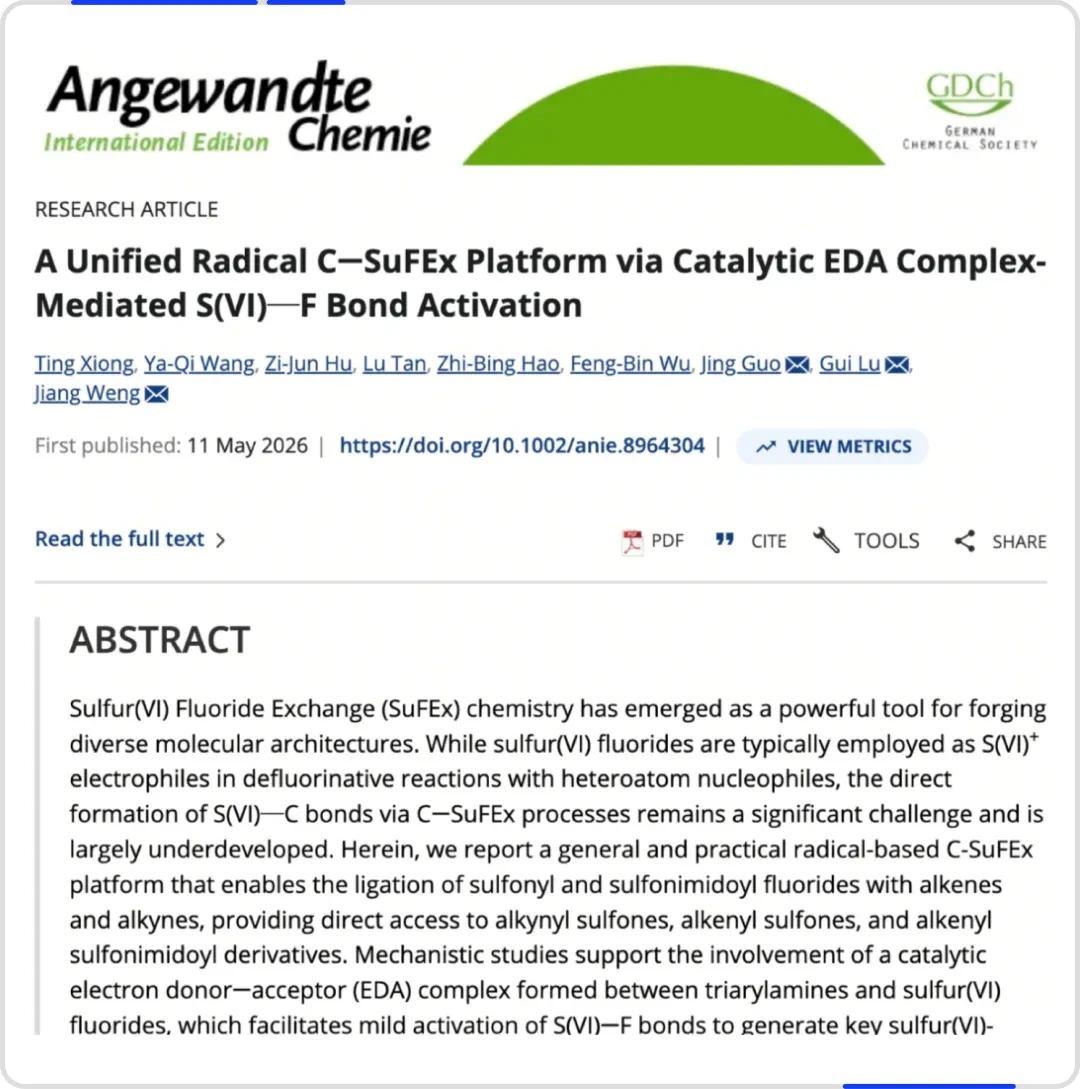
Faced with this challenge, XtalPi (XtalPi,2228.HKIn collaboration with Sun Yat-sen University, an innovative solution was proposed: the development of visible light-mediated electron donor-acceptor (EDA) complexes to gently activate S(VI)–F bonds using a “photo-key.” The Future Chemistry Department of XtalPi, in partnership with Professor Lu Gui’s and Associate Professor Weng Jiang’s research groups at the School of Pharmaceutical Sciences, Sun Yat-sen University, successfully developed a novel sulfur-fluoride exchange (SuFEx) reaction strategy based on visible-light photoredox catalysis. This research was published in a renowned international chemistry journal under the title “Radical C–SuFEx Ligation via Photoinduced Electron Donor-Acceptor Complex.”《Angewandte Chemie International Edition》
* (For the full paper, please click the "Read Original" link at the end of the article.)
As a key participant in this collaboration and the core engine of the company’s technological innovation, XtalPi’s Future Chemistry Department (Future Chemistry)Deeply involved in the development and validation of methodologies. This technology innovatively achieves radical-type carbon–sulfur (C–S) bond formation with hexavalent sulfur fluoride compounds (S(VI)–F) under mild conditions, overcoming the scientific bottleneck of traditional SuFEx reactions in directly forming S(VI)–C bonds. This breakthrough not only expands new chemical space and provides novel tools for the discovery and optimization of sulfur-containing drug molecules, but also significantly empowers XtalPi’s two core business segments:Innovative Backbone Building Block Library (InnoBB)™)and VAST Virtual Compound Library (VAST™), further solidifying the company's technological leadership in the field of AI-driven drug discovery and development.

Technical Breakthrough:
Efficient C–SuFEx Ligation under Mild Conditions
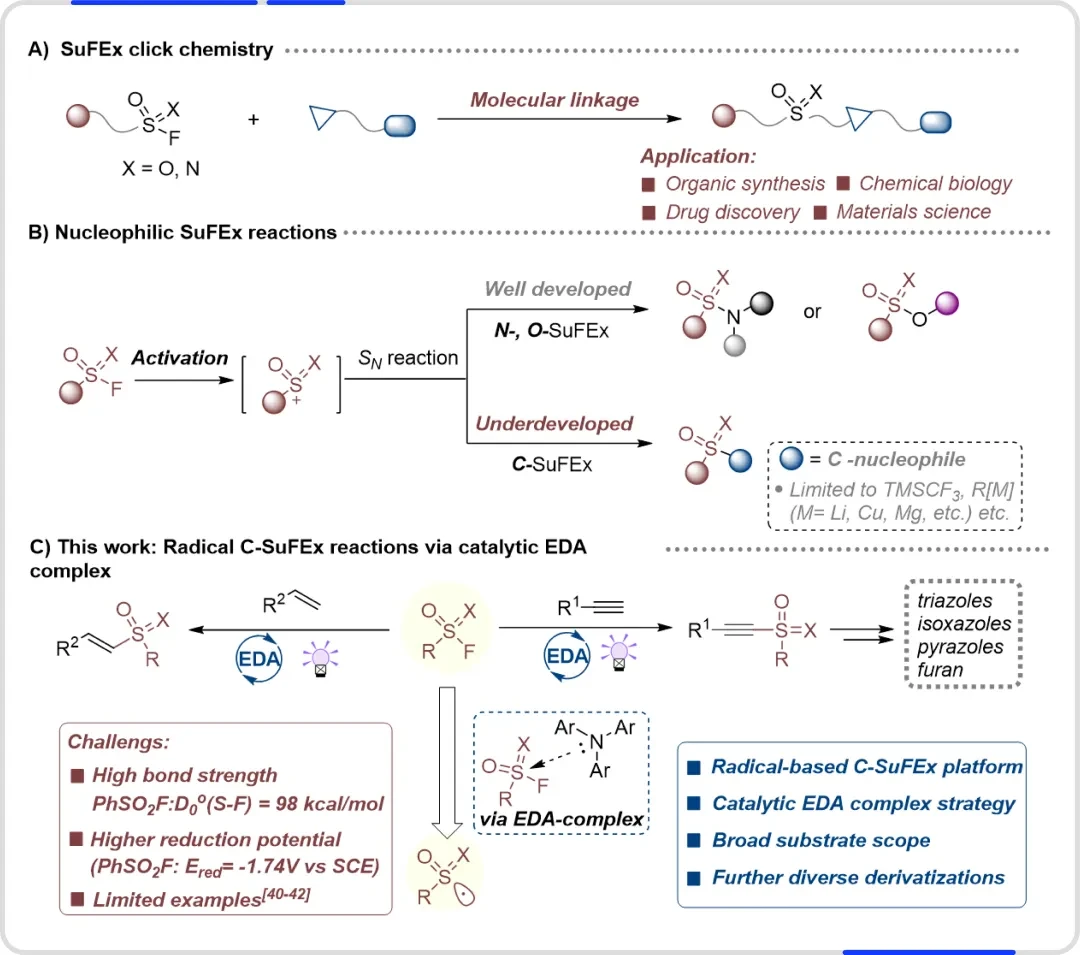
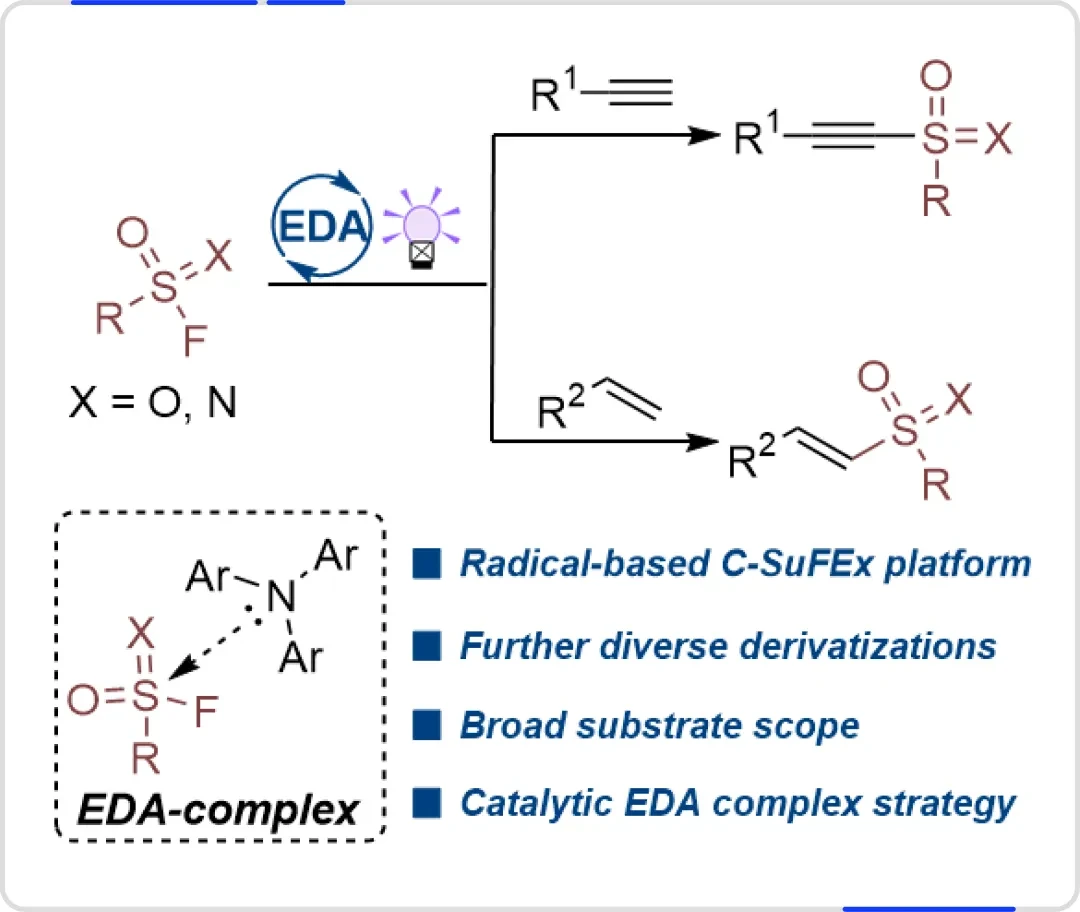
Sulfur–Fluoride Exchange (SuFEx) chemistry, as a next-generation “click chemistry” tool, has demonstrated significant potential in materials science and bioorthogonal applications. However, in traditional SuFEx reactions, hexavalent sulfur–fluorine compounds primarily act as electrophiles reacting with heteroatoms (O, N), and the carbon–sulfur fluoride exchange (C–SuFEx) process for directly constructing S(VI)–C bonds has long been plagued by issues such as harsh reaction conditions and limited substrate scope. XtalPi and the team at Sun Yat-sen University have innovatively introducedVisible Light Photoredox Catalysis Strategy, by forming an electron donor-acceptor (EDA) complex between triarylamine and hexavalent sulfur fluoride compounds, the S(VI)–F bond is efficiently activated under room temperature and neutral conditions to generate key radical intermediates, successfully achievingRadical-Mediated C–SuFEx ReactionThis method enables the efficient synthesis of a series of sulfur-containing functional molecules, including alkynyl sulfones, alkenyl sulfones, and alkenyl sulfonylimine derivatives, demonstrating excellent functional group tolerance and broad substrate scope.
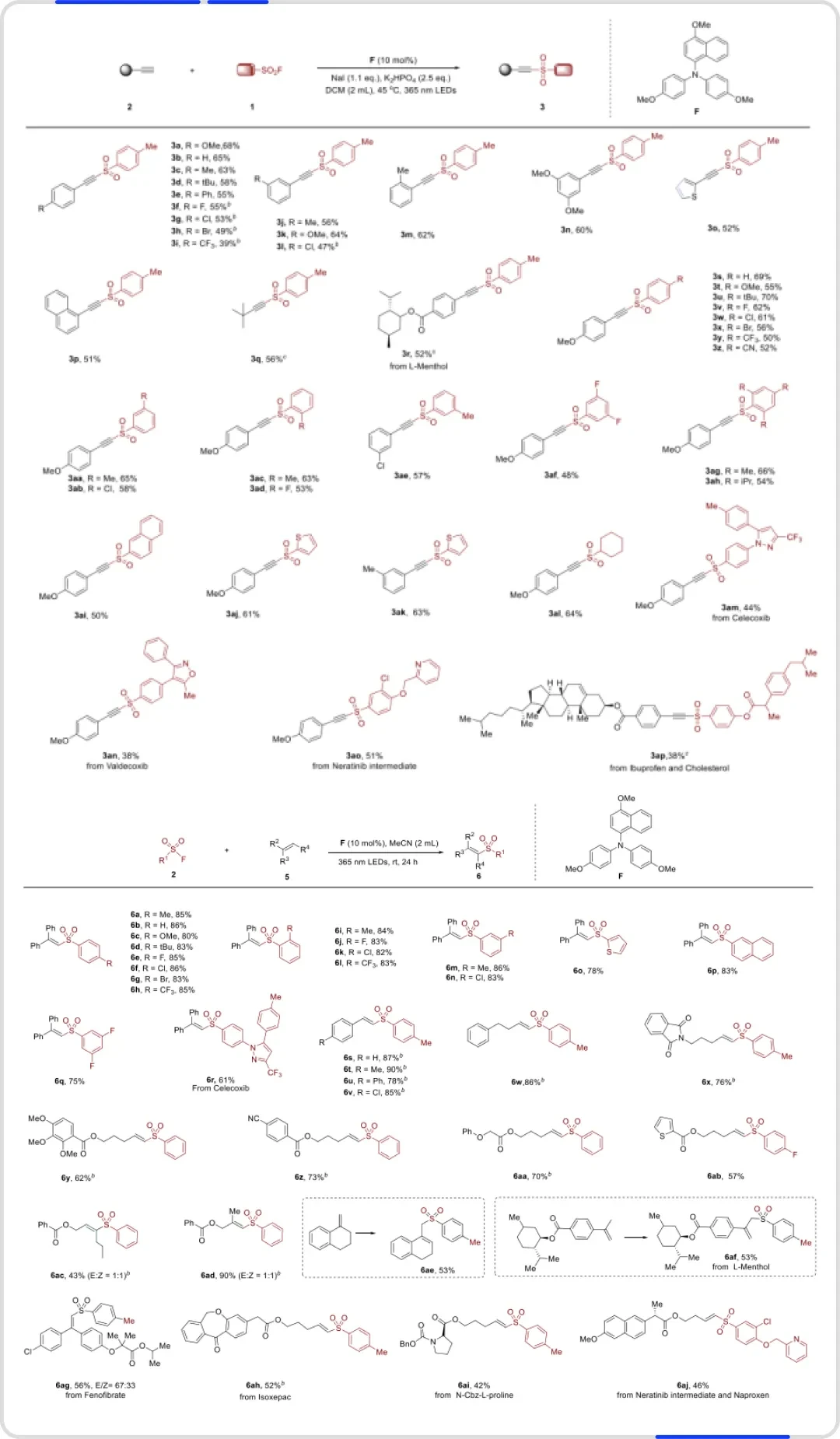
Notably, this technology has successfully achieved late-stage modification of complex natural products and marketed drugs, including steroidal drugs, celecoxib, valdecoxib, and isoxepac, directly demonstrating its practical value in the drug discovery and optimization stages. Through quantum mechanical calculations, the team accurately predicted the reactivity of substrates and the pattern of S–F bond cleavage, providing theoretical guidance for experimental design. This"Computational Guidance for Experiments, Experimental Feedback for Computation"The closed-loop model is the core competitiveness of XtalPi. The subsequent methodological research and development will rely more on Agents and autonomous experiments to achieve implementation.

Comprehensively empower the two major businesses,
Accelerating the R&D of Sulfur-Containing Drug Molecules
● 1. VAST Agent
Based on AI model predictions, XtalPi has built the VAST compound library and its Agent (Virtual, Automated, Swift, and Tailored for drug discovery, Link:vast.xtalpi.com). The different versions of the VAST library contain billions to trillions of synthetically accessible molecules. Each molecule has been precisely predicted for synthesizability using AI models, achieving a synthesis success rate of over 85% and an improvement in synthesis efficiency of more than 30%. Currently, dozens of pharmaceutical companies have utilized this platform for hit compound discovery. The new methodology will expand the chemical space of VAST and library synthesis, supporting first-in-class (FIC) drug discovery.
● 2. Innovative Backbone Building Block Library (InnoBB™): Enriching Sulfur-Containing Chemical Space
Sulfur-containing building blocks are in high demand for drug molecule design due to their unique physicochemical properties and biological activity, yet traditional synthetic methods suffer from limited production capacity. This technology enables the efficient construction of complex sulfur-containing building blocks that were previously difficult to synthesize—such as those featuring alkynyl sulfone and alkenyl sulfone structures—under mild conditions. XtalPi will rapidly integrate this method into its physical skeleton building block library, providing global pharmaceutical clients with more differentiated, higher-value sulfur-containing building blocks to facilitate the generation and optimization of lead compounds.