

Neuralink Achieves Milestone with First-Ever Dual Brain-Computer Interface Implants in One Day; Seven Trial Participants Now Averaging 50 Hours of Weekly Device Use

Neuralink
Brain-Computer Interface System Developer

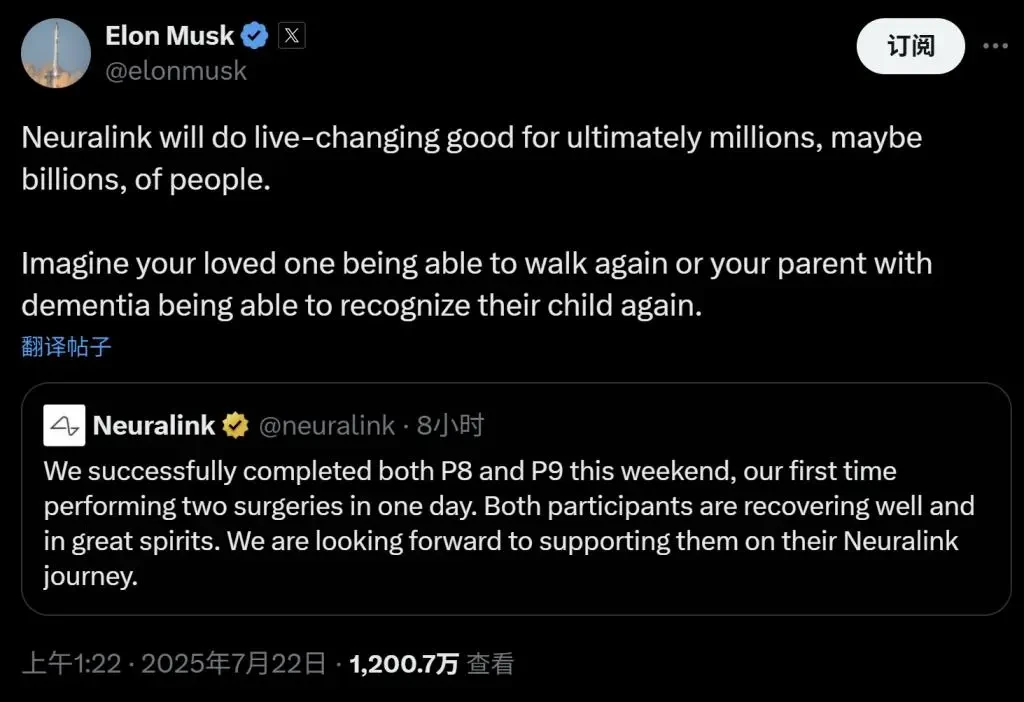
Neuralink, Elon Musk’s brain-computer interface company, achieved a significant milestone on July 22. The company announced that it successfully completed two surgeries, P8 and P9, over the weekend, marking the first time it has performed dual brain-computer interface implantations in a single day. Both patients are currently recovering well and remain in stable mental condition.
This development demonstrates a significant improvement in Neuralink’s surgical efficiency. It is reported that seven participants have received brain-computer interface implants from the company, including four individuals with spinal cord injuries and three with amyotrophic lateral sclerosis (ALS). These participants are actively using the devices, with an average weekly usage time of approximately 50 hours and peak usage exceeding 100 hours.
Musk expressed a profound vision for this achievement. He pointed out that Neuralink will ultimately change the lives of millions, or even billions, of people. Musk depicted an eagerly anticipated future scenario, writing, "Imagine your loved ones being able to walk again, or parents with dementia being able to recognize their children once more."
Neuralink’s technology roadmap reveals an ambitious development plan. The company intends to conduct speech cortex implants in the fourth quarter of 2025, aiming to directly decode silent “intended speech.” By 2026, the number of electrodes on the implanted chip will increase to 3,000, and the first participant in the “Blindsight” project will join the clinical trials.
The project captures images via a camera, converts the information into electrical signals to stimulate the visual cortex, and helps blind individuals regain their vision. In 2027, the number of electrodes will be further increased to 10,000, enabling multi-device implantation. By 2028, the electrode count will exceed 25,000, allowing access to deeper brain regions for the treatment of psychiatric disorders, neuropathic pain, and other conditions.
Neuralink’s ultimate goal is to build a “whole-brain interface” that enables high-bandwidth connectivity between the biological brain and external machines. This technology can write information to neurons anywhere in the brain, achieved through fully automated surgery, and become operational within 24 hours.
The Brain-Computer Interface Industry Is Entering a Period of Rapid Development. The year 2025 is regarded by the industry as the "Year One" of the brain-computer interface (BCI) sector, with the market scale continuously expanding under the dual catalysts of policy support and technological applications. It is projected that from 2025 to 2029, the global BCI market size will grow at a compound annual growth rate (CAGR) of 25.22%, reaching $7.63 billion.
It is reported that Neuralink, founded in 2016, specializes in the research and development of brain-computer interface technology. The company raised $650 million in its latest funding round, pushing its valuation beyond $10 billion. This achievement not only demonstrates the potential for technological breakthroughs but also brings hope to countless patients for regaining dignity and freedom.
Source: Financial Jie
For academic sharing only. If there is any infringement, please leave a message and it will be deleted immediately!
Welcome to the Brain-Computer Interface AI Planet to access more knowledge and resources in fields such as brain-computer interfaces and AI.
'%20fill='%23FFFFFF'%3E%3Crect%20x='249'%20y='126'%20width='1'%20height='1'%3E%3C/rect%3E%3C/g%3E%3C/g%3E%3C/svg%3E)
For collaboration inquiries, please add WeChat: RoseBCI [Note: Name + Industry/Profession].
Call for Papers
1. Submissions welcome. For submission inquiries, please contact us on WeChat: RoseBCI
Click to Submit:Submission Guidelines for Academic News in the Brain-Computer Interface Community
2. To join the community as a part-time creator, please contact us on WeChat: RoseBCI
One-click Triple Action: "Share," "Like," and "Watch"
Stay Updated on Every Frontier Development in Brain-Computer Interfaces