Sam Altman's Merge Labs Challenges Neuralink with Non-Invasive Brain-Computer Interface, Files IPO Prospectus

Neuralink
Brain-Computer Interface System Developer


The “rivalry” between Altman and Musk has spread from the AI sector to the brain-computer interface (BCI) field. On October 25, local time, The Verge reported that Merge Labs, a U.S.-based BCI company co-founded by OpenAI CEO Sam Altman (hereinafter referred to as “Merge”), has hiredNature andScienceMikhail Shapiro, a leading expert in biomolecules who has published numerous papers in journals such as , is a professor at the California Institute of Technology in the United States.
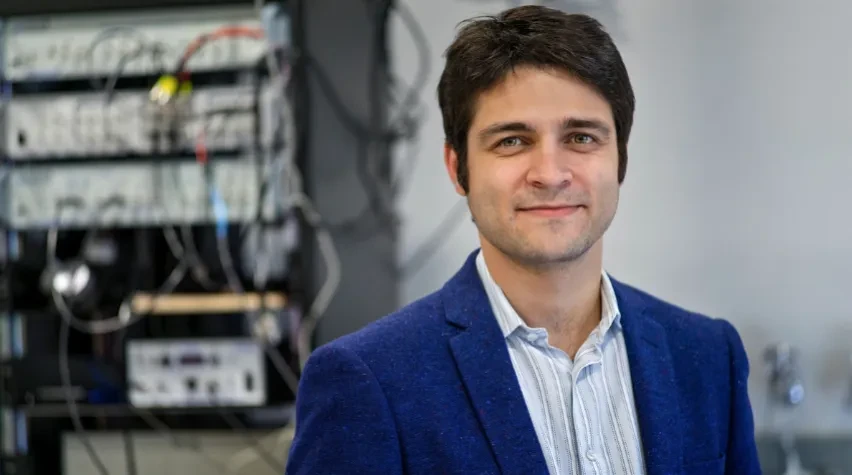
Figure | Mikhail Shapiro (Source: https://chenected.aiche.org/2019/03/mikhail-shapiro-on-engineering-biomedicines-interview)

Elon Musk has publicly expressed disdain for Altman’s brain-computer interface startup
Merge was not a stranger to the public eye; in August 2025, media outlets published comparative reports on Merge and Neuralink, Elon Musk’s brain-computer interface company. At the time, Musk responded to news about Merge Labs on X with an eye-roll emoji.
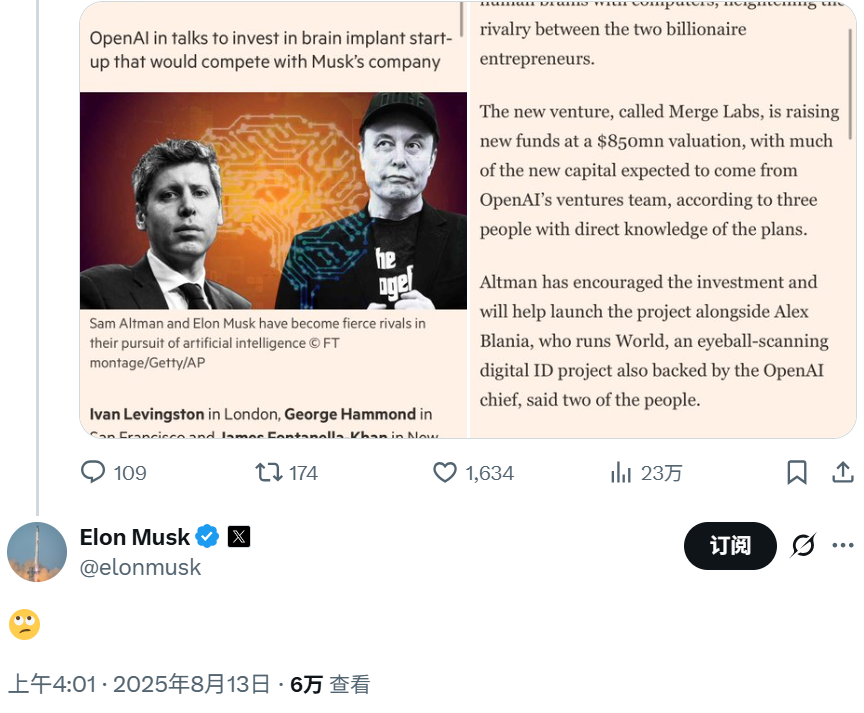
Figure | Musk's response on X to news about Merge in August 2025 (Source: https://x.com/elonmusk/status/1955359078512988231)
Within the next few weeks,Merge Corp. may make an official announcement regarding recent developments, including the recruitment of Shapiro and others. Altman is expected to serve as the company’s chairman but will not be involved in day-to-day operations.Shapiro’s official title at the company remains unclear. The Verge reported that sources revealed Shapiro would be a member of Merge’s founding team and had been identified as a key leader in negotiations with investors. These investment discussions are currently ongoing. According to earlier reports from the Financial Times, Merge is expected to secure $250 million in funding led by OpenAI, which would value the company at $850 million.
If this news is confirmed, it means that Merge Corp plans to use sound waves to read users' brains, and also indicates that it differs from Neuralink in thatMerge will adopt a non-invasive brain-computer interface approach combining “gene therapy + ultrasound.” In other words, Shapiro’s involvement largely reveals the technological direction that Altman has set for Merge.Altman has also recently stated publicly that he dislikes Neuralink’s invasive approach. At a media dinner, he remarked that he would never implant into his brain something like Neuralink’s device, which kills neurons.
In fact, beyond leading OpenAI, Altman has harbored ambitions across multiple technological fields. Years ago, he expressed his expectations for brain-computer interfaces. In a 2017 blog post, he stated, “A hot topic in Silicon Valley is the debate over the year in which humans and machines will merge (or, if no merger occurs, the year in which humans will be surpassed by rapidly improving AI or genetically enhanced species). Most predictions seem to center on the period between 2025 and 2075.” He also predicted in that same blog post: “Genetic enhancement will eventually emerge, as will brain-computer interfaces... We will become the first species in history to design our own offspring. My guess is that we will either serve as the biological bootloader for digital intelligence, gradually fading from the branches of the evolutionary tree, or we will figure out what successful integration looks like.”

Figure | Blog post written by Altman in 2017 (Source: https://blog.samaltman.com/the-merge)
Alex Blania, another co-founder of Merge, holds a master’s degree from the California Institute of Technology in the United States. Blania’s acquaintance with Altman was quite coincidental. After being rejected by Y Combinator, a U.S.-based startup incubator and investment firm, an investor noticed Blania’s Instagram posts. This led to Blania’s introduction to the investor, and subsequently to Altman. Together, Blania and Altman co-founded Merge. In interviews with the media, Blania stated that Merge aims to advance human brain development through non-invasive brain-computer interfaces. He noted that Neuralink, founded by Elon Musk, employs an invasive approach that destroys more neurons than it preserves.

Chosen by Ultraman or having once beenNatureandScience Publish Groundbreaking Results
As previously mentioned, Shapiro has published multiple papers in top-tier journals and is a prominent scholar in the field. He proposed a novel brain-computer interface method, claiming it to be significantly less invasive than Neuralink’s approach.
During his tenure at the California Institute of Technology, Shapiro focused on non-invasive techniques for neuroimaging and neuromodulation, with a particular emphasis on using ultrasound to interact with the human brain, thereby eliminating the need for craniotomy as required by Neuralink. Additionally, Shapiro has made significant contributions to gene therapy research, successfully employing ultrasound to detect cells. This achievement corroborates earlier Bloomberg reports that Merge is considering incorporating this approach into its inaugural product.
In his most recent speech, Shapiro discussed how to use sound waves and magnetic fields to create brain-computer interfaces. He said,Rather than inserting electrodes into brain tissue, it is preferable to introduce genes into cells to modify the brain tissue, thereby enabling it to respond to ultrasound.He stated that he has made it his mission to “develop less invasive methods for interfacing with neurons in the brain and cells in other parts of the body.”
Earlier, Shapiro had successively worked atNatureand Science He has published papers on genetics and non-invasive imaging, which have established his position in the industry.
In 2018, in aNature In the paper, Shapiro et al. introduced an acoustic reporter gene, describing it as a genetic construct that enables in vivo visualization of bacterial gene expression using ultrasound.
Ultrasound is a widely used, cost-effective technology that can penetrate deep tissues while offering high spatial resolution. The constructs in this study are based on gas vesicles, which are air-filled protein nanostructures expressed in aquatic photosynthetic organisms and serve as a means of buoyancy regulation.
Heterologous expression of engineered gene clusters encoding gas vesicles enables non-invasive imaging of Escherichia coli and Salmonella Typhimurium at a volumetric density below 0.01% with a resolution of no less than 100 μm.
In this achievement, Shapiro et al. demonstrated in vivo imaging of engineered cells in proof-of-concept models for gastrointestinal and tumor localization, and developed acoustically distinct reporter genes that enable multiplexed imaging of cell populations. This provides a method for visualizing microbial cells deep within mammalian hosts, thereby facilitating research on the mammalian microbiome and advancing the development of cell-based therapeutics.
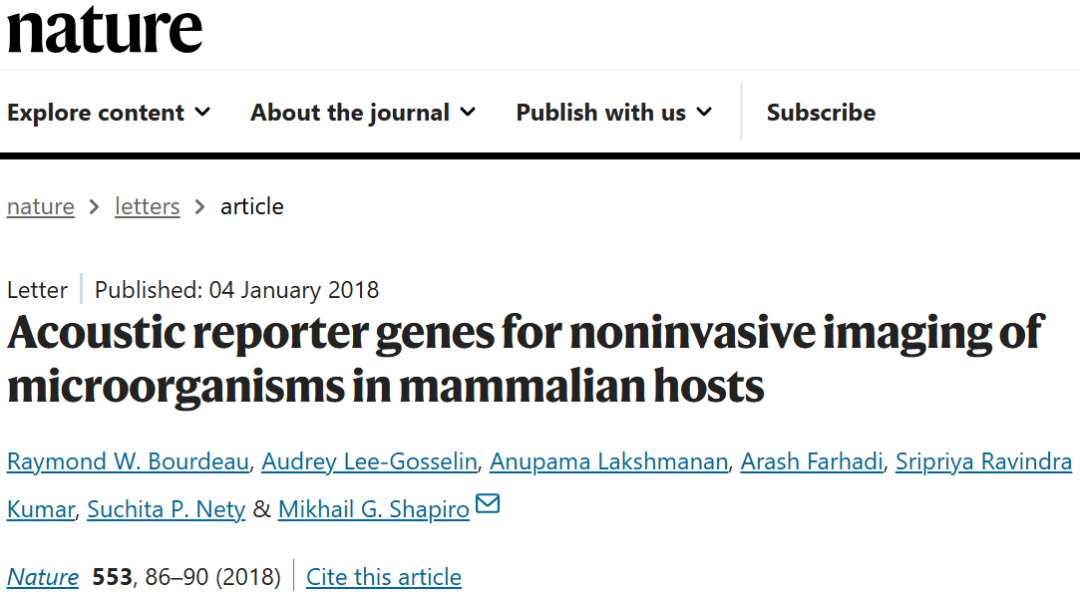
Figure | Related PapersNaturePaper (Source: https://www.nature.com/articles/nature25021)
In 2019, Shapiro and his team had previously ScienceA paper was published. At that time, genetically encoded molecular reporter genes could not link contrast-enhanced ultrasound to gene expression in mammalian cells. To overcome this limitation, Shapiro et al. introduced mammalian acoustic reporter genes. Starting with a bacterial gene cluster, they designed a eukaryotic genetic program and introduced it into mammalian cells, enabling the expression of intracellular gas-filled protein nanostructures that generate ultrasound contrast. This allowed mammalian acoustic reporter genes to visualize cells at volume fractions below 0.5% and achieve high-resolution imaging of gene expression in live animals.
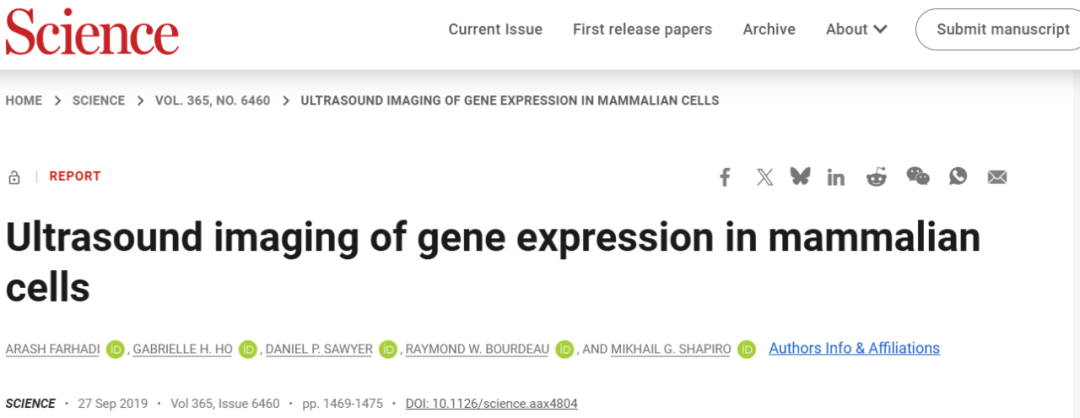
Figure | RelatedScience Paper (Source: https://www.science.org/doi/full/10.1126/science.aax4804)

The “Debate” Between Invasive and Non-Invasive Brain-Computer Interface Technologies
Thus, it is evident that Shapiro primarily focuses on non-invasive brain-computer interface (BCI) technology. BCI technology is generally categorized into three types: non-invasive, semi-invasive, and invasive.
For non-invasive,Wei Kecheng, founder of UBrain Galaxy, told DeepTech that the method involves wearing electrodes on the head to collect signals through the scalp, without requiring any surgery.
For semi-invasive,It also requires penetrating the brain, but not to a significant depth; electrodes are then implanted. Consequently, its signal reliability is superior to that of non-invasive methods, although it still suffers from poor spatial resolution.
For invasive procedures,The head of BrainCo told DeepTech that what Musk is doing is invasive technology, which requires drilling holes into the brain. The depth of these holes is generally a few centimeters, with a diameter of two to three centimeters. After implanting a chip with thousands of electrodes into the hole, it can record thousands of signals. Due to the extremely high electrode density, this is considered "an extraordinary engineering achievement." However, the number of neurons in the human brain is on the order of tens of billions, and collecting 1,000 signal points remain a drop in the bucket in terms of spatial resolution.
Overall, invasive technologies carry higher risks.Professor Wu Dongrui, Deputy Dean of the School of Artificial Intelligence and Automation at Huazhong University of Science and Technology, told DeepTech:“Implantable electrodes can trigger glial scarring, which leads to a significant degradation or even loss of signal quality. Therefore, they are not a permanent solution and may require repeated reimplantation.”Therefore, eliminating or mitigating the immune rejection response to electrodes is a critical consideration for the large-scale application of invasive brain-computer interface systems.
So, between the non-invasive technology advocated by Altman and the invasive technology adopted by Musk, which is more feasible and more popular? This not only concerns commercial success or failure but may also, to some extent, influence the form of human-AI symbiosis.

References:
1.https://mp.weixin.qq.com/s/Mmd6AS5Pk3dL69pj7wWSCw
https://blog.samaltman.com/the-merge
https://www.theverge.com/column/806666/sam-altman-merge-labs-brain-computer-interface-startup-hire
https://scholar.google.com/citations?user=W7ZMoJIAAAAJ&hl=en
https://www.nature.com/articles/nature25021
https://www.science.org/doi/full/10.1126/science.aax4804
https://www.linkedin.com/posts/alexeheath_altman-taps-leading-researcher-for-bci-startup-activity-7387641247265484800-ZRbq/
https://www.aol.com/openai-eyes-brain-implant-startup-095433905.html
Operations/Typesetting: He Chenlong