Synchron Secures $200 Million Series D Funding to Advance Stentrode Brain-Computer Interface Platform

Synchron
Developer of implantable neural interface products

Recently, the U.S. neurotechnology company SynchronAnnounced Completion $200 million (approximately RMB 1.4 billion) Series D financing round, led by Double Point Ventures, with participation from multiple renowned firms including ARCH Ventures, Khosla Ventures, and Bezos Expeditions.
This is one of the largest single-round financings in the Brain-Computer Interface (BCI) sector to date. The company stated that the funds from this round will be used to accelerate its core productStentrode Systemcommercialization process, including regulatory submission, manufacturing capacity building, and the development of next-generation high-channel brain-computer interfaces.
This announcement has drawn significant attention from the global medical device community. For a long time, brain-computer interface (BCI) technology remained largely confined to scientific research and neurological rehabilitation. However, Synchron’s pioneering entry into the clinical phase—characterized by implantability, mass producibility, and usability—marks the sector’s transition into a substantive period of industrialization.
# Company Profile
Synchron, founded in 2016 and headquartered in New York, isThe World's First Dedicated to"Endovascular" Brain-Computer Interfaceone of the medical device companies.
Unlike traditional BCIs that require craniotomy for electrode implantation, Synchron delivers an electrode array via a catheter through the jugular vein into the cerebral vasculature, deploying it on the vessel wall adjacent to the motor cortex to enable the acquisition and transmission of neural signals.
This innovation in non-craniotomy approaches gives its system significant advantages in safety, accessibility, and scalability, making it regarded as “a practical pathway for the clinical translation of brain-computer interfaces.”
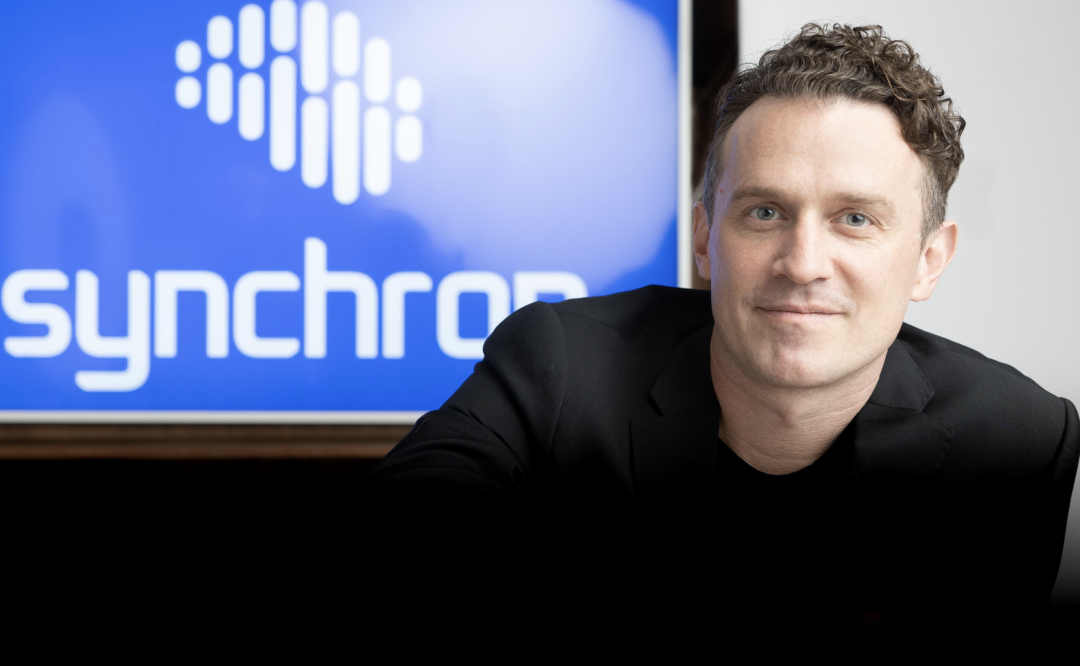
Dr. Tom Oxley, the company’s founder and CEO, is a neurointerventional specialist who has long been dedicated to decoding brain signals and translating neural implant technologies. His vision is: “Implant brain-computer interfaces like stents, rather than through open-craniotomy surgery.”
To date, Synchron has completed multiple clinical implantations in the United States and Australia, enabling participants to control computers and smart devices via brain signals to perform daily tasks such as sending text messages, shopping, and browsing the web.
# Product and Strategy Advancement
(1) Product Introduction | Stentrode System
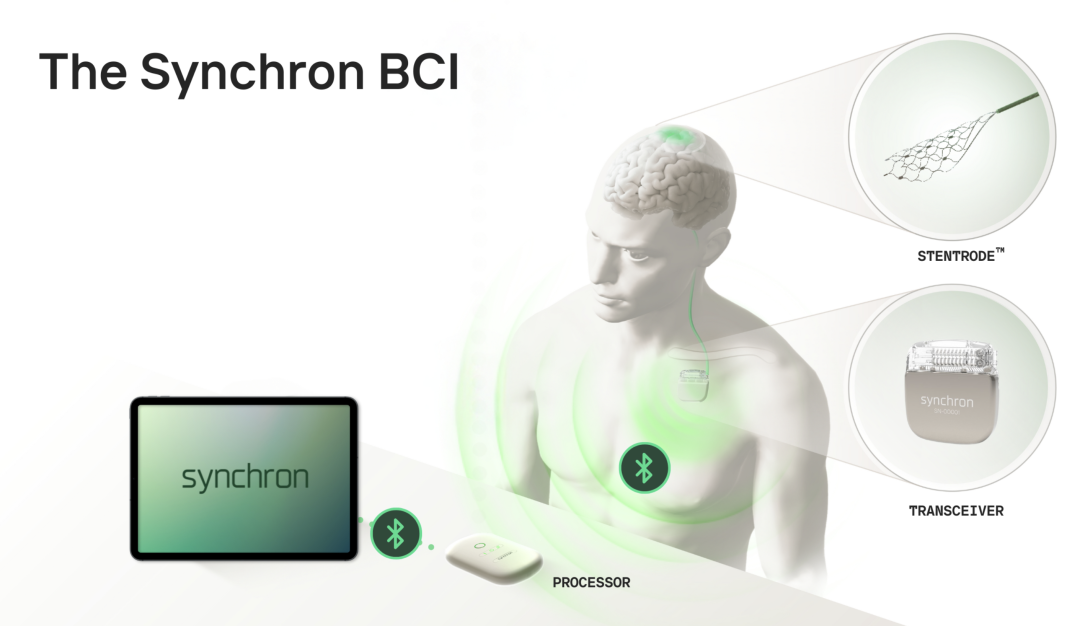
Synchron's Core ProductsStentrodeIt is the world’s first human brain-computer interface system capable of endovascular implantation. The entire system consists of three components:
Stentrode Electrode Array:Made of flexible nickel-titanium alloy, it is delivered via catheter into the jugular vein and deployed against the vessel wall near the brain’s motor cortex to enable electrical signal acquisition;
Cortick Communication Module:Implanted subcutaneously in the chest, wirelessly connected to the electrode array for signal amplification and data transmission;
BrainOS Decoding System:By leveraging AI algorithms to analyze electroencephalogram (EEG) signals in real time and convert them into control commands, users can operate computers, mobile devices, or prosthetic limbs using their "thoughts."
Its main technical features include:
Non-invasive Craniotomy: Transvascular implantation significantly reduces surgical risk and recovery time, and can be performed in an interventional catheterization laboratory.
Long-Term Stability: After the electrodes fuse with the vascular endothelium, a stable interface is formed, enabling long-term signal acquisition.
Strong Compatibility: Direct communication with the iOS system has been implemented, supporting operation on devices such as the iPad.
Real-time Bidirectional Communication: Possesses bidirectional capabilities for signal acquisition and stimulation, laying the foundation for future neuromodulation applications.
To date, the Stentrode has received the U.S. FDA’s “Breakthrough Device” designation and is currently undergoing clinical studies in the Early Feasibility Study (EFS) phase.
(2) Commercialization Pathway and Strategic Priorities
Synchron stated that this round of financing will focus on three key areas:
Accelerated Commercial Registration: Advance multicenter clinical studies in the U.S. and European markets, along with FDA submissions, aiming to achieve initial market access by 2026;
Establishing a Mass Production System: Simultaneously expanding manufacturing facilities in New York and Australia to transition from R&D-scale production to large-scale manufacturing;
Developing Next-Generation Products: Develop a “High-channel” brain interface system to enhance signal bandwidth and resolution, expanding its application to a broader range of neurological disorders.
Synchron’s long-term strategy is to expand its technology from “motor control” to “neuromodulation,” covering multiple disease areas such as aphasia, post-stroke cognitive impairment, and amyotrophic lateral sclerosis (ALS).
# Conclusion
Synchron’s $200 million financing round is not merely a standalone capital event, but ratherThe Landmark Milestone of the Brain-Computer Interface Industry Transitioning from the Technology Validation Phase to the Commercial Validation Phase。
Based on the past decade’s cycle of various BCI companies—“laboratory demonstrations–hype–clinical exploration”—Synchron’s model more closely aligns with the practical logic of medical devices: definable by regulators, usable by clinicians, and trusted by patients.
It has three levels of significance:
First,Path is replicable. The endovascular implantation approach significantly lowers the clinical threshold for brain-computer interfaces, bringing “neural decoding” truly into the operating room rather than remaining confined to the laboratory bench.
Second,The Scene Is ExpandingFrom mind-controlled operation in paralyzed patients to neuromodulation, cognitive rehabilitation, and treatment of mood disorders, the clinical boundaries of brain-computer interfaces (BCI) are being redefined.
Third,The Ecosystem Is Being ReconstructedBrain-computer interfaces are no longer isolated innovations but a full-stack industrial chain encompassing materials science, signal algorithms, clinical neuroscience, and device manufacturing.
Over the next year, Synchron’s clinical data, regulatory progress, and mass-production pace will become key indicators for observing the trajectory of the global neural interface industry.
As “brain-computer interfaces” transition from experimental prototypes to standardized products, they are not merely tools for reading brain activity, but also an integral part of the medical device ecosystemThe Next Definable Therapeutic Platform。
Recent Articles
The Era of Domestically Produced Medical Devices Has Arrived!
From Fragmentation to Symbiosis: Medtronic’s Systems Thinking at the CIIE
19 Major Highlights | Medical Device Exhibition Area at the 2025 CIIE
Global Medical Device Monitor
▌Capital Radar | Money Flow
Overseas Financing Events |Domestic Financing Events |Overseas Acquisition Cases |Domestic Acquisition Cases
Overseas Company IPO |Domestic Enterprise IPO |Foreign Corporate Financial Reports |Domestic Corporate Financial Reports
Exhibition Preview/Review/Roundup
Synchron Annual Event Review:The First Global Ophthalmology Conference | The First Global Orthopedics Congress | The First Global Cardiovascular Congress| The First Global Conference on Medical Aesthetics Technology |The 2nd Global Medical Technology Conference|The 3rd Global Surgical Robotics Conference
Content Statement:“Siyu MedTech” tracks global advancements in medical technology, aiming to disseminate knowledge on technology and industry. All content is provided solely for industry exchange and academic discussion and does not constitute medical advice or commercial promotion. Information regarding companies, products, and registrations mentioned herein is sourced from public materials or verified channels. Should there be any errors or omissions, please feel free to contact us for corrections. Email: jacky@suribot.com
Copyright Notice:“Siyu MedTech” original content is copyrighted by Beijing Siyu Bote Technology Co., Ltd. Unauthorized reproduction, excerpting, or mirroring to other websites, WeChat Official Accounts, or commercial platforms is prohibited. For reprint requests, please contact the backend to obtain authorization. This platform reserves the right to pursue legal action against unauthorized full-text reproduction, content spinning, or rewriting.