

Brain-Computer Interface Advances Clinical Adoption, Embodied Intelligence Moves Toward Personalization

Neuralink
Brain-Computer Interface System Developer

Strategy
Brain-Computer Interfaces Advance Clinical Applications; Embodied Intelligence Moves Toward Personalization
This Week's Top AI News
Event 1:On December 30, 2025, NVIDIA completed the $5 billion private placement announced in September, acquiring approximately a 4% stake in Intel at $23.28 per share and becoming one of Intel’s top ten shareholders. On the day the funds were disbursed, Intel’s stock price had already risen 50% above the subscription price, resulting in an unrealized gain of nearly $3 billion for NVIDIA. The two companies will also collaborate on multiple projects. A joint architecture team has already been established, with Intel customizing data center CPUs for NVIDIA using x86 plus NVLink technology and integrating RTX graphics chiplets into PC-level SoCs. The goal is to launch comprehensive AI system solutions simultaneously across the hyperscale, enterprise, and consumer segments.
Event 2:On December 31, 2025, American entrepreneur Elon Musk stated on social media that his brain-computer interface company, Neuralink, would begin “mass production” of its brain-computer interface devices in 2026 and shift to a “more streamlined and nearly fully automated surgical procedure.” Neuralink, founded by Elon Musk in 2016, is dedicated to developing high-bandwidth, minimally invasive brain-computer interface technology, aiming to help treat neurological disorders and ultimately achieve symbiosis between humans and AI.
Event 3:On December 31, 2025, the team led by Peng Zhihui, Chairman of Swancor Advanced Materials, unveiled Qi Yuan Q1, the world’s first “backpack-sized” whole-body force-controlled humanoid consumer robot. With a volume of only 1.88 cubic meters, it can be folded into a backpack and is designed for personal use, developers, scientific research, and companionship scenarios. By reengineering quasi-direct drive (QDD) joints, the device compresses force-control performance into egg-sized modules, enabling compliant interaction across all joints within a compact form factor. The open SDK/HDK supports 3D-printed enclosures and motion choreography, significantly reducing trial-and-error costs.
(Source: Sina Finance, Shanghai Securities News, etc.)
Weekly Views
AI Industry Chain Continues Evolutionary Trends, with Commercialization of Brain-Computer Interfaces and Small-Scale Robots
(1) This week, the global AI industry continued its momentum of full-chain advancement,Overall, the industry is accelerating the translation of AI value from technological exploration to practical application through the deep integration of capital synergy, technological innovation, and scenario-based implementation.
(2) In terms of computing power and infrastructure, the company continued to strengthen its full-stack AI capabilities through capital consolidation this week.NVIDIA is bolstering its production lines and patent portfolio through a $5 billion investment in Intel, while simultaneously strengthening its software segment by planning to acquire AI21 Labs’ core inference technologies and top talent for $2–3 billion. This move advances NVIDIA’s full-stack strategy of “hardware + software + applications” and may raise the global valuation benchmark for AI talent, forcing competitors to increase retention costs. Meanwhile, SoftBank has acquired DigitalBridge for $4 billion and cumulatively invested $41 billion in OpenAI. These actions not only consolidate OpenAI’s advantage as an industry giant in the global AI race and upgrade DigitalBridge into a self-owned, operable, and scalable heavy-asset platform, but also demonstrate SoftBank’s strategy of securing demand entry points and locking in the infrastructure dividends of next-generation artificial general intelligence (AGI) through intensive investments in leading computing power companies like OpenAI.
(3) At the technical level of models, both domestic and international efforts focus on the industrialization of cutting-edge technologies and the synergistic advancement of AI technology open-sourcing and commercialization.Overseas brain-computer interface (BCI) company Neuralink announced the mass production of BCI devices in 2026 and the advancement of their clinical application. This marks a critical milestone for the AI industry, representing key breakthroughs in data accumulation, interaction paradigms, supply chain expansion, and ethical standards, while simultaneously driving the deep evolution of AI towards closer integration with biological intelligence and human-machine symbiosis. In China, Alibaba open-sourced the MAI-UI mobile Agent foundation model, demonstrating the superiority of its model architecture over other full-scale GUI agent foundation models in three capabilities: "proactive interaction clarification, structured tool invocation, and device-cloud collaboration." Meanwhile, Moonshot AI completed financing to advance the commercialization of large language models and Agents, opting to postpone its IPO. By continuing to raise funds in the primary market to ensure technological investment, and entering niche markets with Agent products such as OKComputer, the company seeks a balance between model performance and commercial returns.
(4) At the application level, the focus is primarily on the personalized implementation of embodied intelligence and the expansion of AI-driven vertical consumer scenarios:In China, Swancor New Materials has launched the world’s first “backpack-sized” full-body force-controlled humanoid robot, Qiyuan Q1, achieving compact and compliant interaction while offering open interfaces to reduce R&D costs, thereby advancing embodied AI toward affordable personal adoption. Overseas, Silicon Valley startup Traini has secured over RMB 50 million in financing. Its multimodal AIPetGPT can accurately analyze pet emotions, and the company has partnered with veterinary hospitals to accelerate the development of AI-powered pet collars. This strategic move expands the boundaries of AI in vertical consumer scenarios, helping to establish a service chain in the smart pet market that integrates “emotional interaction” with “health management.”
(5) Overall, in the computing power segment, global AI industry giants such as NVIDIA and SoftBank leverage their capital advantages to dominate the allocation of core resources and steer industry development, continuously strengthening their full-stack layouts. In the model segment, development paths diverge between overseas and domestic markets: overseas markets prioritize the industrialization of frontier technologies, exemplified by breakthroughs in Neuralink’s brain-computer interface technology, while China balances the construction of open-source ecosystems with commercial implementation, as seen in the deepened industrial development of companies like Alibaba and Moonshot AI. In the application segment, there is a distinct trend toward deep penetration into vertical niche scenarios. Furthermore, new pathways for enterprise transformation and public listings are emerging; traditional enterprises can enter the AI sector through capital operations, albeit accompanied by risks associated with tightening regulatory oversight.
(6) The post-Spring Festival market volatility was pronounced, with the technology growth style—pursuing higher elasticity—outperforming. Given the competitive dynamics of capital flows, some investors positioned themselves early to gain a first-mover advantage as market participants deepened their understanding of the typical patterns associated with the spring rally. Currently, within the broader AI sector, many sub-segments remain at relatively low valuations due to limited short-term catalysts and insufficient accumulation of bullish narratives. Should unexpected positive industry developments occur in the future—such as new technological breakthroughs or hit products gaining mainstream traction—these could help build bullish narratives and consolidate investor consensus, thereby offering attractive risk-reward ratios for these related areas.
This Week's Recommended Reports
[Soochow Electronics] Leader in Memory Interface Chips, New Products Compete in AI Computing Power – Montage Technology (688008)
【Soochow Auto】2026 Strategy Report on Auto Parts: Deepening Globalization × AI Breakthrough, Auto Parts Industry Launches Second Growth Engine
[Soochow Media & Internet] Leader in Aesthetic Education, Building an “AI + Education” Ecosystem – Doushen Education (300010)
【Soochow Electronics】AI Infrastructure, Optical Board Copper Interconnects—A Comprehensive Analysis of Mainstream Compute Chip Scale-Up & Scale-Out Solutions for Optical & Copper
【Dongwu Electronics】Examining Edge AI Opportunities Through the Prospectuses of Zhipu AI and MiniMax
[Dongwu Computer] Meta Acquires Manus, a New Milestone for AI Agents
【Soochow Machinery】Overseas Order Fulfillment Pace Recovers, AIDC Secures Another Major Deal – Jinpan Technology (688676)
Risk Warning: The Federal Reserve's interest rate cuts fall short of expectations, and AI technology development falls short of expectations.
(Analysts: Chen Gang, Xie Lixin)

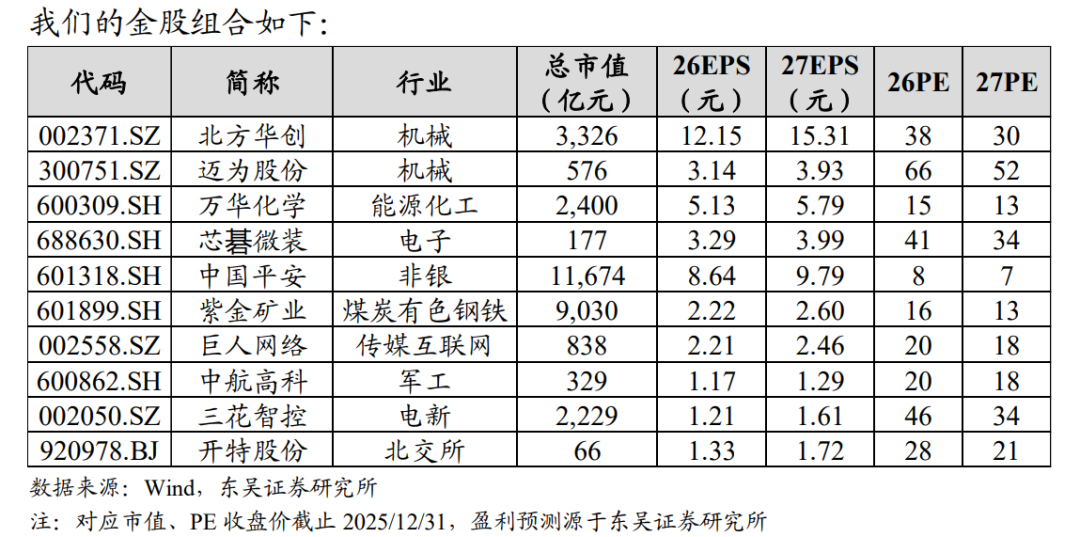
Latest Golden Stock Portfolio

Contact Directory for Institutional Sales, Soochow Securities Research Institute



Legal Statement
This official subscription account (WeChat ID: scsresearch) is legally established and independently operated by the Research Institute of Soochow Securities Co., Ltd. (hereinafter referred to as “Soochow Securities”). This subscription account is not a platform for releasing research findings from Soochow Securities’ Research Institute. All content featured in this account is sourced from research reports that have been officially published by the Research Institute of Soochow Securities. For detailed securities research information, please refer to the complete reports issued by the Research Institute of Soochow Securities. Under no circumstances shall the content presented in this account constitute investment advice to any individual or entity. Neither Soochow Securities nor its Research Institute shall bear any liability for any losses incurred by any party resulting from the use of the content provided in this subscription account. The copyright of all content featured in this subscription account belongs exclusively to the Research Institute of Soochow Securities. Soochow Securities and its Research Institute reserve all legal rights with respect to this subscription account. Subscribers are prohibited from reproducing or reposting any content (including text, images, videos, etc.) published on this subscription account without prior written permission. Where reproduction or reposting is authorized, the source must be clearly cited as “Research Institute of Soochow Securities,” and no quotation, abridgment, or modification of the content may be made in a manner contrary to its original intent.