250 Teams Enter the Fray: How the $100B Small Nucleic Acid Sector Can Win the 'Bottom-Layer Breakthrough'
Rigerna
Innovative Small Nucleic Acid Drug Developer
On one hand, more than 250 teams have flocked into the field, with clinical pipelines so numerous that tertiary hospitals are overwhelmed; on the other hand, extrahepatic delivery remains a persistent challenge, synthesis costs remain prohibitively high, and late-stage clinical failures occur frequently.
As the oligonucleotide therapeutic sector transitions from an “emerging hotspot” to an “industry standard,” the low-hanging fruits have been largely harvested. The outdated model, which relied solely on fast-follow strategies and pipeline padding, needs to be abandoned. The focal point of industry competition is quietly shifting from a “race for targets” to a hard-core breakthrough driven by “foundational technologies and differentiated clinical development.”
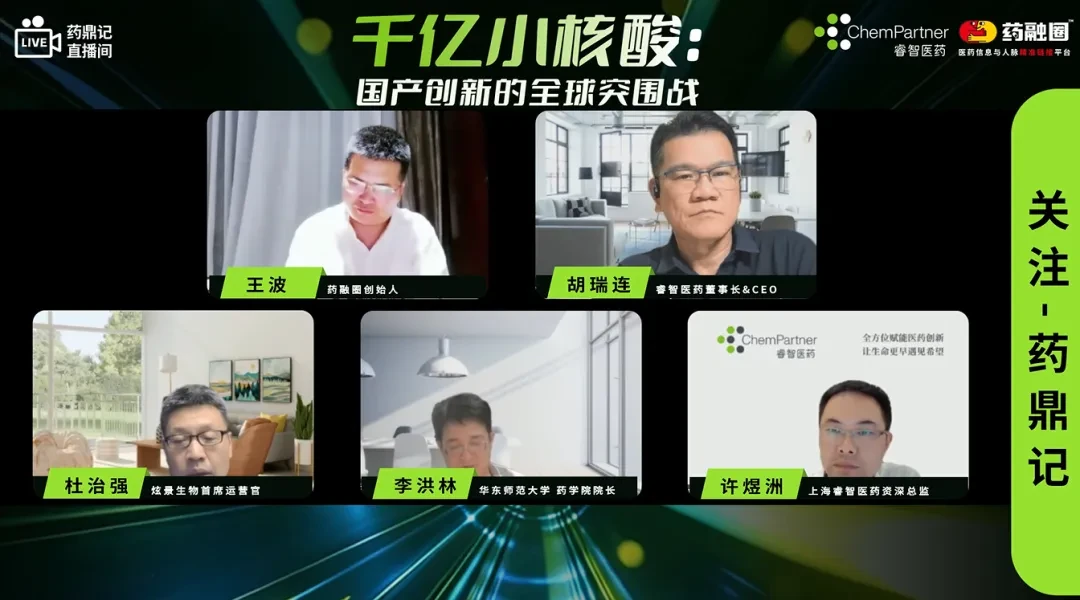
In this Yaorongquan live-streamed dialogue, Li Honglin, Dean of the School of Pharmacy at East China Normal University,RigernaChief Operating Officer Du Zhiqiang, Hu Ruilian, Chairman and CEO of Rigerna Pharma, and Xu Yuzhou, Senior Director at Shanghai Rigerna Pharma, explored the most authentic survival logic in the small nucleic acid sector.
“We have reduced the synthesis time for small nucleic acid nucleotide monomers from the traditional 8 hours to just 18 minutes, without the need for catalysts or alkaline reagents throughout the process, while decreasing the equivalent amount of DMT reagent by 15%–30%.”
The data set presented by Li Honglin, Dean of the School of Pharmacy at East China Normal University, directly addresses the biggest bottleneck in the industrialization of small nucleic acids—cost. Traditional small nucleic acid synthesis is time-consuming and requires large amounts of reagents, which directly drives up the final drug price. The key to breaking this deadlock lies in the original innovation from East China Normal University."Over-limit Manufacturing"Technology.
This is not a fine-tuning of traditional continuous-flow reactions, but a reconstruction of the underlying logic: utilizing femtosecond lasers to create three-dimensional micro-nano channels within a monolithic glass block, trading temporal scale for spatial scale to fundamentally reconstruct mass and heat transfer efficiency. Its core advantages are:
Ultimate Efficiency Enhancement: Reaction time reduced by over 90%, yield increased to 95%, and overall energy consumption decreased by 30%;
Digital Empowerment: Equipped with sensors and AI digital twin technology for precise temperature control, significantly reducing by-products;
Minimalist Scale-Up: From Kilogram to Ton-Scale Production with Minimal Process Changes, Avoiding the "Valley of Death" in Traditional Scale-Up.
This technology, which won first place in the Disruptive Technology Competition hosted by the China Association for Science and Technology, is not only applicable to nucleic acids but is also extending into peptide synthesis. Hu Ruilian, Chairman & CEO of ChemPartner, is highly optimistic about this development. He pointed out that nucleoside monomers are the core raw materials for small nucleic acid drugs.Over-limit ManufacturingThe core advantage lies in achieving technological system unity from the laboratory to commercial-scale mass production, which will bring fundamental cost reductions characterized by high speed and low cost to the entire industry.
“The future of small nucleic acid R&D should not be limited to a single delivery system or a single target; instead, it must integrate multi-platform, multi-target, and multi-delivery systems to truly benefit patients.”
RigernaChief Operating OfficerDu Zhiqiang’s statement pierces through the current impasse in delivery technology. While GalNAc-mediated hepatic delivery is mature, it has become a red ocean; extrahepatic delivery represents the true bottleneck, particularly renal targeting.
The challenge of kidney-targeted delivery lies in the diverse subtypes of renal tissue cells, each requiring a matched specific receptor-ligand pair.RigernaAfter four years of dedicated development, Rigerna has become the first company to complete proof-of-concept for renal delivery in mouse models and advance to non-human primate (NHP) cynomolgus monkey models, with its lead pipeline expected to submit an Investigational New Drug (IND) application by year-end.
However, breakthroughs in delivery technology by no means imply that a single approach will dominate the field.Senior Director, WuXi AppTecXu Yuzhou pointed out that new conjugation models such as AOC and POC are emerging as breakthroughs, theoretically capable of replicating the targeted delivery logic of ADCs to achieve tissue-specific targeting.
RigernaChief Operating OfficerDu Zhiqiang offered a cautionary perspective from the clinical standpoint: “Many previous new drug development efforts failed because, although they achieved target inhibition and effective delivery, they yielded only marginal clinical benefits. Given the complex pathogenesis of chronic diseases and the interplay of multiple signaling pathways, it is difficult to achieve breakthroughs with single-target or single-pathway approaches. The core of innovation lies in differentiated strategic positioning, rather than blindly following popular trends such as siRNA.”
“Major overseas CROs are scaling back their operations in the face of Chinese CROs’ high efficiency and cost advantages, while domestic CROs are intensifying efforts to provide one-stop, end-to-end services. In the future, this will culminate in comprehensive competitiveness that overshadows overseas CROs.”
Chairman and CEO of ChemPartnerAfter visiting the US and UK markets, Hu Ruilian reached this highly disruptive conclusion. In the past, some companies blindly piled up their pipelines to boost valuations and rush for IND approvals, resulting in preclinical data that could not withstand scrutiny.
Senior Director, Shanghai ChemPartnerXu Yuzhou summarized the most common pitfalls in current small nucleic acid drug development:
Insufficient Depth of Preclinical Studies: In China, some projects selectively conduct certain experimental procedures to accelerate timelines and control costs, resulting in insufficient breadth and rigor in preliminary data research, which easily lays hidden risks for the clinical stage; whereas overseas pharmaceutical companies place particular emphasis on preclinical basic research, which is also the core reason for the disparity in new drug success rates between domestic and international markets;
Disconnection in Industrial Chain Collaboration: From upstream nucleoside monomer synthesis and drug design, to midstream efficacy evaluation and CMC processes, and finally to downstream clinical trial applications, the lack of seamless integration across these stages hinders overall progress.
To avoid these pitfalls, fragmented contract manufacturing services are no longer sufficient; pharmaceutical companies require the intellectual empowerment and end-to-end closed-loop solutions provided by CROs.
This is precisely the rationale behind ChemPartner’s significant investment in oligonucleotide therapeutics and its focus on providing “one-stop, fully integrated” solutions. As an industry veteran with over two decades of deep expertise, ChemPartner strategically positioned itself in XDC and PROTAC technologies well before these concepts gained traction in China, and has to date facilitated the regulatory approval and market launch of 17 drug products in both China and the United States.Chairman & CEO of ChemPartnerHu Ruilian candidly stated:
“Rigerna has established a global R&D network with hubs in Shanghai, Boston, and the UK. Historically, 80% of its business has originated from overseas markets. Pharmaceutical companies choose Rigerna not only to eliminate the communication inefficiencies associated with managing multiple vendors, but also to benefit from end-to-end support spanning target identification to IND submission. Additionally, Rigerna helps domestic pharmaceutical companies connect with global business development (BD) resources and expand into international markets, thereby enhancing the success rate of new drug development.”
The oligonucleotide therapeutics sector is no longer a blind race to grab targets; instead, it has become a positional war centered on “cost reduction in foundational synthesis, precise extrahepatic delivery, and efficient end-to-end R&D.”
As overseas containment intensifies, Chinese innovative pharmaceutical companies must abandon low-level involution, exercise greater patience in R&D, resist impulsive bandwagoning, and leverage genuine differentiated clinical value to earn respect on the global stage.
In an era that demands core technological prowess, do not compete on how quickly you can follow trends. The depth of your foundational capabilities ultimately determines how far you can go.
September 4-5, Suzhou International Expo Center
See you at the 8th CMC Expo!

↑↑↑ Scan the QR code to register now ↑↑↑
(This article is compiled from the “Yaodingji × Yaorongquan” online live roundtable discussion)
WeChat Channels Playback Access