ViaLase Announces First Commercial FLIGHT Procedures for Incisionless Femtosecond Laser Glaucoma Treatment in Europe

ViaLase
Glaucoma Treatment Developer

Ophthalmic Medical Technology Company ViaLase recently announced that its FLIGHT Glaucoma Treatment ProcedureThe First Commercialized Procedures Completed in Europe, marking this “No Incision, Image-Guided, Femtosecond Laser"Interventional Glaucoma Technologies Officially Transition from Clinical Validation to Commercial Application."
Developed by ViaLaseViaLase Laser System, its core capability isCombining Femtosecond Laser with High-Precision OCT Imaging, enabling micrometer-level precise targeting and ablation of the target tissue. Based on this technological platform, the FLIGHT glaucoma treatment procedure is performed—using image-guided gonioscopic femtosecond laser to non-invasively remove specified portions of the trabecular meshwork and the inner wall of Schlemm’s canal, thereby establishing drainage channels within the trabecular meshwork to improve aqueous humor outflow.
According to ViaLase’s announcement, the first commercial FLIGHT procedures were performed at Centre for Sight in London, UK, and at Breyer, Kaymak & Klabe Augenchirurgie in Düsseldorf, Germany. Dr. Sheraz Daya and Dr. Gus Gazzard from Centre for Sight in London, along with Dr. Karsten Klabe from Breyer, Kaymak & Klabe Augenchirurgie in Germany, participated in performing these procedures.
# From MIGS to "Incisionless Intervention"
The core objectives of glaucoma treatment are to lower intraocular pressure and delay optic nerve damage and visual field progression. Current treatment pathways typically begin with eye drops, followed by selective laser trabeculoplasty (SLT), minimally invasive glaucoma surgery (MIGS), and finally filtering surgeries such as trabeculectomy.
This system is relatively mature, but there are still some long-term issues.
Pharmacological therapy requires long-term patient adherence; although selective laser trabeculoplasty (SLT) is a non-incisional treatment, its efficacy and duration vary among individuals; minimally invasive glaucoma surgery (MIGS) is less traumatic than traditional filtering surgery, but it remains an intraocular procedure, and many MIGS devices are often combined with cataract surgery.There remains an unmet therapeutic gap in clinical practice for a subset of patients who have not yet progressed to conventional surgery but seek to reduce their medication burden or achieve more stable intraocular pressure control.。
ViaLase is targeting precisely this gap in the market.
FLIGHT stands for Femtosecond Laser Image-Guided High-Precision Trabeculotomy, i.e., “Femtosecond Laser Image-Guided High-Precision Trabeculotomy.” Its core mechanism is not to “cauterize” or “stimulate” the trabecular meshwork tissue, but ratherEstablishing Microchannels in the Trabecular Meshwork Using the Photodisruption Effect of Femtosecond Laser, allowing aqueous humor in the anterior chamber to flow more directly into Schlemm's canal, thereby improving the conventional outflow pathway of aqueous humor.
Compared with conventional MIGS, FLIGHT does not require entry into the eye through a corneal incision, nor does it require the implantation of permanent devices.Therefore, ViaLase positions it as “Non-Invasive Interventional Glaucoma Treatment.”
# Femtosecond Laser with OCT Image Guidance
FLIGHT procedure by ViaLase'sViaLuxe Laser SystemCompleted. This systemCombining Femtosecond Laser with High-Resolution OCT Imaging, for observing the angle structures and performing precise treatment in the trabecular meshwork region.
From a technical perspective, the key to this system lies in introducing real-time imaging guidance and micrometer-level positioning at the anterior chamber angle—an anatomically complex site with high demands for visualization. For glaucoma surgery, the observation, localization, and operational stability of the anterior chamber angle structures directly impact treatment accuracy.
According to publicly available information from ViaLase, the ViaLuxe system assists physicians in identifying the trabecular meshwork and surrounding corneoscleral structures through high-definition gonioscopic imaging and OCT imaging, and establishes channels in the target area.The FLIGHT procedure can create channels approximately 500 microns wide and 200 microns high in the trabecular meshwork, covering an angular width of about 5 degrees., more akin to a "precision angle intervention under image guidance."
In July 2024, ViaLase announced that its ViaLase Laser had received the CE Mark in the European Union for the treatment of adult patients with primary open-angle glaucoma. In the U.S. market, the system is currently still in the clinical research phase. ViaLase had previously announced in December 2025 that the first patient had been treated in its U.S. Investigational Device Exemption (IDE) clinical trial.
# From Early Data to Localization Validation
During the initial phase of commercialization, the most concerning issues regarding FLIGHT remain the durability of efficacy, safety, and the boundaries of its indications.
Previously disclosed data from ViaLase cited the first-in-human study, which enrolled 18 eyes of 12 patients with open-angle glaucoma.
At the 24-month follow-up, the mean intraocular pressure decreased from a baseline of 22.3 ± 5.5 mmHg to 14.5 ± 2.6 mmHg, representing a 34.6% reduction; 82.3% of eyes achieved at least a 20% reduction in intraocular pressure.
Regarding safety, data indicateNo serious device-related adverse events occurred, immediately after the procedure, some eyes experienced mild bleeding that resolved spontaneously.
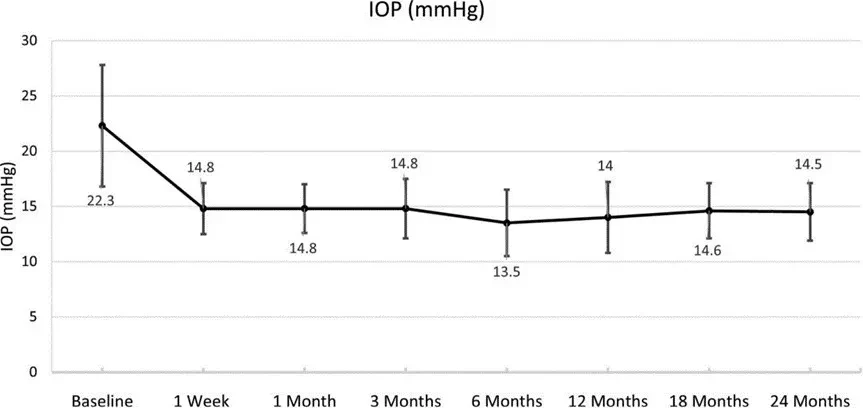
These preliminary data provide a foundation for technical feasibility but cannot replace larger-sample, randomized controlled, multicenter clinical studies. Particularly for chronic conditions such as glaucoma, therapeutic value depends not only on short-term intraocular pressure reduction but also on the duration of efficacy, the potential for retreatment, combinability with medications and other surgical modalities, and long-term safety.
This is also why ViaLase is advancing pivotal clinical trials in the United States with SLT as a control. The results of this study will directly influence futurePosition of FLIGHT in the Glaucoma Treatment Pathway: Is it ultimately a complementary option between SLT and MIGS, or could it potentially be shifted to an earlier stage of intervention?
# Implications for the Chinese Market
From the perspective of the Chinese market, glaucoma devices have long not been a commercialthe most dynamic sector. Compared with cataract intraocular lenses, refractive surgery equipment, fundus imaging devices, and dry eye diagnosis and treatment devices, glaucoma devices are more complex in terms of market awareness, physicians’ usage habits, reimbursement pathways, and patient education.
However, in recent years,New Stratification Emerging in Glaucoma Treatment Devices and Consumables。
One category comprises traditional diagnostic and follow-up devices, including tonometers, perimeters, optical coherence tomography (OCT) systems, and anterior chamber angle imaging devices;
One category comprises treatment-related devices and consumables, such as SLT, MIGS implants, and drainage devices.
An emerging new direction includes home-based intraocular pressure management, nocturnal intraocular pressure intervention, AI-assisted risk identification, and incision-free laser therapy.
The Metrics for Evaluating Product Value Are Changing: While lowering intraocular pressure remains the core objective, surgical invasiveness, earlier timing of intervention, reduction of long-term medication burden for patients, and operational convenience within clinical workflows are becoming equally important competitive dimensions.
# Eye Future Insights
ViaLase’s completion of the first batch of commercial FLIGHT procedures in Europe signals a trend:Interventional Therapy for Glaucoma Is Evolving Toward Greater Precision and Incision-Free Approaches. The applications of femtosecond laser have expanded from refractive surgery and cataract treatment to glaucoma angle therapy. Next, real-world commercial performance in Europe, IDE clinical trial results in the United States, physician learning curves, and reimbursement status will determine whether FLIGHT can transition from a "novel technology event" to a "routine clinical choice."

Ophthalmic Solutions Case Studies