

Dyno Therapeutics Secures $100M Series A Financing to Advance AI-Driven AAV Capsid Engineering for Next-Generation Gene Therapy

Dyno Therapeutics
Developer of Artificial Intelligence Gene Therapy Platform
was once referred to by Jack Ma asThe artificial intelligence that could “trigger a third world war” has now gradually permeated various industries. Keeping pace with the times, Dyno Therapeutics willArtificial Intelligence (AI) applied to the field of gene therapy. What kind of landscape will the integration of these two ultimately create?
Bill ·Gates once said,"Artificial intelligence and gene therapy are life-saving remedies." Dyno Therapeutics, through machine learning and quantitative high-throughput in vivo experiments, has engineered a modified...Adeno-associated virus (AAV) capsid protein. This method expands the scope of gene therapy.
``Recently``,Dyno announced the completion of a $100 million Series A financing round. This roundFinancing provided byLed by Andreessen Horowitz, with participation from Casdin Capital, GV, Obvious Ventures, Lux Capital, and founding investors Polaris Partners, CRV, and KdT Ventures. The proceeds from this financing will be used to expand the company's CapsidMap platform.
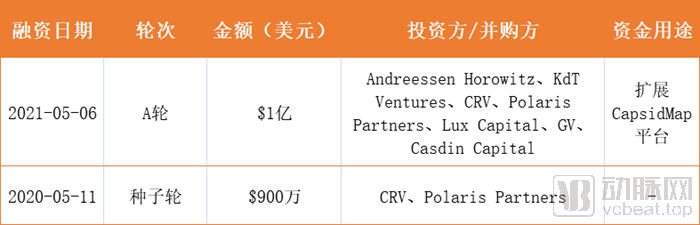
Dyno's seed funding round was by Polaris Partners andUS Venture Capital Firm Charles River Ventures(CRV)Co-investment, totaling$9 million.

AlthoughThe application of AAV vectors in the field of gene therapy has become highly widespread, yet significant limitations remain. Approximately 50% to 70% of the global population has pre-existing immunity to natural AAV vectors, which prevents the vast majority of patients from receiving AAV-based gene therapies. DynoThe goal is to overcomeThe immunogenicity of AAV vectors expands the scope of gene therapy.
In 2018,Harvard Medical School'sGeorge Church and his team partnered with original researchers from Sweden's Karolinska Institute and Lund University to co-found Dyno, jointly developing viral capsid engineering technology.
Except for Dr. George,Dyno’s scientific co-founders includeTomas Bjorklund, Eric Kelsic, Alan Crane, Adrian Veres, and Sam Sinai.
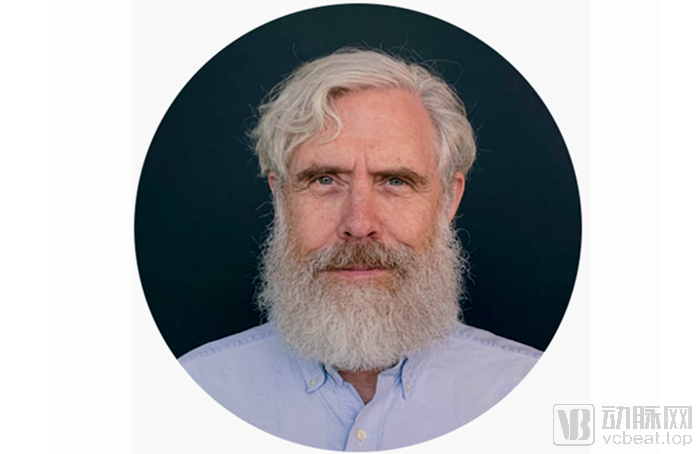
Image source: Dyno Therapeutics official website
GeorgeThe Ph.D. holds multiple identities: he is a Professor of Genetics at Harvard University, a dual member of the U.S. National Academy of Sciences and the National Academy of Engineering, and the Personal Genome ProjectChief Director of the (PGP), Member of the Inaugural Academic Advisory Committee of Alibaba "DAMO Academy", and Director of the Center for Genomics Research at Harvard Medical School.
GeorgeDr. is a pioneer in multiple biomedical fields, including genome sequencing, synthetic biology, and genome engineering, among others. He is hailed by the industry as“Titan of Genetics,” “Polymath Scientist,” “Socrates of Contemporary Genetic Engineering”......Beyond being a scientist, GeorgeDr. also founded approximately20 biotechnology companies.
“Curiosity” is a skill that every scientist unlocks. As a child, Dr. George would crush tablets into powder and dissolve them in water to compare the growth of tadpoles in medicated versus unmedicated water. He would also water plants with gibberellin solutions, attempting to make them grow faster and larger.
During his time at Duke University, Dr. George missed his other coursework to focus on the experiment "X-ray crystallographic study of the three-dimensional structure of transfer RNA," which resulted in him failing two courses and ultimately led to his expulsion from Duke University.
However, dropping out did not deter Dr. George's pursuit of scientific research. A year later, Dr. George applied to the Ph.D. program in Molecular Biology at Harvard University and was successfully admitted. From that point on, his research career began to steadily reach new heights.
To this day, Dr. George has already achieved numerous remarkable accomplishments, yet his curiosity remains undimmed. "Mammoth de-extinction," "canine rejuvenation experiments," "porcine organ transplantation"... one after another, these "visionary" studies have successively entered the public spotlight.
Dr. George has received numerous honors. In 2008, he was named one of the eight Science Heroes of the Year by the British magazine *New Scientist*. In 2011, Dr. George was awarded the Bower Award and the Franklin Institute Award for Science Achievement. Dr. George was also a leading candidate for the 2016 Nobel Prize in Chemistry.

AAV is currently the dominant force in the gene therapy field.Most recombinant [therapeutics] currently used in clinical practiceAAV capsids are closely related, or even identical, to natural AAVs in amino acid sequence and biological properties. Such naturally selected capsids exhibit limited cell-targeting specificity and low in vivo transduction efficiency in many target tissues, particularly following intravenous administration. This is primarily because the capsids have not been optimized for therapeutic applications.
For native AAV capsids, their inherent immunogenicity can impact therapeutic safety and efficacy. Furthermore, pre-existing humoral and cellular immunity in patients may also limit treatment options and therapeutic efficacy.
To overcome these challenges, scientists have embarked on their“The Capsid Engineering Journey.” Currently, approaches to developing novel capsids include mining naturally occurring sequence diversity, rational design, and directed evolution. However, given the vast number of potential capsid variants, the screening capacity of existing methods falls far short of market demand, resulting in slow discovery rates and limited yields.
After extensive research, machine learning (ML) offers Dyno Therapeutics a promising new option. ML can be integrated with established methodologies, or directly employed as a standalone technology, to open new avenues for discovery through high-throughput in vivo screening.
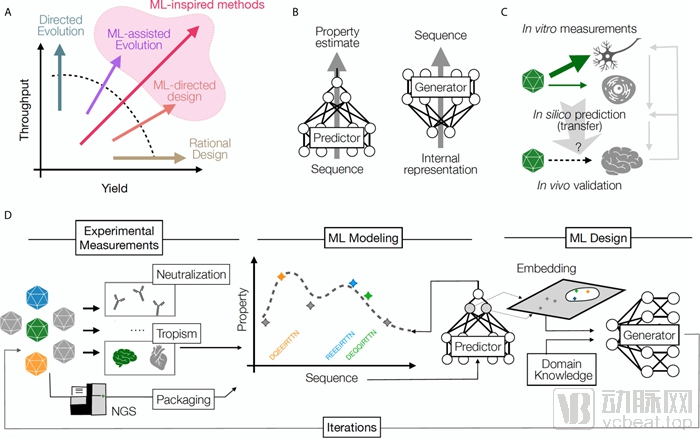
Image source: Official website of Frontiers in Immunology (hereinafter referred to as Figure 1)
Figure 1 illustrates the methodological process of viral capsid engineering technology.
The first step in viral capsid engineering technology is to compare the throughput (number of samples) and yield (number of successful samples generated per run) of various protein design methods,i.e., FigurePanel A in Figure 1. ML methods increase the likelihood of success for this technology by balancing yield and throughput. Rational design can improve yield, while directed evolution can enhance throughput.
Part B indicates passage throughPredictionLeveraging machine learning models, scientists mapped capsid sequences to their functional properties and subsequently developed a method. This method converts latent representations into capsid sequences to generate desired samples.
About the FigureIn Part C of 1, an example of "a model transferring information across different cell types and experimental environments" is provided to illustrate this. A model trained on in vitro capsid performance from transduction experiments across various cell types (including neurons) is subsequently used to predict in vivo transduction outcomes in brain neurons when experimental data are scarce or missing.
In vivo validation data for predicted capsids are used to refine model performance and elucidate the relationship between in vivo and in vitro assays. The gray arrow on the right in Panel C illustrates the iterative nature of this approach, which continuously refines the predictive and generative models over time.
Section D covers the design cycle. The design cycle begins with high-throughput screening and the measurement of several AAV capsid variant properties. These attributes are used to train predictive models, which can infer properties for unknown sequences (predictor models) and contribute to building informative representations (embeddings). These are then integrated with auxiliary inputs (such as domain knowledge) to propose a batch of new sequences (generator model). The entire design process can be iterated multiple times until the desired capsid is identified.
Dyno has developed an AI-based CapsidMap platform, whichThrough optimizationThe cell-targeting protein capsid of AAV vectors overcomes the limitations of gene therapies currently on the market.
The workflow of the CapsidMap platform is primarily divided into two phases. First,Through next-generation# DNA DocumentLibrary Synthesis andDNA sequencing is used to measure the high-throughput characteristics of capsids. Following the generation of extensive in vivo data,,CapsidMap can employ advanced search algorithms and leverage ML methods to generate optimized capsid sequences.
InWith the assistance of machine learning, researchers at Dyno TherapeuticsLeveraging neural networks inBy designing selective mutation sites at 28 amino acid positions, 110,689 viable AAV2 capsid variants were identified.

In May 2020, alongside the launch of the CapsidMap platform, Dyno announced a collaboration with NovartisandSarepta Therapeutics respectively entered into collaboration agreements.
According to the terms of the agreement, Dynowill be conducted viaDyno leverages ML technology to tailor novel AAV vectors for the two companies' experimental gene therapies, while Novartis and Sarepta will independently conduct all preclinical and clinical studies.revealed that these two partnerships are expected to bring the company over$2 billion in funding.
This collaboration between Dyno and Novartis primarily leverages the DynoCapsidMap artificial intelligence platform and Novartis’s expertise in gene therapy development and global commercialization to deliver novel gene therapies for patients with severe ocular diseases. Under the terms of the agreement, Dyno will receive upfront research funding and licensing fees, clinical, regulatory, and sales milestone payments, as well as royalties on net sales of commercial products.
The collaboration between Sarepta and Dyno utilizes the CapsidMap platform to jointly develop novel AAV vectors for the treatment of muscle diseases. According to the collaboration agreement, Dyno willObtain$40 million in upfront and licensing payments.IfSarepta will develop and commercialize multiple drug candidates, and Dyno will also receive additional milestone payments.
In October 2020, Dyne and Roche and its subsidiary Spark Therapeuticsreached an agreement valued atUnder an $1.8 billion collaboration agreement, they will jointly develop gene therapies for central nervous system (CNS) diseases and liver-targeted delivery.
Pursuant to the terms of the agreement,Dyno will be responsible for designing novel AAV capsids capable of improving the functional characteristics of gene therapies, while Roche and Spark will be responsible for using the novel capsids to conduct preclinical trials, clinical trials, and later-stage development of candidate gene therapies.Promotional campaign.Dyno will receive upfront and milestone payments, as well as royalties on sales of any collaborative product.
These three landmark collaborations, which haveBoston MediaXconomy on DyneThe company was namedthe title of "2020 Startup of the Year".
April 2021,Harvard Medical School'sDr. Debora Marksand the University of California, San Francisco'sDr. Nicole Paulk has joined the Scientific Advisory Board of Dyne.
Dynecompany'sCEO Eric Kelsic stated: "In the combined application of machine learning and protein structure, Debora for DynoThe company has provided many unique insights. WhileNicole possesses extensive expertise in AAV gene therapy research, development, and manufacturing.。"Their addition also brought constructive support to Dyno Therapeutics."

Regarding Dyno Therapeutics' viral capsid engineering technology, some praise its uniqueness, while others express skepticism.
Massachusetts Eye and EarLuk Vandenberghe, Director of the Gene Therapy Center, once commented in *Chemical & Engineering News*: “Viral capsid engineering technology is a remarkable masterpiece.”
However, this scientist, who praised the viral capsid engineering technology, nonetheless expressed reservations regarding DynoHolds reservations regarding whether the company can succeed.Dr. Luk has previously endured a painful failure in viral capsid engineering, leaving him fully aware of the immense difficulties and complexities inherent in this technology.
Dr. Luk stated: "This field remains notably limited in its capacity to develop vectors capable of carrying large transgenes and evading neutralizing antibodies." Meanwhile, leveraging AI to engineer and optimize AAV capsid proteins requires substantial domain knowledge and technical expertise.
Francois Vigneault, CEO of gene therapy startup Shape Therapeutics, contends: "What Dyno is doing now is novel, but in five years, all companies will be able to do it."
Despite widespread external skepticism, it is undeniable that solely based onA CapsidMap platform, justLetDyne, Courted by Industry Giants Including Sarepta, Novartis, and RocheThe company undoubtedly has its distinctive strengths. AlthoughDyno has not yet established its own therapeutic pipeline.
Besides Dynocompany, other companies are also attempting to design newAAV. In early May this year, gene technology company Affinia Therapeutics completed a $110 million Series B financing round to further develop its gene therapy platform. Meanwhile,In April of last year, Affinia and Vertex Pharmaceuticals entered into a partnership valued at up to $1.6 billion.