

GE Healthcare China and the Imaging Technology Branch of Chinese Medical Association Sign Three-Year Strategic Cooperation Agreement

GE Healthcare
Digital Solution Provider
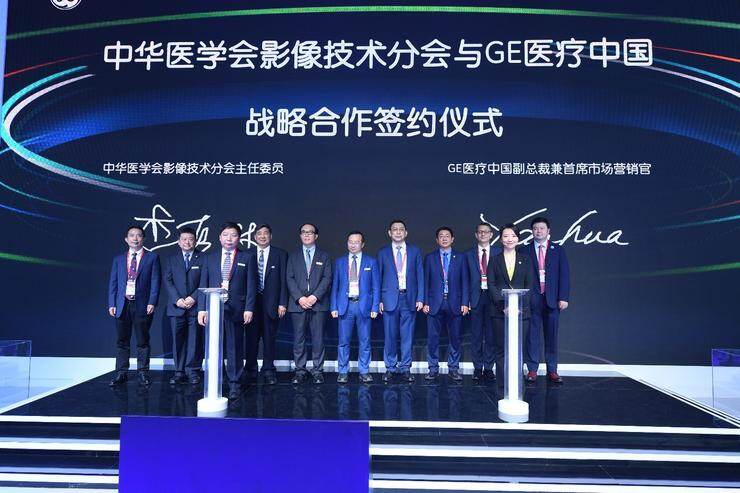
Recently, at the 84th China International Medical Equipment Fair (CMEF), GE Healthcare and the Branch of Radiological Technology, Chinese Medical Association (hereinafter referred to as the "Association") signed a three-year strategic cooperation agreement. According to the agreement, both parties will engage in in-depth cooperation across four key areas: talent development and leadership empowerment for imaging technologists, the construction of a broader-coverage online continuing education platform, specialized capacity building focused on the operation of core imaging equipment such as CT and MRI and the standardization of clinical scanning protocols, and the formulation of an expert consensus on the standardization of after-sales services. Through a pragmatic, efficient, and constructive collaborative implementation plan, both parties will work together to contribute to the high-quality development of the healthcare industry and the quality control of clinical medical imaging services during the 14th Five-Year Plan period.
According to statistical data publicly released by the China Association of Medical Equipment, the installed base of medical imaging equipment such as CT, MRI, and angiography systems in the Chinese market has maintained rapid growth over the past five years, with the compound annual growth rate (CAGR) of the installed base for MRI equipment exceeding 15% and that for CT equipment reaching 16.1%.
At the outset of the 14th Five-Year Plan, driven by public health and epidemic prevention requirements, the demand for upgrading imaging examinations in fever clinics and enhancing imaging capabilities at primary healthcare institutions has become increasingly prominent. Along with the further deployment of medical imaging equipment and infrastructure, the need for talent development, capacity building, quality control, and related areas has also grown significantly.
Professor Li Zhenlin, Chairman of the Imaging Technology Branch of the Chinese Medical Association, Director of the Department of Imaging Technology at West China School of Clinical Medicine, Sichuan University, and Deputy Director of the Department of Radiology at West China Hospital, has for years been dedicated to the training and capacity building of imaging technologists through various innovative models and multi-stakeholder collaboration. He believes that hospital-based imaging technologists serve as the vanguard of modern medical imaging examinations, and their professional competence directly determines the quality of disease diagnosis. "Precision medicine, imaging first; precision imaging, technology first." Integrating imaging technology with clinical diagnosis to better serve clinical practice and patients is a long-term mission that demands sustained commitment.
This strategic partnership between GE HealthCare and the Chinese Society of Radiological Technology is precisely anchored in these most pressing current realities and needs. By leveraging the experience and expertise accumulated since the implementation of GE HealthCare’s development strategy of comprehensive production in China, digital empowerment, and win-win cooperation, the collaboration aims to advance imaging technology by focusing on the critical elements of "personnel" and "quality control".
Under the agreement, GE Healthcare will collaborate with the association to jointly establish a three-pillar talent development program, including: the “Medical Imaging Technologist Empowerment Academy,” delivered through an offline, closed-door learning format and featuring a three-year, phased curriculum designed to enhance the leadership and management capabilities of imaging physician teams and promote professional exchange; the development of the “Medical Imaging Physician Online Training Platform” to conduct continuous learning and exchange activities via online study and sharing; and targeted capacity-building collaborations. These will involve the irregular organization of expert training sessions, equipment technical skill competitions, and standardized clinical scanning training programs for imaging physicians at hospitals of all levels, focusing on the operation and technical application of core imaging equipment such as CT and MRI. Through this long-term, multi-dimensional program, the close integration of imaging technology and clinical diagnosis will be continuously fostered, thereby elevating the overall clinical and research proficiency of medical imaging physicians in China.
Yan Hua, Vice President and Chief Marketing Officer of GE Healthcare China, stated: “Talent development is the cornerstone of sustainable growth in any industry, and it is particularly critical in the healthcare sector. Over the years, GE Healthcare has consistently fostered multi-party collaborations, leveraging digital technologies to empower talent development and advance grassroots healthcare. With the signing of this strategic partnership with the Imaging Technology Branch of the Chinese Medical Association, we are confident that by combining our expertise and investments across multiple domains—including expert guidance, technical equipment, online platform resources, and elite training program design—we will elevate the career development of a broader range of imaging physicians to a new level. By focusing on ‘people’ as the core element, we will effectively propel the Healthy China Initiative forward.”
The strategic partnership signed on this occasion also includes collaborating with the association's experts to advance the expert consensus on original manufacturer services for GE HealthCare CT and MRI equipment, fully supporting the improvement of quality control standards in primary healthcare. Concurrently with the signing of the strategic agreement, the association and GE HealthCare jointly released《Expert Consensus on OEM After-Sales Service for GE HealthCare 3.0T Magnetic Resonance Imaging Systems》(hereinafter referred to as the "3.0T Consensus"), standardizes equipment repair, predictive maintenance, preventive maintenance, acceptance testing, relocation, functional expansion throughout the equipment lifecycle, clinical applications, and after-sales quality control services for scientific research, to expand coverage to primary hospitals, enhance the effectiveness of clinical applications from a quality control perspective, and improve scan image quality.
In June 2020, the Imaging Technology Branch of the Chinese Medical Association, frontline clinical professionals from over 50 hospitals in China, and GE Healthcare jointly compiled and released the 《Expert Consensus on Original Manufacturer After-Sales Service for GE 1.5T Magnetic Resonance Imaging Systems》, implementing strict quality control over more than 100 indicators for MRI system after-sales services. At the 2020 China International Import Expo (CIIE), 100 hospitals that continuously studied the “1.5T MRI Consensus” and achieved gold-standard images were jointly designated as “Gold Standard” Service Bases by the association and GE Healthcare. These hospitals have become regional leaders in imaging technology, extending their influence to surrounding areas to disseminate high-quality imaging and scanning techniques, while enforcing rigorous quality control starting from the image acquisition stage.
Building on the successful promotion of the 1.5T MRI consensus, the association and GE Healthcare have initiated the development of the 3.0T MRI consensus. Compared to 1.5T systems, 3.0T MRI is utilized not only for clinical applications but also carries immense research value. Its precise quantitative imaging facilitates the early detection of major human diseases, including cardiovascular and cerebrovascular conditions, cancers, and neurological disorders. Beyond the shortage of imaging physicians and engineers, the technical complexity is substantially greater. Each scan involves the adjustment of dozens of parameters, while imaging quality control and spectral calibration encompass numerous performance metrics. This necessitates highly experienced technologists to continuously ensure that the system meets the manufacturer's designed performance specifications, thereby satisfying clinical requirements and advancing research initiatives.
The newly released “3.0T Consensus” implements “dual control” over both clinical application standards and quality control protocols for the equipment., ensures the imaging quality, accuracy, and stability of clinical and research equipment, and is also of significant importance for the safe operation of the system——In clinical practice, the consensus specifies standard scanning parameters such as matrix size, number of slices, and scan time for 26 scanning sequences across five anatomical regions (head, abdomen, male pelvis, knee joint, and breast) on 3.0T MRI equipment; in terms of quality control, 《3.0T Consensus》 standardizes eight quality and safety standards, including magnetic field homogeneity parameters, cooling system parameters, eddy current calibration parameters, noise, and signal-to-noise ratio.
Zheng Jieming, Vice President of GE Healthcare China and General Manager of After-Sales Service, stated: “The core and sole objective of standardization is quality control. By implementing strict quality control from the very source of image scanning, we aim to drive improvements in the quality of basic medical services. Over the past year, the ‘MRI Standardization Nationwide Tour,’ launched by GE Healthcare and the Imaging Technology Branch of the Chinese Medical Association, has reached over 5,000 technicians through online and offline lectures and training, and established more than 180 gold-standard demonstration/training bases. Today, the release of 《3.0T Consensus》 marks the beginning of a new chapter in the collaboration between GE Healthcare and the association.”
Leiphone(WeChat Official Account: Leiphone)Leiphone
This article is copyrighted by Leiphone. Unauthorized reproduction is strictly prohibited. For details, please seeReprint Guidelines。