Sanofi Signs Agreement with Beijing ETDZ to Expand Insulin Production Capacity

Sanofi
Pharmaceutical R&D Developer
China.org.cn Finance, June 8 (Reporter: Du Ding) Recently, at the "Signing Ceremony for the Insulin Capacity Expansion Project at Sanofi's Beijing Production Base and the 25th Anniversary Celebration of the Beijing Plant," the Administrative Committee of the Beijing Economic-Technological Development Area and Sanofi officially signed the agreement for the insulin capacity expansion project at Sanofi's Beijing production base.
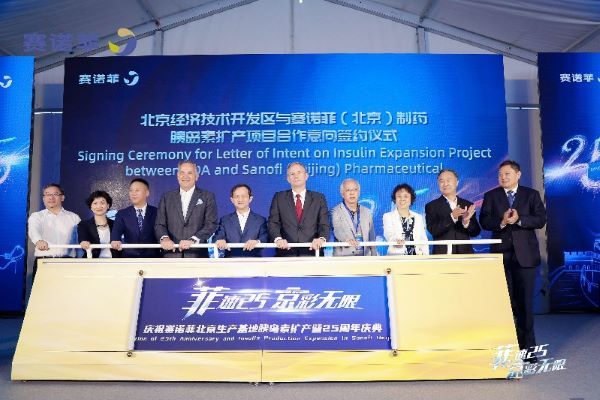
Yin Yong, member of the Standing Committee of the CPC Beijing Municipal Committee and Vice Mayor of Beijing, and Mr. Laurent Bili, French Ambassador to China, attended and witnessed the signing ceremony. Vice Mayor Yin stated that Beijing welcomes leading global healthcare enterprises, including Sanofi, to seize the opportunities presented by the development of Beijing's "Two Zones", make full use of the policy dividends from pilot initiatives, and introduce more advanced medical and healthcare products and services to China.
Ambassador Luo Liang expressed his delight at the strengths and long-standing partnership between China and France in the pharmaceutical and healthcare sector. He remarked, “Sanofi's history in China is the finest example of the enduring partnership between our two countries.”
“As a leader in the field of chronic disease management, Sanofi, leveraging a century of experience and robust resources in this domain, remains steadfastly committed to driving innovation in medicines and disease solutions,” stated Dr. Pius S. Hornstein (PhD), President of Sanofi Greater China. He noted that this expansion of insulin production capacity is one of the initiatives to strengthen Sanofi’s overall strategic presence in China.
According to records, in December 1995, Sanofi's Beijing production base was officially established in the Beijing Economic-Technological Development Area. Following 25 years of continuous investment, capacity expansion, and upgrades, the facility now operates world-class insulin production lines, including a state-of-the-art insulin glargine injection filling line, fully meeting the glycemic control requirements and medication safety needs of diabetes patients in China. Last year, Sanofi announced an additional investment of RMB 200 million to launch a new insulin glargine injection formulation production line (the Toujeo project). Upon completion, the manufactured products will not only supply the Chinese market but also be exported to Australia, Japan, and other Asia-Pacific regions.
In addition, with continued investment and expansion, the Beijing production site will further meet the manufacturing needs for the upcoming innovative insulin products in Sanofi China's diabetes pipeline.
Zhang Ping, Head of Industrial Affairs for Sanofi China, stated, "As one of the first multinational pharmaceutical companies to enter the Chinese market, the Sanofi Beijing production facility is currently being designed and expanded to the highest global standards. While ensuring drug quality and quality throughout the product lifecycle, we are also committed to improving access to innovative medicines and solutions by delivering high-quality products."
——Interview: Sanofi Emphasizes Localized Production
Zhang Ping, Head of the Industrial Affairs Department, Sanofi China
He Guoling, General Manager and Plant Manager, Sanofi Beijing Pharmaceuticals
China.org.cn Finance: Mr. He, Sanofi's Beijing manufacturing facility has been operating in China for 25 years. As a long-serving employee, could you please share the changes over these 25 years?
He Guoling: I joined Sanofi in 1996 and came to the Beijing plant in 2001. When I arrived, the facility had no products and was in the phase of product introduction. In 2003, our first product involved the secondary packaging of a widely used oral antidiabetic medication—Amaryl (glimepiride tablets). Staffing was very lean at the time; our production workshop operated with just six people, and the entire plant, including myself, comprised only 23 employees. With this small team, we gradually built our operations from scratch, expanding in tandem with the rapid development of China's pharmaceutical industry. Since 2010, Sanofi has continuously made additional investments in the Beijing plant, and to date, we have completed three consecutive rounds of investment.
China.org.cn Finance: What are the respective investment amounts for the three rounds?
`He Guoling`: In 2010, we invested €27.2 million, primarily to construct a Lantus manufacturing facility, while also expanding the entire plant and building a secondary packaging workshop, enabling imported Lantus to be packaged at the Beijing facility. In 2012, we made a second-phase investment of over €23 million to establish a Lantus filling production line, which was put into operation in 2020, successfully achieving the local manufacturing of Lantus. In 2019, we initiated another investment—the Toujeo project—investing RMB 200 million to establish a Toujeo secondary packaging production line.
Sanofi's investment philosophy is rather unique. We place a strong emphasis on localized production, providing patients with an end-to-end service—comprehensive support from start to finish.
China.org.cn Finance: After 25 years, what proportion of our products are currently manufactured in-house at our Beijing production facility?
He Guoling: The Beijing plant currently manufactures 4 products, 3 of which are solid dosage forms: Amaryl, Tritace, and Essentiale; and one additional product, Lantus.
China.org.cn Finance:The combined volume across these factories is still quite substantial. Would it be feasible to localize the supply in China?
Zhang Ping: For our products, packaging materials that do not directly contact the product are fully procured domestically; however, we have not yet made significant progress with those that do come into direct contact with the product. First, the quality of domestic auxiliary materials still requires further improvement and lags behind international standards. Therefore, to ensure product quality, we are proceeding rather cautiously with this initiative at present.
China.org.cn Finance:With national volume-based procurement and national medical insurance negotiations now normalized, and centralized procurement fully institutionalized, how will our manufacturing capacity and overall strategic layout in China be arranged under these circumstances?
Zhang Ping:On one hand, we are actively aligning with the national centralized procurement policy while building up our own product pipeline and manufacturing capacity. As a multinational enterprise, we leverage our inherent advantages, including robust support from our global headquarters and a network of multiple production facilities. At the same time, we are committed to actively introducing new products. Over the next five years, we plan to launch more than 20 products, with approximately five to six new products reaching the market each year. This outlines the future strategic direction for multinational companies in China. Rather than merely promoting existing offerings in an era increasingly saturated with generics, our core focus remains on continuously bringing innovative new products to the Chinese market. This is exactly what we are doing today.