

SynCardia Files for IPO: The Global Leader in FDA-Approved Total Artificial Hearts Sets Sights on Expanding Access in China

SynCardia Systems
Total Artificial Heart Manufacturer and Supplier
For patients with end-stage heart failure, heart transplantation is the optimal treatment, but human donor hearts are in short supply.
According to the *Report on Cardiovascular Health and Diseases in China 2019*, it is conservatively estimated that there are approximately 4 million patients with chronic heart failure in China. Meanwhile, the 35 heart transplant centers in China (excluding Hong Kong, Macao, and Taiwan) performed a total of 1,583 heart transplant procedures between 2015 and 2018. The number of patients receiving heart transplants is far lower than the number of patients with end-stage heart failure. While awaiting a heart transplant, some patients are highly likely to succumb to the disease.
In this case, patients may consider temporarily implanting an artificial heart to sustain life while awaiting a suitable donor heart. The artificial heart developed by SynCardia isThe World's Only FDA-Approved Total Artificial Heart, it is used asBridge Therapy for Patients with Advanced Heart Failure Prior to Heart Transplantation, has been used clinically for over 35 years.
As a bridging therapy, SynCardia's artificial heart serves as a bridge to life for patients with end-stage heart failure.
The most fundamental function of the heart is to pump blood. However, in patients with heart failure, myocardial diastolic and/or systolic dysfunction impairs normal cardiac pumping. An artificial heart utilizes biomechanical means to partially or completely replace the heart's pumping function, thereby maintaining the patient's systemic blood circulation.
Artificial hearts can be functionally classified into ventricular assist devices (VAD) and total artificial hearts (TAH). A ventricular assist device is an electromechanical pump used to support cardiac circulation, which is implanted around the patient's heart, whereas a total artificial heart replaces the patient's native heart with new ventricles and valves.
SynCardia Systems has been dedicated to the research and development of total artificial hearts,Its cardiac products trace their origins to the Jarvik 7, the first permanent artificial heart in history., has a history of over 30 years.
In 1982, cardiac patient Barney Clark became the first recipient of the Jarvik 7 implant and successfully survived for 112 days. Subsequently, between 1985 and 1991, approximately 170 patients received the Jarvik 7 as a bridge-to-transplant therapy. However, because the two ventricles of the Jarvik 7 were connected to external components via several driveline cables, patients were prone to sepsis and multiple organ failure following implantation. In 1991, the FDA suspended the clinical application of this artificial heart.
Subsequently, CardioWest—the predecessor of SynCardia—improved this artificial heart and renamed it the CardioWest.In 2004, the CardioWest artificial heart received FDA approval as a bridge to heart transplantation for patients with irreversible biventricular failure., became the only FDA-approved and CE-certified total artificial heart at the time.
Seventeen years on, SynCardia’s Total Artificial Heart remains the only FDA-approved product of its kind globally. To better facilitate the research, development, manufacturing, and sales of total artificial heart products, the company is continuously optimizing its talent pool.
SynCardia was originally founded in 2001, with founding members including Jack G. Copeland, biomedical engineer Richard G. Smith, and interventional cardiologist Marvin J. Slepian. In September 2016, the company was acquired by the private equity investment firm Versa Capital Management.
Don Webber joined SynCardia in 2018 as Chief Operating Officer, overseeing manufacturing operations, engineering, quality, and supply chain logistics. Due to his outstanding performance, he was promoted to Chief Executive Officer in 2019. Don has over 25 years of management experience in the life sciences sector. Previously, he served as Chief Operating Officer at the medical device company OptiScan and as Vice President of Manufacturing Operations at C.R. Bard (acquired by BD). That same year, Blago Herrera was appointed Vice President of Quality at SynCardia, having previously served as Senior Director of Operations at OptiScan.
Additionally, SynCardia boasts an exceptional sales force. Eric Lambert, the company's European Sales Director, brings over 18 years of global sales and marketing experience in the healthcare industry. Previously, he served as the Sales and Marketing Director for the Sorin Group. John Arancio serves as the company's North American Sales Director, with over 30 years of sales experience in the healthcare sector. Prior to joining SynCardia, he held various sales leadership positions at St. Jude Medical.
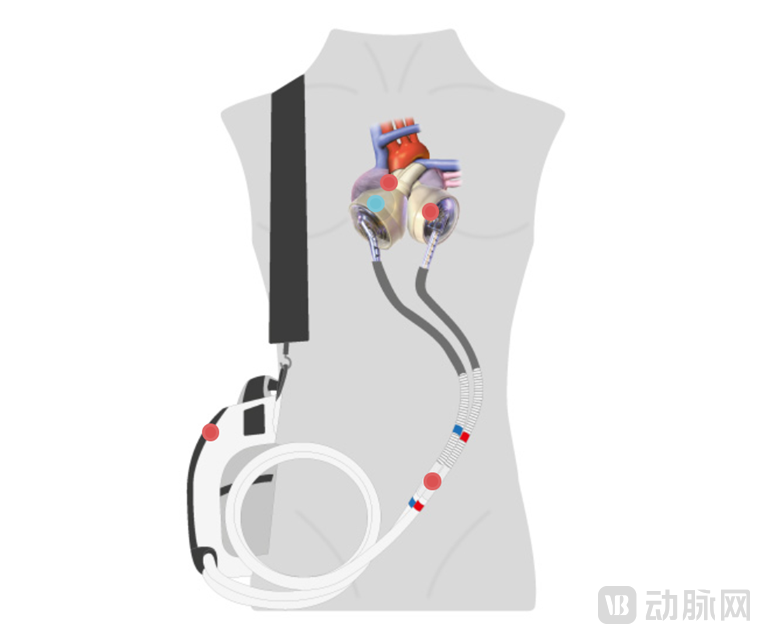 Source: SynCardia official website
SynCardia's total artificial heart consists of two ventricles and four valves.The two ventricles are connected by nylon straps, allowing surgeons to position them within the chest according to the patient's anatomy, while four valves control the direction of blood flow into and out of the ventricles. It isMade of a special biocompatible plastic, exhibits high fatigue resistance and strength, and can prevent implant rejection in patients.
The operating principle of this total artificial heart is pneumatic drive. An external pneumatic pump generates air and vacuum pulses to inflate and deflate the diaphragm within each ventricle, thereby propelling blood in and out of the ventricles.
In addition, SynCardia's artificial heart is a`Fixed Rate``device, once the pacing rate is set, the beats per minute will remain constant. When the patient is physically active, the body automatically directs increased blood flow to the artificial heart, which correspondingly pumps the increased volume back into the systemic circulation.`
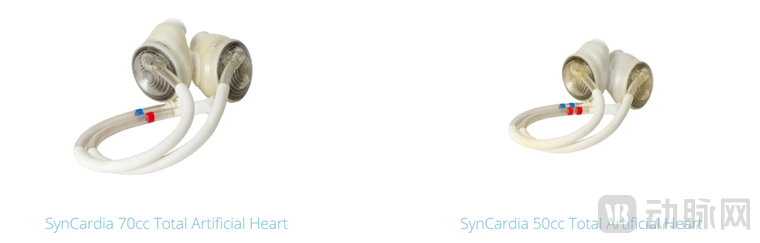
Currently, SynCardia offers two models of artificial hearts and two external drivers, suitable for a broader range of patients with end-stage heart failure and diverse clinical settings.
 Source: SynCardia official website
The SynCardia 70cc is the world's first commercially available total artificial heart, approved by the FDA for patients with end-stage heart failure as a bridge to heart transplantation.It has over 1,700 transplant patients worldwide, ranging in age from 9 to 80.The 70cc TAH is relatively large in size, suitable for most men and some women. It can generate a blood flow of up to 9.5 liters per minute, whereas a typical individual’s resting cardiac output is approximately 5 liters per minute.
Currently,The 70cc TAH is currently undergoing an FDA-approved Investigational Device Exemption (IDE) clinical trial for the treatment of adult patients ineligible for heart transplantation.This may be a crucial step for SynCardia toward a permanent artificial heart.
The 50cc TAH is a smaller version of the 70cc TAH, designed for most women and some adolescents. It delivers a cardiac output of 7.5 liters per minute. This device enables more women and adolescents to benefit from total artificial heart technology, expanding the pool of eligible transplant candidates.
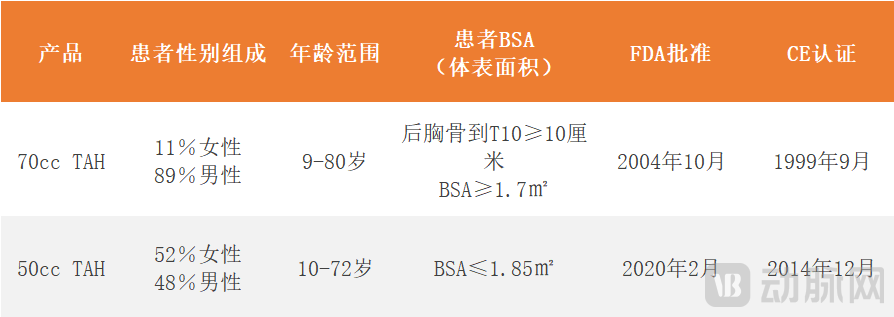
According to a demographic survey conducted by SynCardia, among recipients of the 50cc TAH, the proportion of female patients has significantly increased compared to the 70cc TAH cohort, while the number of pediatric patients under 18 years of age has also risen, accounting for 22% of the total transplant population.
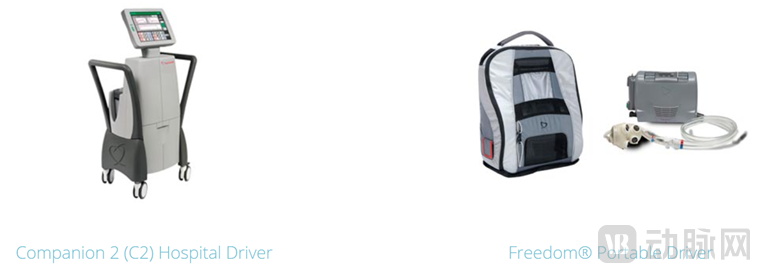 Source: SynCardia official website
SynCardia's artificial heart is connected to an external driver via two cannulas passing through the abdominal wall. To facilitate postoperative mobility, SynCardia has developed two driver models tailored to different application scenarios.
Among them,The C2 Driver is intended for patient use during hospital recuperation.. Medical personnelIndependent, adjustable vacuum and pressure can be delivered to both ventricles via the C2 driver.,Customize drive performance according to the individual needs of each patient.。During use, the C2 driver can be placed in a hospital cart or carrying case to facilitate transport and charging.
During the initial phase of postoperative recovery, the C2 driver can be housed in a hospital cart. Equipped with a large touchscreen display, support handles, and locking casters, the cart provides stable support during patient ambulation. Once the patient is able to get out of bed and mobilize, the C2 driver can be transferred to a more compact carrying case to facilitate walking and exercise.
When the patient's condition is stable enough for discharge, SynCardia also offers the Freedom Portable Driver. It is a smaller, lighter pneumatic pump,Weighs 13.5 lbs (approx. 6.1 kg), which can be placed in the patient's backpack for portability. The waiting period for a heart transplant is often lengthy; the ability to move freely outside the hospital with the artificial heart not only improves patients' quality of life but also reduces hospitalization costs.
Transitioning from a controlled clinical setting to dynamic daily life scenarios represents a crucial step for artificial hearts to effectively mimic the natural human heart.
The high technical complexity and the challenges in conducting clinical trials have consistently kept the development of total artificial hearts at a slow pace.
At the end of 2020, French company Carmat obtained EU CE certification for its total artificial heart product, which can serve as a bridge to heart transplantation for patients with end-stage heart failure. Following over a decade of research, development, and clinical trials, the company’s Aeson artificial heart is scheduled for market launch in the second quarter of this year.
Despite the commercial availability of total artificial hearts and continuous technological advancements, the global number of implantations remains remarkably low. The primary reason is the prohibitive cost. The combined expenses for the artificial heart, surgical procedures, and postoperative immunosuppressive medications represent a substantial financial burden. Secondly, the procedure is inherently irreversible. The implantation of a total artificial heart necessitates the removal of the patient's native heart; given this irreversible nature, many patients remain psychologically hesitant to rely on a mechanical heart.
Furthermore, there are significant inconveniences in daily life. The total artificial heart requires a constant power supply; if the power is depleted, the patient faces imminent death. Moreover, patients must carry an external driver at all times, which imposes numerous lifestyle restrictions, such as avoiding water exposure and refraining from strenuous exercise.
It is precisely because total artificial hearts face technical barriers and ethical challenges that ventricular assist devices are currently more widely used in the artificial heart field. Unlike total artificial hearts, implanting a ventricular assist device does not require the removal of the native heart, making it more psychologically acceptable to the general public.
Currently, Chinese companies are actively developing ventricular assist devices.The first and only commercially available ventricular assist device in China is the Chongqing "YongRenXin" artificial heart.It is an implantable left ventricular assist system manufactured by Chongqing Yongrenxin Medical Device Co., Ltd. using technology introduced from Japan's HI-LEX Group, filling a gap in China's artificial heart field.
Meanwhile, Suzhou Tongxin Medical Device Co., Ltd. has independently developed a fully magnetically levitated artificial heart with fully independent intellectual property rights,Weighing less than 180 grams, it is approximately the size of a ping-pong ball.。In addition to minimizing the size of the blood pump within the artificial heart while ensuring operational efficiency, Tongxin Medical has also resolved the issue of hemocompatibility, effectively preventing thrombosis in patients.
To date, the NMPA has only approved two registry clinical trials evaluating the safety and efficacy of artificial hearts for the treatment of end-stage heart failure, specifically those developed by Yongrenxin and Tongxin. These two companies are at the forefront of ventricular assist device (VAD) research and development in China.
Despite the presence of industry giants such as Abbott and Medtronic in the United States, which have established a relatively mature market for ventricular assist devices (VADs), these high-cost products have not yet entered China. Consequently, a significant blue ocean remains in the domestic sector. Domestically produced artificial hearts hold a substantial opportunity to capture the local market.