

Tech Giants Flood into the Medical Trusted Data Space: A New Billion-Dollar Industry is About to Emerge!

BEDI Web Services
--
What kind of project can make medical institutions invest for ten years despite losses? Medical data governance must be on the list.
To unlock the hidden value of medical data, waves of institutions and companies have plunged into the field. Over the years, they've built platforms, set standards, and revolutionized technologies, producing a large number of high-quality datasets. However, they have consistently failed to打通后半段的价值转化 (connect the latter half of value transformation), preventing medical data from circulating like a true asset and covering the substantial initial investments.
The reasons behind this are twofold: firstly, medical data itself is characterized by diverse and heterogeneous properties, making its governance costs inherently higher than other types of data; secondly, the needs of various entities within the healthcare sector for medical data are often opaque, with high barriers to integration. Even if hospitals possess the data required by demand-side entities, they may choose to withhold data supply due to compliance considerations or other factors.
The emergence of a trusted data space may be able to change this situation. It is a data circulation and utilization infrastructure based on consensus rules, constructing a special space that includes a data-sharing trust mechanism. It builds a secure and trustworthy data circulation environment for different entities, industries, and regions, allowing high-quality data obtained through governance to flow in an orderly manner and fully realize their value.
In the medical field, for example, this technology could theoretically enable timely communication among medical institutions, pharmaceutical companies, insurance firms, research organizations, and other parties regarding data dimension requirements, thereby reducing governance costs. It can also provide rules that allow suppliers to securely share various types of medical data, such as patient treatment data and clinical research data, breaking down data silos and promoting the deep integration and utilization of medical data.
As early as November 2024, the National Data Administration issued the "Action Plan for the Development of Trusted Data Spaces (2024-2028)," which regards trusted data spaces as "a data circulation infrastructure for achieving shared use of data resources, an application ecosystem for co-creating value of data elements, and an important carrier supporting the construction of a unified national data market" to realize compliant and efficient circulation of data elements, supporting the construction of a unified national data market. BEDI Web Services has become one of the earliest enterprises to implement and apply medical trusted data spaces.
Driven by policy, leading enterprises and research institutions in the medical industry have begun to rapidly deploy. In 2025, among the 50 industry/corporate pilot projects in the initial list of Trusted Data Space Innovation Development Pilot Projects, seven projects are related to healthcare. Beyond these pilots, a large number of companies outside the official list are also voluntarily participating in research and development, attempting to unlock the potential value of medical data through Trusted Data Spaces.
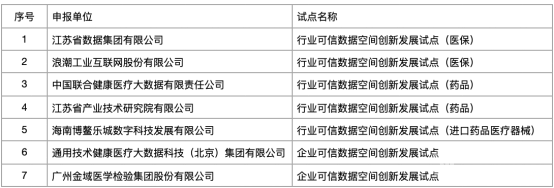
List of Innovative Development Pilots for Trusted Data Spaces in 2025 (Healthcare Section)
To date, many trusted data spaces in the medical field have started to show initial results. To explore the real-world applications of this technology, we spoke with several companies involved in the construction of trusted data centers related to healthcare, focusing on trusted data spaces within hospital settings, in an attempt to clarify the development prospects of trusted data spaces in the medical industry.
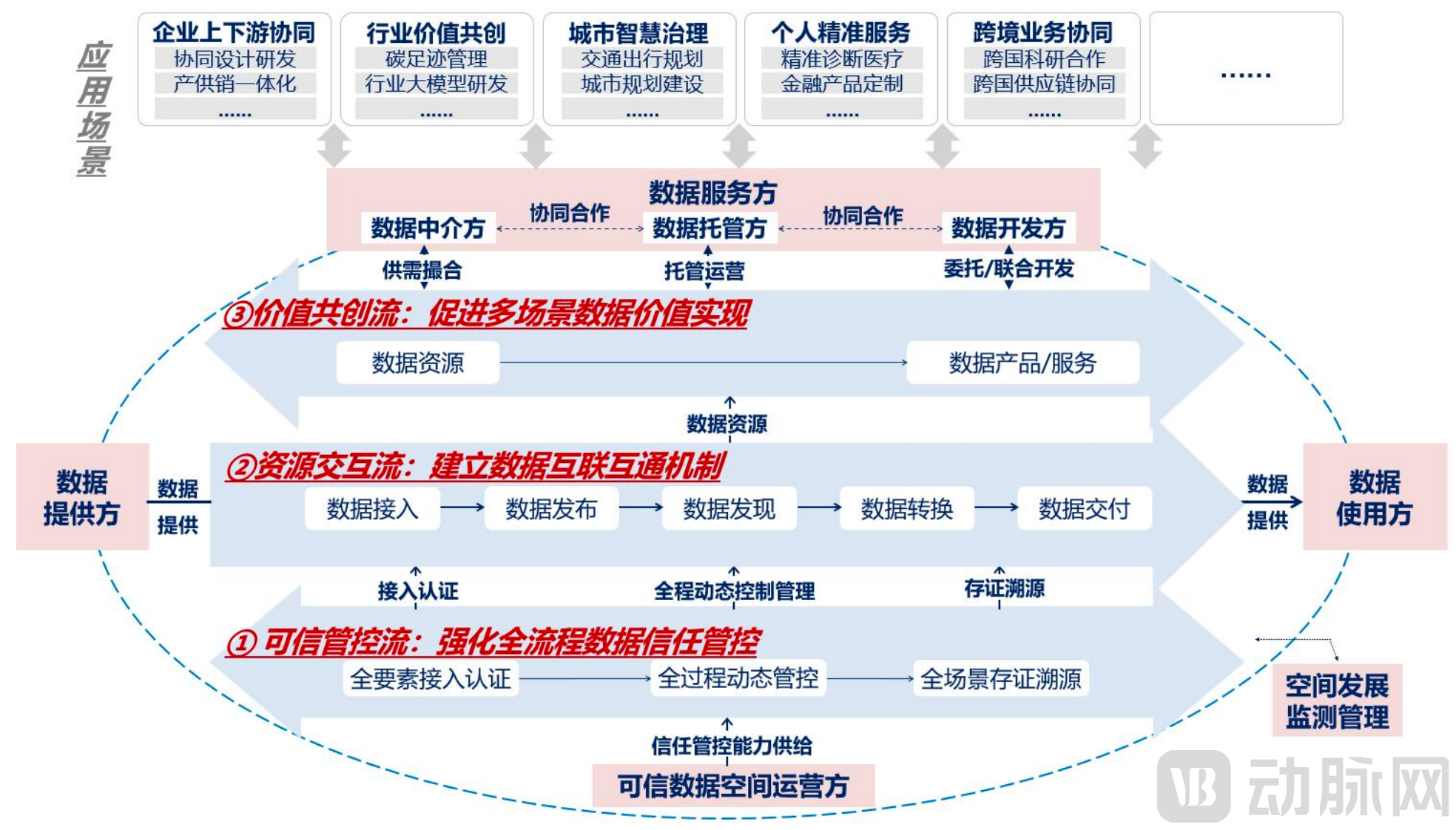
Capability View of Trusted Data Space (Source: Action Plan for the Development of Trusted Data Space (2024-2028))
To understand the value of a hospital's trusted data space, we may compare it with the traditional data application pathways of a hospital data center.
Generally, hospitals have their own data warehouses and data aggregation platforms. When there is a need for scientific research collaboration related to medical data, they will physically extract the data and send it outside the hospital for use.
In this process, even if hospitals adopt strict protective measures, the risk of data leakage still exists. Ultimately, once data leaves the physical environment of the hospital, the risk shifts from being technically controllable to relying on reputation-based guarantees. Due to the lack of effective restrictive measures, hospitals can only hope for the principal credibility of data requesters, thus preferring to collaborate with large companies or high-quality state-owned enterprises to reduce compliance pressure through brand endorsement.
Trusted Data Spaces avoid the traditional concept of data extraction. The original data of the data owner always remains stored in the local database/storage node and is not extracted or copied to a public area within the space or to the storage of other participants. Therefore, it can ensure that the data itself remains within its domain while being accessible to data users, significantly reducing the risk of structural leakage.
In this way, hospitals can consider cooperation more from the perspectives of application scenarios and collaboration models, allowing more enterprises and institutions to participate in the ecosystem of circulation and utilization.
Moreover, the way hospitals handle data has also undergone a paradigm shift. Shao Bing, head of BEDI Web Services' AI Trusted Business, believes that when hospitals previously built data centers, the core consideration was data security, and the architecture used was not oriented towards "data utilization," akin to locking wealth in a safe. In contrast, the introduction of a trusted data space allows for the construction of a "controlled laboratory" focused on data utilization within the safe, without changing the hospital's data security model. This permits data governance and development parties to enter and achieve the activation of data applications under secure conditions.
In other words, although hospitals have accumulated massive amounts of data in the past, the data has not been flowing, like a stagnant pool. Now, through technical means, trusted data spaces have broken down barriers between various data sources, forming an ecosystem that supports cross-domain data circulation, bringing the data to life.
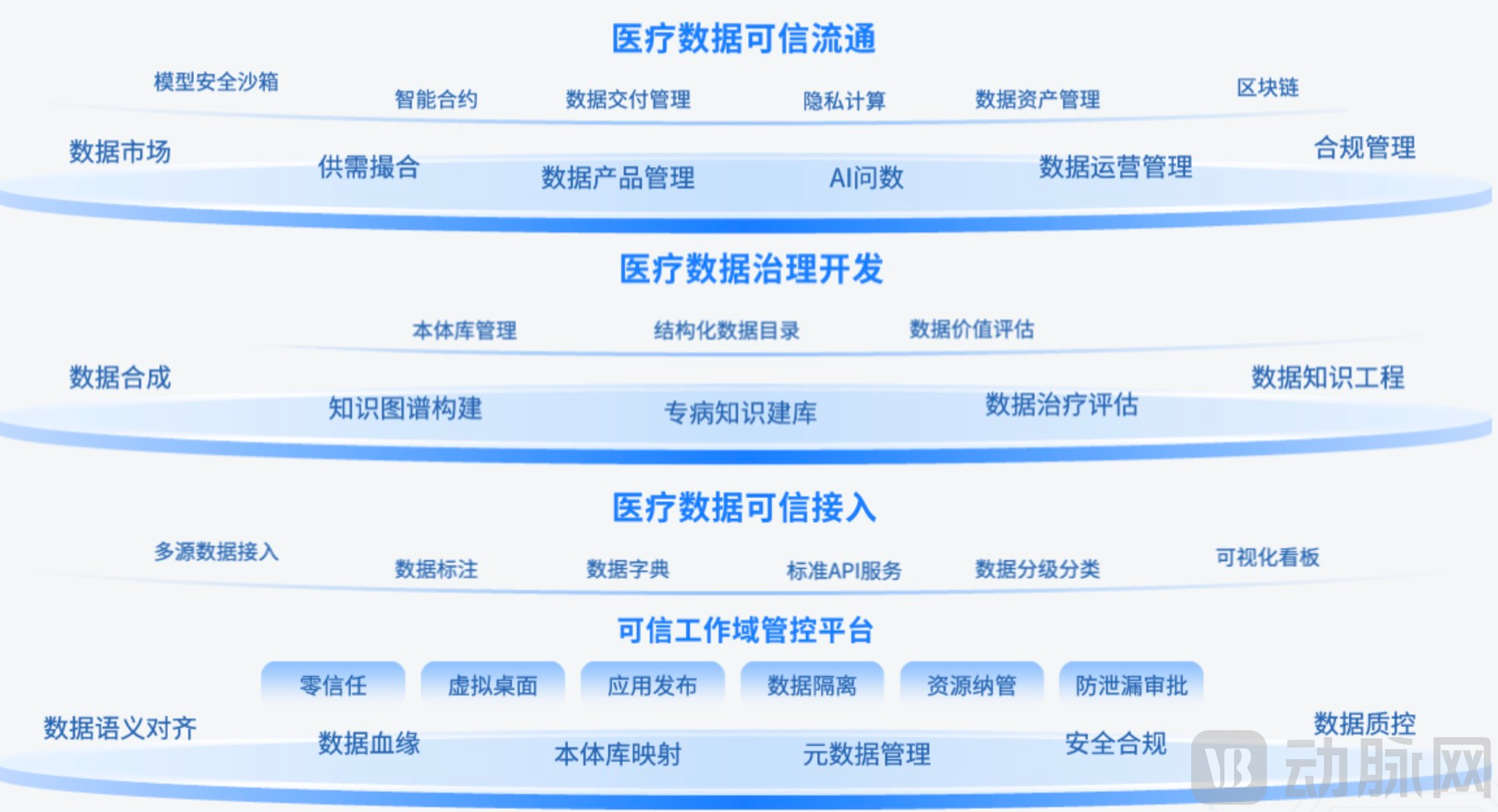
Ideal State of Data Application in the Medical Industry (Image Source: BEDI Web Services)
However, it should be noted that, in the face of the long-standing difficult issue of "data rights confirmation" in the circulation of medical data, trusted data spaces still cannot play a direct role.
BEDI Web Services believes: "When discussing data assets, all parties are intentionally avoiding the complex issue of rights confirmation because once the 'right to hold' is examined in depth, it involves legal aspects such as informed consent from relevant parties, which would rapidly decrease circulation efficiency. However, the introduction of trusted data space, with technologies like log generation and blockchain traceability, allows the entire circulation process to be recorded, achieving controlled use rights and management rights under the 'separation of three powers.' This not only facilitates post-audit but also provides a technical buffer for subsequently addressing compliance authorization."
To ensure the smooth operation of this new data circulation mechanism, a trusted data space requires a new set of industrial support for its functioning.
First, on the technical side. The capitalization of data involves participation from multiple parties, which requires technologies related to data circulation and identity management. Under the new mechanism, distributed identity becomes crucial. Meanwhile, privacy computing, previously in the "laboratory stage," will find real application scenarios, ensuring the privacy of data owners is not violated. Additionally, a trusted data space must be AI-oriented, promoting the development of innovative technologies such as AI data labeling and data synthesis.
Second is the infrastructure. To build a functional trusted data node, in addition to the software solution, precise matching of computing power is also required. Currently, one of the top tertiary hospitals in China needs to configure about 4-5 high-performance accelerator cards in the initial deployment phase to achieve its goals. Compared with traditional large data center construction, this computing power deployment plan appears to be very pragmatic and highly cost-effective. For hospitals, this is no longer a heavy asset investment requiring extremely high thresholds, but rather an "activation project" that can be initiated within a regular budget.
Security protection solutions also need to be redesigned. Kai Xue, Senior Product Director of Hangzhou Meichuang Technology Co., Ltd., believes: "In the past, when hospitals implemented data security protection, they mostly relied on point-based, tool-oriented security capabilities such as auditing, desensitization, and encryption. These capabilities were more 'stacked' and lacked deep integration with actual medical business processes."
This approach is acceptable for one-time data transmission from a hospital (Node A) to an external data user (Node B), but it falls short when dealing with dynamic, cross-domain data flows among multiple entities and various systems. Once the data reaches the external data user (Node B), the hospital essentially loses its ability to monitor and control subsequent data usage, creating a security vacuum.
However, under a trusted data space, it inevitably involves chained circulation with multiple points, multiple times, and multiple paths, and even complex scenarios such as cross-platform, cross-cloud, and cross-industry. This requires us to rethink the entire security protection system. We can no longer be limited to static authorization or node boundary protection but should build a dynamic, continuous, and trusted protection system centered on 'security in flow.'
"From the current perspective, in order to ensure secure circulation within a trusted data space, the primary task is to establish a unified identity authentication system and trust evaluation mechanism. By continuously monitoring and assessing each node, the security and trustworthiness of all transaction nodes can be guaranteed. At the same time, by integrating AI agents, automatic node verification, real-time environmental assessment, and dynamic policy execution can be achieved. This ensures that data is fully traceable and controllable throughout the entire process while effectively improving the overall operational efficiency of the system, driving the efficient implementation of a trusted data space."
To complete the aforementioned elements, multiple entities such as the government, enterprises, hospitals, and research institutions have joined the exploration of a trusted medical data space. With multi-party collaboration, a well-functioning ecosystem for a trusted medical data space has begun to take shape.
From the list of the first batch of trusted data space innovation development pilot projects, the pilot direction is mainly based on regions and industries as the criteria for building trusted data centers. However, if it is just a single hospital, is it still valuable to build a trusted data space?
In Shao Bing's view, the medical data owned by hospitals has the characteristic of regional concentration, with slightly insufficient generalization. However, compared with the industry dimension, the advantage of these data lies in their sufficient depth and completeness, covering the entire process from the onset of the disease to recovery.
Taking the China-Japan Friendship Hospital, which collaborates with BEDI Web Services, as an example, the hospital has accumulated millions of such complete medical records, enough to train an intelligent model that meets its own needs, and preliminarily realizes the value of a trusted data space.
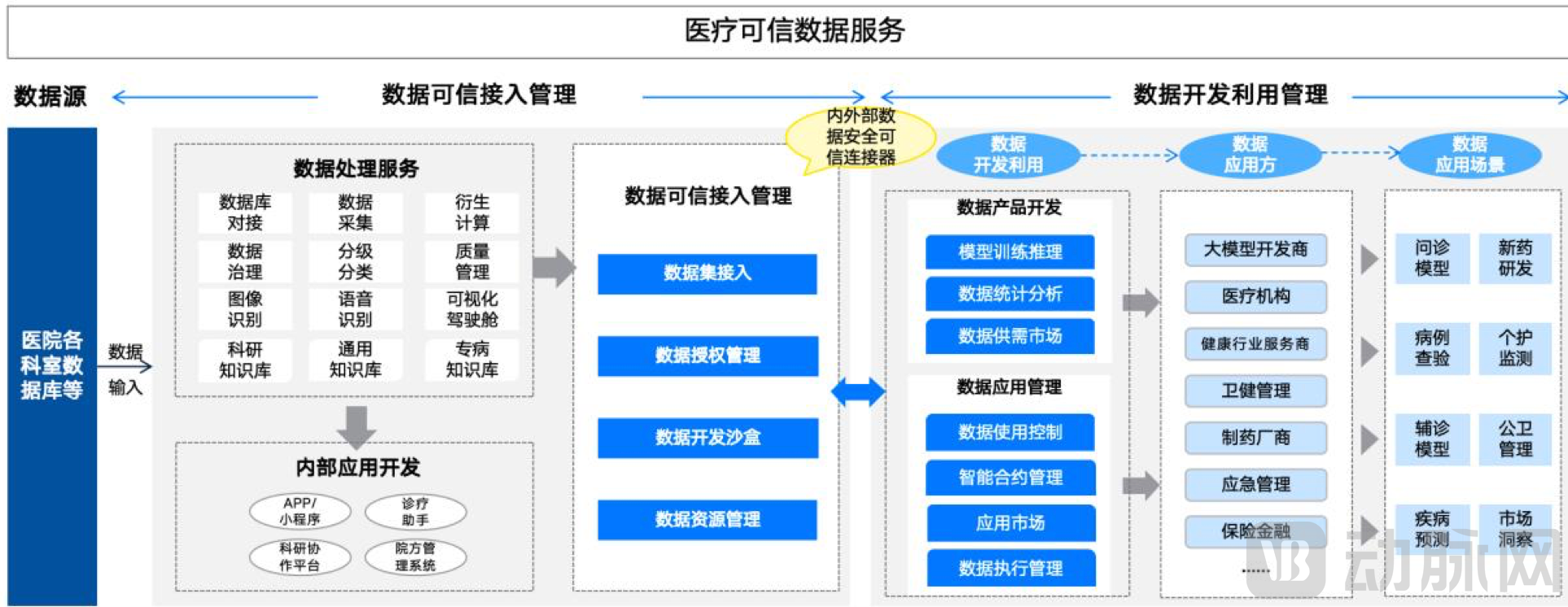
Demonstration of Medical Trusted Data Space Architecture (Image Source: BEDI Web Services)
As for the issue of overly concentrated patient data samples in hospitals, Shao Bing believes that there are currently two main approaches to solving this problem.
First, a single hospital can collaborate with other hospitals in the future to build a trusted data space. Each hospital exists as a node, collectively joining a larger data space.
Secondly, a single hospital can also expand regionally, such as jointly building a regional dataset with the entire medical consortium. In November last year, China-Japan Friendship Hospital was approved to establish a key laboratory under the National Health Commission, with plans to aggregate and standardize clinical big data to meet the needs of integrated applications.
Overall, top-tier hospitals can gradually expand the scope of connectivity by establishing trusted data spaces, thereby accelerating the development of medical data value. For other hospitals, a better current choice is to become nodes of existing trusted data spaces and harness data value through data sharing.
Despite the numerous advantages of trusted data spaces, various difficulties may still arise during actual implementation.
The technical difficulties mainly lie in system integration. When configuring a trusted data space, it must be integrated with a large number of systems such as the Hospital Information System (HIS) and the data warehouse in the data center, requiring the handling of numerous interfaces. Moreover, even after establishing a data center, hospitals still face a significant amount of heterogeneous data that needs to be categorized and labeled individually, which will incur extremely high costs in the process.
Specifically, during the construction process, since different applications have varying requirements for data governance, the builder needs to pay special attention to the sequence of various types of data in data governance. It is crucial to clarify which data is used for research and which is used for application, and to design the governance pathway in advance. For instance, the data governance needs for rare disease research and common disease diagnosis and treatment are entirely different. Hospitals need to decide which issue to address first in order to maximize the value of data governance.
Non-technical aspects mainly involve the challenges of "talent" and "awareness." For research and development institutions, a trusted data space in the medical field is a product of the integration of multiple technologies. It requires researchers to have knowledge in medicine, hospital business processes, and compliance—such talents are currently very scarce.
For hospitals, the trusted data space is still in its early stages of development. Some managers do not understand the value of this technology and are reluctant to try related technologies due to concerns about data security. Similarly, companies need to spend time on market education to gradually accept the development of innovative technologies.
Overall, the medical trusted data space has found a new path to achieve the flow of medical data, providing underlying technical support for the release of medical data value and accelerating the arrival of the era of medical data value explosion.
The rise of the medical trusted data space essentially represents a leap in medical IT from "management digitization" to "asset valorization." Although it is still some way from a full-blown outbreak, the established logic of "staying within boundaries and controlled utilization" has become the optimal technical solution to the dilemma of medical data circulation.