

Global First Launch Accounts for 69%! Antibody New Drug Breakthrough in 2026, GENRIX BIO Leads with Three Candidates

GENRIX BIO
Developer of Novel Monoclonal Antibody Drugs
China's new antibody drugs have become a weathervane in the global antibody drug field. By 2026, it will also become a critical watershed for China's innovative pharmaceutical companies to shift from R&D investment to commercial returns.
At the beginning of 2026, the academic journal mAbs published the highly anticipated 17th annual review, "Antibodies to Watch in 2026." With a comprehensive overview of the global antibody drug market, the report predicts that 26 new antibody drugs will be approved for marketing in 2026 (antibody therapies currently undergoing their first regulatory review), with 18 marketing applications submitted in China, accounting for 69%.
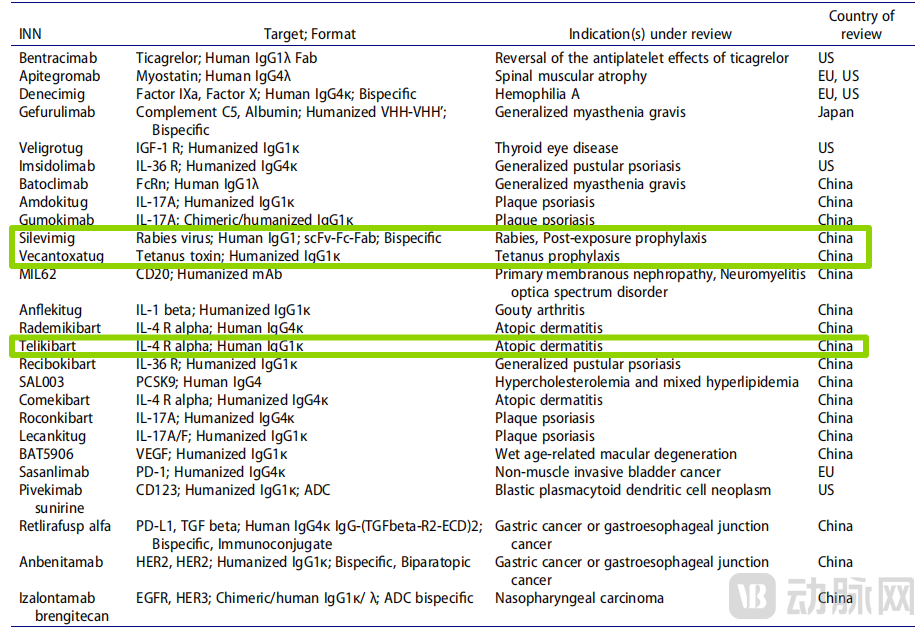
Antibodies to watch in 2026——Antibody therapies under first regulatory review in various countries (Data as of December 31, 2025)
Among the 18 products submitted for New Drug Application (NDA) in China,Chongqing Genrix Biopharmaceutical Co., Ltd. (hereinafter referred to as "GENRIX BIO") exclusively holds 3 products, making it the Chinese Biotech with the highest proportion, accounting for 10% (3/28) of global antibody new drugs in the NDA stage.The 2025 annual earnings forecast provides a vivid footnote to this data: expected revenue for 2025 is projected to reach 209 million to 251 million yuan, with an estimated year-on-year growth of 596% to 734%. Additionally, GENRIX BIO's first commercial product, Selicibart, has been included in the National Medical Insurance Catalogue for the first time for its two major indications—moderate to severe plaque psoriasis and ankylosing spondylitis (officially implemented starting January 1, 2026), paving the way for a new wave of hospital adoption.
The dual validation of product pipelines and financial data clearly outlines the determined trajectory of GENRIX BIO entering a full commercial explosion phase.
1Three New NDA Antibody Drugs Bet on the Huge Existing Market for Autoimmune and Infectious Diseases
GENRIX BIO's Three Class 1 New Drugs Set to Go Public by 2026 Target Indications in Autoimmune Diseases and Acute Infectious Diseases (Rabies, Tetanus), Focusing on Three Major Indication Tracks with Broad Existing Markets.Particularly noteworthy is that GENRIX BIO has established core commercialization channels for these three products.
The most advancedSlervevimab Injection(Silevimig, GR1801) is a recombinant fully human bispecific antibody against rabies virus (RABV). Rabies is an acute infectious disease, and once clinical symptoms appear, the fatality rate is nearly 100%. Globally, approximately 59,000 people die from rabies each year, with China ranking second in the world for rabies-related deaths.
In January 2025, the NDA for Slewemab for passive immunization in adult suspected rabies virus exposure was accepted by the CDE. Once approved, it will becomeThe World's First Bispecific Antibody for Passive Immunization Against RabiesAt the same time, a Phase III clinical study on the passive immunization indications for children and adolescents aged 2 to under 18 who are suspected of being exposed to the rabies virus is currently underway. If approved, this product will enter a long-standing market dominated by traditional human rabies immunoglobulin (HRIG), which faces risks of unstable supply and blood-source safety. As a scalable recombinant bispecific antibody, it has disruptive potential in terms of supply security and standardization, and is expected to redefine the standard for passive immunization.
Vicantuzumab Injection(Vecantoxatug, GR2001) is a recombinant humanized monoclonal antibody against tetanus toxin (TeNT). It specifically binds to the C-terminal of the TeNT heavy chain, blocking its entry into neuron cells and preventing tetanus. It has been included in the list of breakthrough therapies.
Tetanus is an acute specific infection caused by the invasion of Clostridium tetani through wounds, with a global mortality rate as high as 30%-50%. Currently, passive immunization agents used in clinical practice mainly include Tetanus Antitoxin (TAT) and Tetanus Immunoglobulin (TIG), which have limiting characteristics such as a high incidence of allergic reactions, high risk, high cost, and insufficient supply, leading to significant clinical demand.
In the autoimmune track,Telituximab Injection(Telikibart, GR1802) is a novel recombinant fully human IL-4Rα monoclonal antibody injection. In addition to the already submitted indications for moderate to severe atopic dermatitis, chronic rhinosinusitis with nasal polyps, chronic spontaneous urticaria, adult seasonal allergic rhinitis, and adolescent seasonal allergic rhinitis are all in Phase III clinical trials. Particularly, Telikibart.Will form a product synergy with GENRIX BIO's first commercialized product — China's first domestically produced fully human IL-17A monoclonal antibody, Selicrelumab, to build a product portfolio covering different inflammatory pathways, enhancing overall market competitiveness in the autoimmune field.
In terms of commercialization layout, GENRIX BIO has demonstrated foresight.September 2025, GENRIX BIOAuthorize Chiesi PharmaceuticalsVimcizumab and Sleremab have exclusive commercialization rights in mainland China, as well as in the Asia-Pacific, Middle East, and North Africa markets outside of mainland China, and are entitled to receive a total payment of 510 million yuan. Importantly, these two new antibody drugs will leverage the sales network and promotion team of Chongqing Genrix Biopharmaceutical Co., Ltd., which covers more than 30 provinces, autonomous regions, and municipalities across China, to quickly expand into the nationwide market and overseas markets, achieving commercial implementation and maximizing innovative value.
At the same time, GENRIX BIO has built a commercial team of over 200 people for its autoimmune products and reached commercial strategic cooperation with several well-known distributors in China, such as China Resources Pharmaceutical, achieving nationwide channel network coverage in China. This has paved the way for the launch of Talizumab, significantly shortening the market penetration cycle after the product's release.
2Solid technical platforms and innovative product capabilities build the core engine for sustainable output.
At the core logic, GENRIX BIO's ability to quickly seize the leading position in the new field of domestically produced biologic innovative formulations relies on its deep technical accumulation and industrialization engine. The competitiveness of this system is directly reflected in three dimensions: "speed," "differentiation," and "cost."
In the source innovation stage, GENRIX BIO has shortened the discovery cycle of novel monoclonal antibody drug candidates to 6-9 months based on its monoclonal antibody drug discovery technology platform using a new phage display system. Currently, it owns two bispecific antibody development technology platforms with different structures — the scFv+Fab bispecific structure allows for convenient construction of bispecific antibodies based on any two selected monoclonal antibodies, suitable for developing single-dose bispecific antibody drugs; the Fab+Fab bispecific structure based on a common light chain has a high technical threshold, a structure highly similar to monoclonal antibodies, low immunogenicity, and can leverage monoclonal antibody production processes, making it suitable for developing bispecific antibody drugs requiring multiple doses in clinical settings. The common light chain for two selected monoclonal antibodies can be quickly screened within three months.
In the industrial transformation phase, GENRIX BIO has gradually improved its recombinant antibody drug process development platform, significantly enhancing production stability and cost controllability. The antibody industrialization base has completed the construction of 24,400 liters of bioreactor capacity, which can simultaneously meet the large-scale commercial production needs of multiple products.This closed-loop capability, which打通 "rapid discovery" and "reliable production," constitutes GENRIX BIO's core moat to address the challenges of homogeneous R&D and payment pressures.
The value of the platform is ultimately reflected through the pipeline.GENRIX BIO's research and development is not a simple repetition of chasing popular targets, but is committed to addressing unmet clinical needs, and has already given rise to multiple highly differentiated drug candidates: For example, among the products under development, GR1603 is China’s first anti-IFNAR1 monoclonal antibody to enter clinical trials; GR1901 is China’s first approved clinical anti-CD123×CD3 bispecific antibody; GR2002 is the world’s first TSLP dual-epitope bispecific antibody to be approved for clinical trials.
On a deeper level, in order to break through the intense competition among Biotech companies developing antibody drugs targeting popular pathways and indications with repeated focus, GENRIX BIO's strategy is:Precision cultivation, targeting the main thread of "unmet clinical needs," with a three-pronged approach in autoimmune diseases, infectious diseases, and oncology.Exploring low-permeability, unmet clinical need niche markets while also engaging in high-profile, popular target oncology fields is sufficient to demonstrate a Biotech's technical strength and team determination.
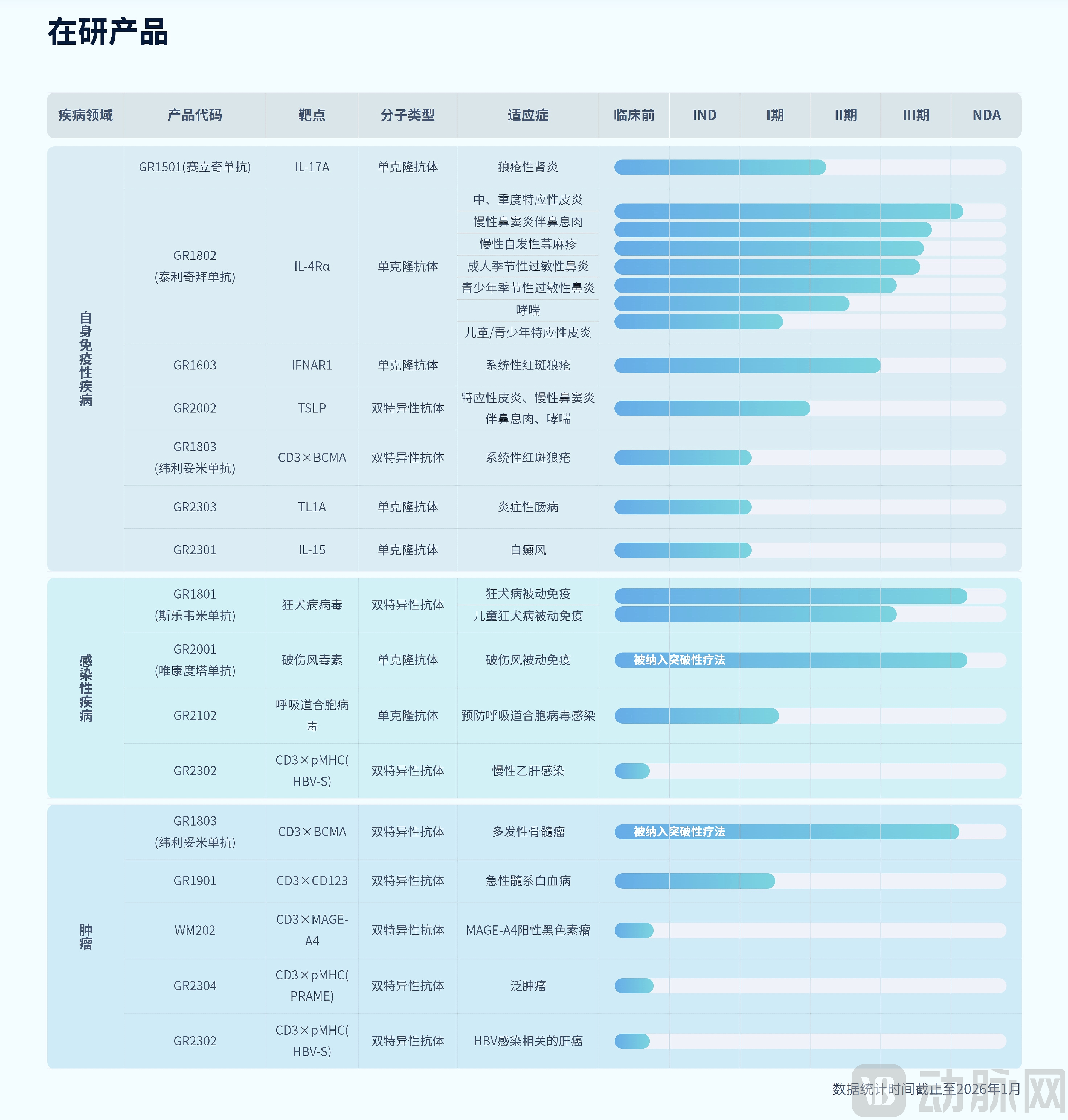
GENRIX BIO Product Layout
3In 2026, an NDA for a new antibody drug has been accepted, aligning with BD's bet on the new blue ocean of autoimmune diseases.
In January 2026, the conditional marketing application for Velinotamig (GR1803) was accepted and has been included in the list of breakthrough therapies and priority review lists. It is intended for the treatment of adult patients with relapsed or refractory multiple myeloma who have received at least three prior lines of therapy.GENRIX BIO has reached a critical juncture with four new drugs nearing market launch.
And GENRIX BIO's strategic vision is not limited to the domestic market — Wealimumab is also the target of its "first overseas order."In June 2025, GENRIX BIO entered into an overseas licensing cooperation agreement with Cullinan, a Nasdaq-listed company. GENRIX BIO will receive an upfront payment of $20 million, as well as up to $692 million in development, regulatory approval, and sales milestone payments, totaling $712 million. In this transaction, GENRIX BIO...Retained the development, production, and commercialization rights of Velitumab in China.
The significance of this deal goes far beyond the amount itself—on one hand,Completing global transactions in the early clinical stage not only demonstrates its front-end R&D global competitiveness but also represents a dual recognition of GENRIX BIO's source innovation capabilities and the global value of its molecules. On the other hand,Two Biotechs Join Hands for In-depth Collaboration in Clinical, Regulatory, and Production Capacity to Accelerate Product Approval and Market Launch. This also marks a significant step for GENRIX BIO.The overseas expansion model has been upgraded from "product export" to"Global Strategic Cooperation Based on Early High-Quality Assets"。
It is worth mentioning that GENRIX BIO has launched clinical research on Weiliritomab for the indication of Systemic Lupus Erythematosus (SLE) in mainland China. This move,Accurately positioned at the forefront of global MNC trends—expanding the bispecific antibody technology, which has been proven effective in the oncology field, into the vast blue ocean of autoimmune diseases with a larger patient population and significant unmet needs.
From monoclonal antibodies to bispecific and multi-specific antibodies, from oncology to autoimmune and infectious diseases, the pipeline evolution of GENRIX BIO is not a blind expansion, but a logical strategic expansion centered around its core technology platform——It not only secures a steady cash flow through anti-infective products but also builds a product portfolio and competitive moat in the autoimmune field, while maintaining R&D leadership through cutting-edge oncology targets and bispecific antibody technology, paving the way for future entry into the global blue ocean market.
Going back 10 years, simultaneously establishing platforms for both monoclonal and bispecific antibodies, with a pipeline spanning the three major fields of oncology, autoimmune diseases, and infectious diseases, seemed like "a fairy tale" for China's antibody Biotech companies. However, represented by GENRIX BIO, Chinese antibody drug companies have indeed progressed step by step to reach where they are today.
Walking on the right path for 10 years, you can see the glory of China's innovative pharmaceuticals today.
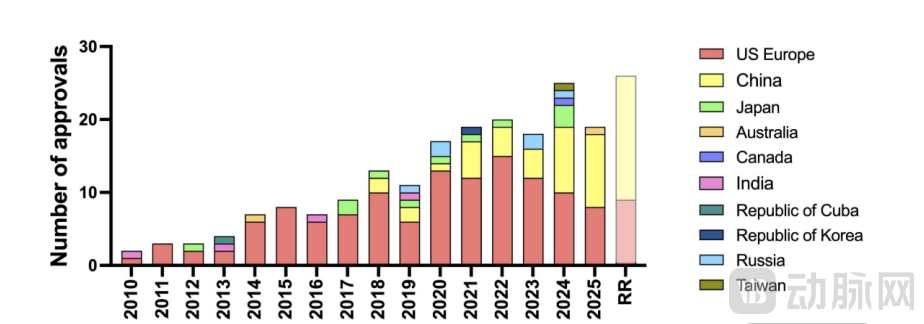
Antibodies to Watch in 2026——Trends in the Source of Approved Antibodies from 2010-2025