

GigaCeuticals Files IPO Prospectus Highlighting DLEPS AI Platform Published in Nature Biotechnology

GigaCeuticals
AI Drug Discovery Company
On June 17, 2021, GigaCeuticals published a research paper titled “Prediction of drug efficacy from transcriptional profiles with deep learning” online in Nature Biotechnology (Impact Factor: 36.6), revealing the application of a drug efficacy prediction system (DLEPS, LingSu system) based on gene signatures and deep learning in innovative drug research and development.
In this study, the researchers first constructed a neural network that used chemical encoding as input to match the transcriptomic changes measured in the data. The study utilized disease-related gene signatures to reflect the "intrinsic trace" of specific diseases and employed Gene Set Enrichment Analysis (GSEA) to evaluate the potential therapeutic efficacy of compounds against these diseases. The researchers named this methodology and model the Deep Learning-based Efficacy Prediction System, abbreviated as the Drug Efficacy Prediction System (DLEPS, Lingsu System). In predicting gene expression changes, the Lingsu System accurately forecasts the transcriptomic impact of novel molecules, achieving an average correlation of 0.74.
As the developer behind the system, Xie Zhengwei, founder of GigaCeuticals, stated that the Lingsu system can be successfully applied to screen compounds for the treatment of obesity, hyperuricemia, and NASH, with an overall accuracy exceeding 50%. Furthermore, the Lingsu system overcomes the challenges of traditional drug development by predicting candidate molecules for highly diverse and complex diseases based solely on genetic fingerprints.
Beyond its role in screening candidate small molecules for diseases, this study also demonstrates the potential of the Lingsu system in elucidating disease pathogenesis and identifying pathogenic target proteins. With the advancement and application of omics technologies, most diseases—including age-related diseases, metabolic disorders, and cancers—now possess well-defined genetic markers, laying the foundation for applying the Lingsu system to other indications. Furthermore, for diseases that currently lack clear therapeutic targets, the Lingsu system may yield unexpected therapeutic efficacy. It is poised to become a powerful tool for the pharmaceutical industry, bringing new hope to patients with complex diseases.
The advent of artificial intelligence (AI) has comprehensively accelerated development across various industries. In the biopharmaceutical field, as deep learning enables a more comprehensive analysis of chemical similarity, compound-protein interactions, physicochemical properties, and chemogenomic relationships, AI can assist researchers in rapidly screening for highly potent compounds.
Guided by this same logic, GigaCeuticals has adopted a strategy that integrates deep learning with laboratory validation to address key pain points in drug development, and has successfully built an AI-powered drug discovery platform—the Lingsu System—to enhance the standards and efficiency of pharmaceutical R&D. Dr. Xie Zhengwei explained that by fine-tuning gene models to identify candidate compounds, the platform can uncover novel mechanisms of action or targets, predict compound activity, tackle multi-target and multi-mechanism diseases (complex or refractory conditions), and rapidly yield clinical candidate drugs.
Specifically, this "speed" refers to the Lingsu system's ability to significantly shorten the timeline for compounds to enter animal testing. For instance, while traditional methods typically require 3–5 years to reach the animal testing stage, compounds predicted by the Lingsu system can proceed directly to in vivo studies. Consequently, new drug R&D costs are substantially reduced, achieving savings of 70%–80%, and the overall development timeline is shortened from 3–5 years to 1–2 years.
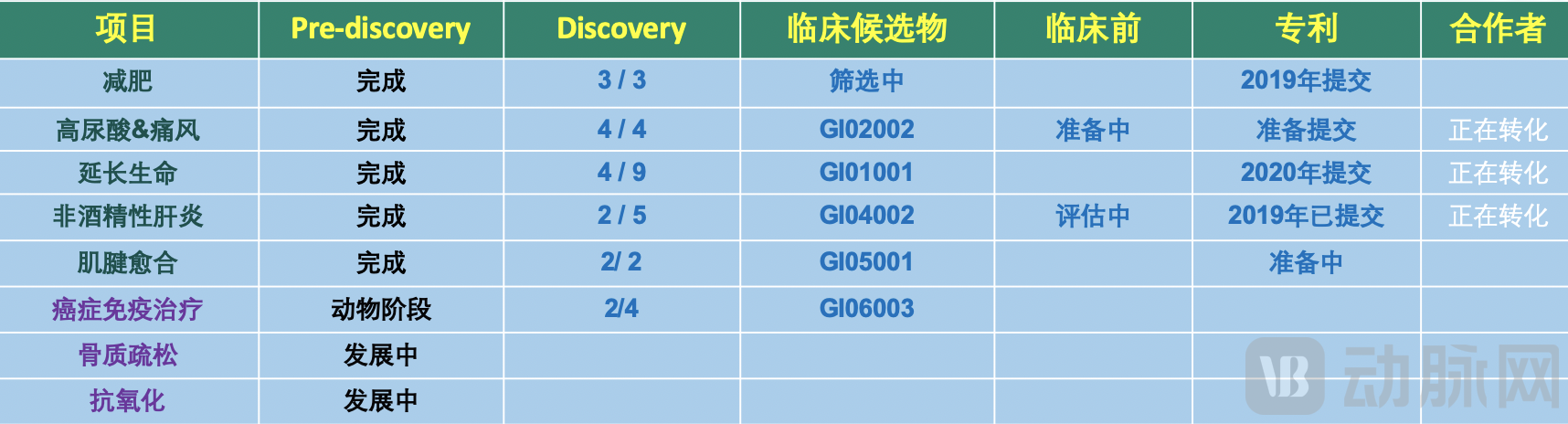
Based on this drug discovery system, GigaCeuticals has independently established multiple preclinical pipelines, advancing drug development in therapeutic areas such as lifespan extension, obesity, hyperuricemia, non-alcoholic steatohepatitis (NASH), and osteoporosis, all of which have demonstrated highly promising results in animal studies. For instance, in the lifespan extension program, GigaCeuticals has identified a candidate compound capable of extending the lifespan of mice by 145 days.
In addition to the aforementioned pipeline layout, GigaCeuticals can theoretically design drugs targeting up to 800 targets. Over a dozen compound functionality patents have already been filed for these programs, which are currently in the Preclinical Candidate (PCC) stage. The company's future pipeline will expand to cover 30 disease areas.
In addition to developing its proprietary pipeline, GigaCeuticals also employs two additional service models within its business framework: SaaS platform services, and technical services for drug molecular design and screening. Collaborations with leading research universities have yielded significant R&D outcomes, with multiple patent applications and academic publications forthcoming. Meanwhile, the company is partnering with pharmaceutical manufacturers, integrating multiple approaches such as artificial intelligence, CADD, and MD to deliver novel molecular designs as requested by clients, accelerate partners' R&D timelines, and ultimately benefit patients.
GigaCeuticals is a novel AI-driven innovative drug R&D company. It holds proprietary intellectual property rights to the DLEPS system (Lingsu System), a target-agnostic platform based on deep learning and gene fingerprints. The company is dedicated to the research and development of innovative therapeutics for various diseases, including aging, obesity, gout, non-alcoholic hepatitis, and cancer.
Dr. Xie Zhengwei, founder of the company, is a Researcher and Assistant Professor at Peking University Health Science Center. With an interdisciplinary background in systems biology, artificial intelligence algorithms, pharmacology, and molecular and cellular biology, his research has long been dedicated to the mechanisms of aging and AI algorithms. His early research findings have been published in *Cell*, *Aging Cell*, and *Bioinformatics*. He has served as principal investigator or co-investigator on five National Natural Science Foundation of China (NSFC) projects.
Currently, Dr. Xie Zhengwei is primarily responsible for developing the core algorithms, neural networks, and deep learning methods for the artificial intelligence platform, closely integrating them with medicinal chemistry and systems biology to improve the prediction accuracy of compound activity to 30–70%.
Another Head of Medicinal Chemistry at GigaCeuticals is Wang Jingxiang. He graduated from Shihezi University in Xinjiang (a national "Project 211" key university) with a degree in Pharmaceutical Engineering. His research focuses include oncology, immunology, diabetes, and gout. He has led and participated in the R&D of multiple drug candidates and holds related research patents. Currently, he oversees the Medicinal Chemistry Virtual Screening Platform, which is utilized for predicting drug physicochemical properties, target activity, enzymatic and cellular activities, microsomal enzyme stability, plasma protein binding (PPB), drug-drug interactions, pharmacokinetic parameters, toxicity, and more.
Finally, GigaCeuticals' pharmacology validation platform is overseen by Gao Mingjing. With extensive experience in gene cloning, screening, and research on immune response mechanisms, his work focuses on diabetes, gout, arthritis, Alzheimer's disease (AD), Parkinson's disease (PD), cancer, hypertension, and hyperlipidemia. Currently managing the company's pharmacology and toxicology validation platform, he has established eight disease models and is developing five new ones. The platform provides testing services for enzymes, cells, plasma, and organs, as well as in vivo and in vitro pharmacodynamic, pharmacokinetic, and toxicological assessments.
It is reported that GigaCeuticals is currently securing a new round of financing. The proceeds will be allocated to advance its drug pipeline to the Investigational New Drug (IND) stage, as well as to fund platform development, talent recruitment, and R&D. In the coming months, GigaCeuticals will establish a drug R&D platform with an investment of tens of millions of RMB. Its long-term strategy will prioritize self-sustaining operations and original R&D, ultimately aiming to become a next-generation pharmaceutical enterprise driven by emerging technologies such as artificial intelligence.