

The First Online Diagnosis is Finally Here, Who Will Be the Biggest Winner in the Industry?
Recently, a document about the first diagnosis of Internet medical treatment quickly ignited industry enthusiasm: the General Office of the National Health Commission agreed to allow Beijing to carry out the pilot project of standardizing the first diagnosis of Internet medical treatment.
This pilot project relies on Beijing Children's Hospital, Capital Medical University, and Capital Children's Medical Center, Capital Medical University, focusing on three specialties: children's growth and development, children's nutrition, and children's skin diseases. The pilot period will run from January to December 2026. Based on the summary of work experience at the pilot institutions, the National Health Commission will conduct an evaluation at an appropriate time.
Since internet medical services gained policy recognition for follow-up consultations on common and chronic diseases in 2018, whether the scope of services could be expanded to include first consultations for specific diseases has been an expectation the industry has continuously focused on for 8 years. From the end of 2022 to early 2023, temporary policies allowing first consultations via internet medical services for COVID-19 addressed urgent patient needs during a special period and also showed the industry the potential for loosening restrictions on first consultations.
Nowadays, under the normalized medical service system, the policy window for the first diagnosis of Internet medical treatment has finally been opened a crack. However, after the industry's initial excitement, it is even more necessary to consider the deep value and future direction of this pilot from a rational perspective.
It needs to be clear that the pilot program for first-visit online medical consultations has well-defined boundaries, including multiple limitations on medical institutions, departments, and attending physicians.
First, the selection of medical institutions for the initial diagnosis pilot was not accidental but based on a comprehensive evaluation from multiple dimensions. The competent authorities considered core indicators such as the comprehensive management capabilities of medical institutions, the volume and operational experience of internet-based follow-up consultations, the scale of out-of-town patients, and the professional service capacity of the physician team. Ultimately, two Class A tertiary hospitals with strengths in pediatric care were chosen based on the actual situation of medical institutions in Beijing. The three major specialized directions of the pilot were also carefully screened, balancing the high-frequency medical needs of children while considering the feasibility and safety of internet-based medical treatment.
Different from previous internet-based follow-up consultations, this pilot initiative for first-time internet diagnosis and treatment is a beneficial attempt conducted within the limits of designated institutions and specialized departments while strictly adhering to the bottom lines of safety and quality in medical care. Within the framework of the pilot, doctors can directly complete the initial diagnosis of patients via the internet and issue prescriptions based on the patient’s condition, marking a breakthrough exploration in the model of internet-based medical treatment.
From the operation situation in the few days since the pilot project was implemented, the accessibility of Internet-based first diagnosis services is relatively high.
According to the pilot arrangement, patients can access the internet hospital sections of either the "Beijing Children's Hospital" mini-program or the "Capital Children's Medical Center" official account. They can choose appointments marked as "first consultation" or select relevant departments. Appointments opened on the afternoon of January 31, and patients could have their first online consultation as early as February 1.
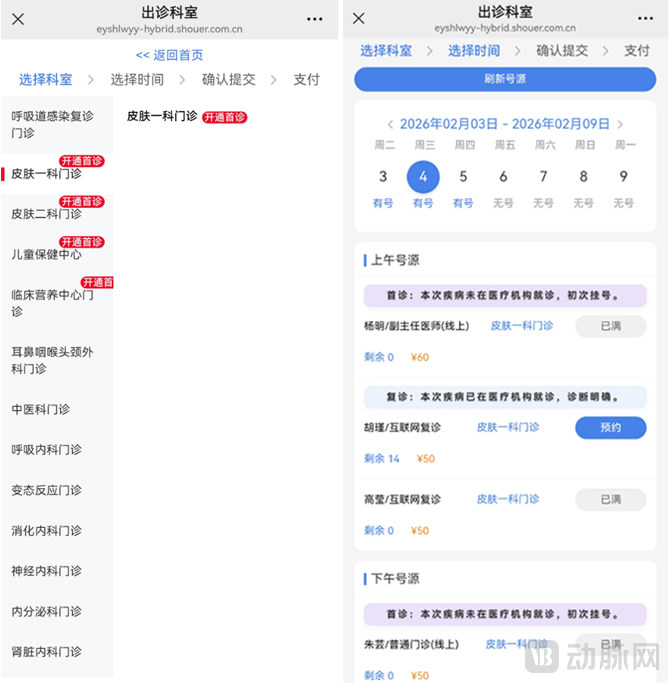
Appointment Status for Initial Consultations at the Capital Institute of Pediatrics Internet Hospital (As of 15:00 on February 3)
Taking the Capital Pediatric Medical Center as an example, VCBeat has observed over the past few days that the overall supply and demand for its online first-visit appointments have remained balanced. Among these, appointments for pediatric dermatology and pediatric growth and development are relatively in high demand, while those for clinical nutrition are relatively more available. As of 3 PM on February 3, all available same-day appointments for pediatric dermatology had been booked, with only a small number remaining for the next day; however, appointments for the 5th were relatively plentiful. Based on the current operational trends, this pilot program is not merely a symbolic gesture with "much ado about nothing," but rather an effective exploration that genuinely meets patient needs.
Overall, the first-visit pilot is a small-scale, precisely matched supply-and-demand policy experiment. Its core purpose is to accumulate experience and verify models within a controllable range. In the short term, the direct changes it brings to internet healthcare companies are limited.
Therefore, the industry value of this pilot project is more reflected at the symbolic level.It sends a key signal: the regulatory authorities always pay attention to patients' medical needs and the industry's development expectations, and have opened a policy window for first-time consultations under the full consideration of medical safety. This signal allows the industry to clearly see that, based on medical needs and industry expectations, the scope of first-time consultations may gradually expand in the future, giving the industry more confidence in its long-term development.
Although the pilot program for first diagnosis does not directly cover internet healthcare platforms, the indirect opportunities it brings to internet healthcare companies are also significant and should not be overlooked.
First, at the specialist demand level, the choice of the first-consultation pilot provides an important reference for the specialized layout of Internet healthcare platforms.
This pilot program for the first diagnosis further confirms that pediatric growth and development, pediatric nutrition, and pediatric dermatology remain fields with strong cross-regional medical demand.
In recent years, focusing on specialized disciplines and specific diseases, and establishing in-depth service capabilities have become important strategic initiatives for Internet healthcare platforms. The three major specialties selected for this pilot project also correspond to several high-potential health consumption sectors. In the field of children's growth and development, bone age testing and height management-related services and products are in a phase of rapid market expansion; specialized medical foods corresponding to pediatric clinical nutrition are gradually moving towards personalization and precision; innovative drugs and professional care products in pediatric dermatology precisely meet parents' core needs for children's safe medication.
Internet healthcare platforms can leverage their flexible operating mechanisms and strong resource integration capabilities to continuously cultivate high-demand niche markets, further enrich service offerings, meet users' multi-level needs, and build differentiated competitive advantages in specialized disease fields.
Secondly, at the user penetration level, the implementation of the first-consultation pilot helps to encourage more patients to try online medical services, enhance public trust in internet healthcare, and thereby increase the service penetration rate across the entire industry.
According to the report data from the China Internet Network Information Center, as of June 2025, the number of internet healthcare users in China is approximately 393 million, with a penetration rate of 35% (the percentage of internet healthcare users out of the total number of internet users).
Looking at the overall data changes, since 2022, the number of internet healthcare users has remained around 400 million, with a trend towards stability. The main fluctuations occur in the second half of the year, which typically sees higher numbers than the first half. This is likely due to increased demand for online medical consultations during the flu season. The user growth curves of major internet healthcare platforms also show signs of slowing growth rates.
Digging deeper into the reasons behind this, they mainly stem from two aspects: On one hand, for public internet hospitals, online medical consultation services are limited to follow-up scenarios. Moreover, the vast majority of hospitals have set strict thresholds for follow-ups, requiring patients to first complete an offline visit at the hospital's department before being able to pursue an online follow-up, which restricts patients' willingness to use the service. On the other hand, for third-party internet healthcare platforms, user engagement remains heavily reliant on the medication purchasing scenario—many users only approach these platforms due to their need to buy medicines, and most patients still lack in-depth experience with online medical consultation services.
In short,The current internet healthcare industry is in the development stage of "existing users, existing market," and the implementation of the first-diagnosis pilot is expected to become a key fulcrum for driving incremental growth.First-visit services can better cover patient groups who have not previously accessed internet-based medical consultations, as well as those patients kept outside the closed loop of initial and follow-up visits at the hospital. If the number of new patients reaches a sufficient scale, it will inject new growth vitality into the industry and drive internet healthcare into another phase of incremental expansion.
There is no doubt that the pilot program for initial diagnosis is a significant opportunity for the internet healthcare industry, butAs the pilot program gradually progresses, the industry needs to think one step further: If internet-based first consultations at top-tier hospitals become routine in the future, how should third-party platforms accurately position themselves?
The selection of top-tier hospitals in Beijing for the pilot program of initial diagnosis can be attributed to the uneven distribution of high-quality resources. According to the Beijing Municipal Health Commission, Beijing has a concentration of high-quality medical resources and a significant demand from out-of-town patients seeking medical care in the city, with some key departments of tertiary hospitals having a high proportion of out-of-town patients. The introduction of internet-based initial diagnosis will further support experts in Beijing's hospitals to leverage their expertise and provide more efficient online diagnostic services to out-of-town patients.
In recent years, the country has been vigorously promoting the balanced allocation of high-quality medical resources. Among these efforts, the National Medical Centers and National Regional Medical Centers, built upon high-level hospitals across the regions, have assumed important responsibilities. The long-term goal is to support the construction of a tiered medical treatment system and reduce cross-regional patient visits. Although internet healthcare platforms have also played a significant role in optimizing resource allocation, it is undeniable that large tertiary hospitals remain the main force in providing high-quality medical resources.
Based on the above situation, if the pilot scope for the first diagnosis in internet medical treatment expands in the future, it may be prioritized within the top-tier tertiary hospital system.
Moreover, reviewing the development process of Internet healthcare, the medical insurance policy was once a key policy that the industry eagerly anticipated. However, from the actual implementation situation, the vast majority of platforms have not gained large-scale benefits. The ideal state of "one consultation, one reimbursement" has not only failed to appear but is also almost impossible to achieve in the future. Currently, enterprises that can indirectly benefit through medical insurance payments either deeply empower regional medical insurance fund supervision or connect Internet medical insurance drug purchases through the O2O model.
From the implementation path of medical insurance policies, the promotion logic of the first-consultation pilot may have similarities, meaning the scope of policy benefits released is relatively limited and more inclined toward public medical institutions.Under the premise of uncertainty regarding the future scope of the first-visit policy, internet healthcare companies may need to prepare for this: if the first-visit is mainly advanced within the large tertiary hospital system, third-party platforms need to more clearly identify their own differentiated positioning.
Therefore, for the platform, further collaboration and complementarity with physical hospitals are still needed to build irreplaceable ecosystem value.For example, becoming a digital specialty operation partner for hospitals, utilizing technical capabilities and off-campus resources to jointly build an efficient online specialty service center; collaboratively constructing a robust and reliable medical, pharmaceutical, and insurance closed loop, especially for specific specialties and diseases, by co-developing more precise payment products with commercial insurance companies to enhance the accessibility of innovative drugs and devices; under the premise of compliance, fully leveraging integrated data accumulated from both inside and outside the hospital to assist hospitals in conducting clinical research...
In summary, when considering the policy opportunity of the first-consultation pilot, internet healthcare companies should move beyond a simple traffic-focused mindset. They need to base their strategies on the current state and future trends of the medical service system, adopting a broader perspective to consider how platforms can enhance the operational efficiency of the healthcare system. The industry should focus more on leveraging its technological and operational strengths to address the shortcomings of the existing healthcare system, rather than adopting an individualistic approach that blindly chases short-term traffic and sales revenue brought by the first consultation.
Finally, there is one more point that warrants vigilance across the entire industry. The phenomenon of "instant prescriptions" being issued online after patients select a diagnosis continues to erode the foundation of the industry's development.Nowadays, the window for the first-consultation pilot program has opened, and there are more possibilities for the future development of the industry. At this critical juncture, platforms should adhere to the essence of healthcare and avoid rushing for short-term gains. Only in this way can the internet healthcare industry develop more steadily, allowing companies to go further and achieve greater success.