

Takeda China and Chinese Red Cross Foundation Announce Strategic Collaboration to Advance Rare Disease Ecosystem in China

Takeda
Biopharmaceutical Manufacturer
Beijing, June 202128Date /PR Newswire/ --Takeda ChinaTakeda and the Chinese Red Cross Foundation announced a strategic partnership in Beijing. Through a series of comprehensive solutions, both parties will jointly promote industry development in rare diseases such as Fabry disease, Gaucher disease, and hereditary angioedema, enhance the accessibility of innovative medicines, optimize whole-course patient management, and advance the construction of care and diagnosis and treatment systems for rare disease patients in China.

Chinese Red Cross Foundation and Takeda China Announce Strategic Partnership in Beijing
On the same day, Takeda China announced its innovative drug Takhazyro for the standard treatment of hereditary angioedema (HAE)®(Lanadelumab Injection) has been officially launched, bringing an innovative treatment option for HAE patients in China.

TAKHZYRO® China Launch Ceremony
Mr. Bei Xiaochao, Vice Chairman and Secretary-General of the Chinese Red Cross Foundation; Prof. Li Dingguo, Chairman of the Shanghai Rare Disease Prevention and Treatment Foundation; Ms. Wang Lin, Secretary-General of the Joint Conference of Chairpersons of China Rare Disease Academic Societies; Prof. Yin Jia, Director of the Department of Allergy at Peking Union Medical College Hospital, Chinese Academy of Medical Sciences, and Prof. Zhi Yuxiang; Ms. Wang Yi'ou, Secretary-General of the Beijing Illness Challenge Foundation; and Mr. Shan Guohong, President of Takeda China, along with numerous other distinguished guests, attended the event and delivered speeches.
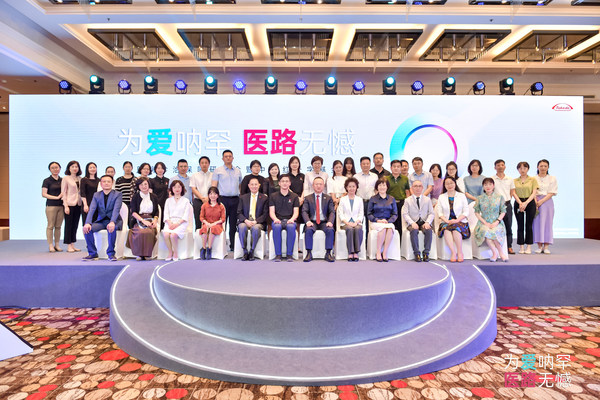
Group Photo of Distinguished Guests
Under this strategic partnership, both parties will collaborate to develop comprehensive rare disease solutions tailored to the actual needs of patients. The cooperation will encompass six key areas: enhancing diagnostic and treatment capabilities for rare diseases, elevating the overall standard of care for rare disease patients in China, shortening the time to diagnosis for rare diseases, strengthening public and patient awareness, establishing a digital comprehensive disease management system for rare disease patients, and jointly discussing the establishment of a dedicated fund for rare disease-related initiatives. Through a series of activities and programs including physician education, patient education, patient assistance, and patient care, the partnership will advance the development of rare disease management in China, particularly in the fields of hereditary angioedema, Fabry disease, and Gaucher disease, thereby improving patient access to innovative medicines and enhancing comprehensive disease management capabilities. Over the next two years, both parties will progressively implement these initiatives to jointly drive the development of the rare disease sector.
“We are pleased to establish this strategic partnership with Takeda China, enabling long-term collaboration across multiple areas, including physician training, patient education, and patient assistance.”Bei Xiaochao, Vice President and Secretary-General of the Chinese Red Cross FoundationHe stated: “We believe that by leveraging Takeda's extensive experience in the field of rare diseases and integrating the resource platform of the Chinese Red Cross Foundation in related areas, this collaboration is expected to further enhance the diagnosis and treatment standards for rare diseases in China, drive industry development in the rare disease sector, bring tangible health benefits to patients, and contribute to the Healthy China initiative.”
As one of the companies deeply committed to the rare disease field for many years, Takeda has consistently spared no effort to drive the development and advancement of rare disease care. Since entering China 27 years ago, Takeda has continuously partnered with various sectors of society to promote public education on rare diseases such as hemophilia, lysosomal storage disorders (LSD), and hereditary angioedema (HAE). The company has also supported the establishment and development of Chinese patient organizations for HAE, helping to raise public awareness of these conditions. Meanwhile, Takeda has collaborated with multiple stakeholders to advance the standardization of diagnosis and treatment for rare diseases in China, while implementing patient care and assistance programs to provide ongoing support to rare disease patients nationwide.
“It is a great honor to establish a long-term strategic partnership with the Chinese Red Cross Foundation to jointly advance the further upgrade of China’s rare disease diagnosis and treatment ecosystem.”Mr. Shan Guohong, President of Takeda Chinastated, "Upholding the 'patients first' principle, Takeda has consistently remained closely attuned to the unmet needs of rare disease patients in China. While focusing on accelerating the introduction of innovative rare disease products, Takeda actively explores diagnostic, treatment, and healthcare access solutions, committed to delivering comprehensive patient care to create healthier lives and a brighter future for rare disease patients in China."
China has a substantial rare disease patient population, with the current estimated total exceeding 20 million and over 200,000 new cases reported annually. In recent years, the government has placed high priority on the rare disease patient community and introduced multiple supportive policies, driving rapid development in China's rare disease sector. However, due to factors such as insufficient public awareness and the uneven distribution of medical information and resources, rare disease patients in China continue to face numerous challenges. These include low diagnosis rates, high misdiagnosis rates, and the unavailability of appropriate therapeutic drugs for certain rare diseases in China, leaving patients facing a severe shortage of accessible healthcare and medications. Many patients therefore have an extremely urgent need for the introduction of targeted innovative therapies.
Rare diseases represent one of Takeda’s key therapeutic areas globally. In recent years, Takeda has continuously strengthened its R&D capabilities and product pipeline in rare diseases, actively aligning with China’s favorable policies supporting rare diseases to accelerate the introduction of innovative therapies. The company has already launched relevant drugs in China for the treatment of hemophilia and Fabry disease. Today, Takeda China announced another rare disease therapy under its portfolio—Takhzyro, the world’s first monoclonal antibody drug for the standard treatment of HAE.®(Lanadelumab Injection) has officially launched in China. Dazeyou®(Lanadelumab Injection) is recommended by the US and Canadian HAE management guidelines as a first-line standard therapy for HAE.[1],[2], selectively inhibits activated plasma kallikrein in patients, thereby preventing disease attacks.
Professor Zhi Yuxiang, Department of Allergy, Peking Union Medical College Hospital, Chinese Academy of Medical Sciencesstated: "Standardized treatment is crucial for controlling attacks of hereditary angioedema. I am very pleased that lanadelumab, a targeted therapeutic agent, is now available in China, bringing HAE patients one step closer to the goal of 'zero swelling attacks,' and will also mark a brand-new starting point for the advancement of diagnosis and treatment for hereditary angioedema."
Hereditary angioedema (HAE) is a rare autosomal dominant genetic disorder. Deficient levels and/or impaired function of C1 esterase inhibitor (C1-INH) in the body lead to unpredictable acute angioedema attacks affecting multiple sites, including the extremities, face, genital skin, respiratory tract, and gastrointestinal mucosa. Gastrointestinal mucosal attacks are accompanied by severe colic, nausea, and vomiting, which severely impact patients' daily work, study, life, and emotional well-being. For most HAE patients, attacks are unpredictable, and laryngeal attacks progress rapidly, potentially leading to asphyxiation and death. Statistics indicate that 58.9% of HAE patients in China have experienced laryngeal edema.[3], its mortality rate can reach up to 40%[4], is one of the leading causes of death among HAE patients. In May 2018, the First Catalog of Rare Diseases, issued by five departments including the National Health Commission, listed HAE as one of the first 121 rare diseases.[5]。
Takhzyro®(Lanadelumab Injection) was first approved for marketing in the United States in 2018; and in December 2020, it received marketing approval in China, filling the long-standing gap in targeted therapy for HAE in China.
Declaration:
1. This article is intended to provide cutting-edge medical and pharmaceutical information and does not constitute a recommendation or promotion of any drug or diagnostic and treatment regimen.
2. For more information regarding diseases, medications, diagnosis, or treatment, please consult a healthcare professional.
About Takeda Pharmaceutical Company Limited
Takeda Pharmaceutical Company Limited (Tokyo Stock Exchange ticker: 4502; New York Stock Exchange ticker: TAK) is a global, values-based, R&D-driven biopharmaceutical company headquartered in Japan. Takeda is committed to translating scientific discoveries into highly innovative medicines to safeguard patients' health and secure a brighter future for them. We focus our research and development on four therapeutic areas: oncology, gastroenterology, neuroscience, and rare diseases, with dedicated R&D investments in plasma-derived therapies and vaccines. We remain dedicated to developing highly innovative medicines by pioneering novel treatment modalities and strengthening our collaborative R&D engine to build a robust and diverse pipeline that helps improve people's lives. Our employees across approximately 80 countries and regions work alongside local healthcare partners to deliver better health outcomes for patients worldwide.
Takeda entered China in 1994. Takeda China's headquarters is located in Shanghai, with its main business centers in mainland China situated in cities and regions including Beijing, Shanghai, Tianjin, Guangzhou, and the Hong Kong Special Administrative Region. The company maintains offices in major cities across China and currently employs over 2,000 staff members in the country. With China's economic development and the growing demand for healthcare, China has become one of Takeda's most important emerging markets globally.
For more information, please visithttps://www.takeda.com
Forward-Looking Statements
This press release and any other materials distributed in connection therewith may contain forward-looking statements, views, or opinions regarding Takeda's future business, future conditions, and operating results, including Takeda's estimates, forecasts, objectives, and plans. Forward-looking statements often include, but are not limited to, words such as "objective," "plan," "believe," "hope," "continue," "expect," "aim," "intend," "ensure," "will," "may," "should," "would," "might," "anticipate," "estimate," "forecast," or similar expressions, or the negative thereof.
The forward-looking statements in this document are based solely on Takeda's estimates and assumptions as of the date of publication. Such forward-looking statements do not constitute a guarantee by Takeda or its management of future performance and involve known and unknown risks, uncertainties, and other factors, including, but not limited to: economic conditions affecting Takeda's global operations, including the macroeconomic environments in Japan and the United States; competitive pressures and developments; changes in applicable laws and regulations; the success or failure of product development programs; decisions or the timing of decisions by regulatory authorities; fluctuations in interest and currency exchange rates; claims or concerns regarding the safety or efficacy of marketed products or product candidates; the timing and impact of post-merger integration efforts for acquired companies; and the ability to divest assets that are non-core to Takeda's operations and the timing of any such divestitures, all of which could cause Takeda's actual results, performance, achievements, or financial condition to differ materially from any future results, performance, achievements, or financial condition described or implied by such forward-looking statements.
For more information regarding the above and other factors that may affect Takeda’s results, performance, achievements, or financial condition, please refer to Takeda’s latest Annual Report on Form 20-F filed with the U.S. Securities and Exchange Commission, “Item 3. Key Information—D. Risk Factors,” and other reports, available on Takeda’s website.https://www.takeda.com/investors/reports/sec-filings/orwww.sec.gov。Takeda's future results, performance, or financial position may differ materially from those expressed or implied by the forward-looking statements. Persons receiving this press release should not place undue reliance on any forward-looking statements. Takeda assumes no obligation to update any forward-looking statements contained in this press release or any other forward-looking statements that the Company may issue, except as required by law or securities exchange rules. Historical performance is not indicative of future results, and Takeda's performance in this press release is not intended to be, nor should it be construed as, an estimate, forecast, or projection of Takeda's future performance.
[1] Busse P J , Christiansen S C , Ms M A R , et al. US HAEA Medical Advisory Board 2020 Guidelines for the Management of Hereditary Angioedema[J]. The Journal of Allergy and Clinical Immunology: In Practice, 2020.
[2] Betschel S , Badiou J , Binkley K , et al. The International/Canadian Hereditary Angioedema Guideline[J]. Allergy Asthma and Clinical Immunology, 2019, 15:72.
[3] Busse P J, et al. The Journal of Allergy and Clinical Immunology: In Practice, 2021, 9(1):132-150
[4]National Health Commission, Office of the Expert Committee on Diagnosis, Treatment and Security of Rare Diseases (Peking Union Medical College Hospital). Guidelines for the Diagnosis and Treatment of Rare Diseases (2019 Edition). 2019.
[5]National Health Commission, Ministry of Science and Technology, Ministry of Industry and Information Technology, National Medical Products Administration, National Administration of Traditional Chinese Medicine. Catalogue of Rare Diseases (First Batch), Guo Wei Yi Fa [2018] No. 10.http://www.nhc.gov.cn/yzygj/s7659/201806/393a9a37f39c4b458d6e830f40a4bb99.shtml