

Novartis' First-in-Class siRNA Therapy Inclisiran Administered in China for the First Time at Boao Lecheng

Novartis China
Innovative Drug Developer
HAIKOU, July 2, 2021 /PRNewswire/ -- This morning, Novartis's blockbuster small interfering RNA (siRNA) lipid-lowering drug LEQVIQ®The press conference for the debut of (Inclisiran) in China's Boao Lecheng was held in Haikou, announcing that the first dose in China of Novartis Pharmaceuticals' innovative cholesterol-lowering drug Inclisiran was administered yesterday at Boao Super Hospital in the Hainan Boao Lecheng Pilot Zone. The first batch of authorized administration hospitals also includes the Lecheng Campus of Hainan Provincial People's Hospital.
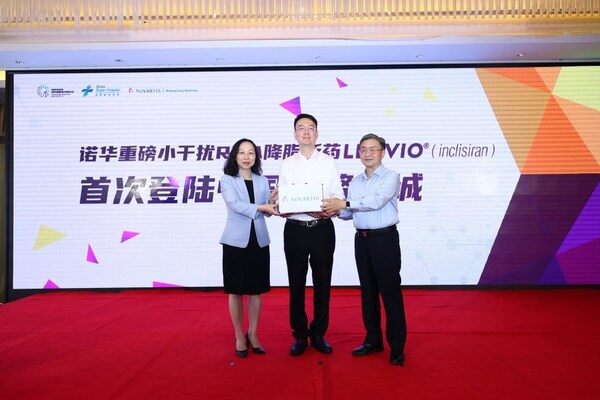
Group photo at the launch ceremony, from left: Xu Yunlan, Vice President of Communications & Patient Engagement, Novartis China; Gu Gang, Party Secretary and Director of the Lecheng Administration; and Fang Pihua, Executive Vice President of Boao Super Hospital.
As the first-in-class small interfering RNA (siRNA) therapy designed to lower low-density lipoprotein cholesterol (LDL-C), Inclisiran was approved in Europe in December 2020 for the treatment of hypercholesterolemia and mixed dyslipidemia in adults. Its innovative siRNA mechanism of action enables patients to achieve lipid-lowering efficacy with only two subcutaneous injections per year.
Reduced Dosing Frequency, Pioneering a New Era in Lipid-Lowering Therapy
Globally, cardiovascular disease is the "number one killer" threatening human health, ranking first among global causes of death.[1]With socioeconomic development, the prevalence of cardiovascular diseases in China has shown a continuous upward trend. Data indicates that the number of patients with cardiovascular diseases has reached 330 million, with an average of approximately 3.5 million deaths from cardiovascular diseases annually.[2]. Hyperlipidemia is one of the major risk factors for atherosclerotic cardiovascular disease (ASCVD); however, approximately 80% of patients at high cardiovascular risk with dyslipidemia in China still fail to achieve the guideline-recommended target levels for low-density lipoprotein cholesterol (LDL-C).[3][4][5][6], finding a safe, effective, and highly adherent lipid-lowering drug has always been a challenge for such patients.
Although existing statin therapies are highly effective in lowering LDL-C, the Chinese population faces a higher risk of drug-induced myopathy and elevated liver enzymes with high-dose statins compared to other ethnic groups. Consequently, most Chinese patients can only tolerate moderate-dose statin therapy, and poor treatment adherence further contributes to a low rate of achieving LDL-C treatment targets. Moreover, high-dose statin use can upregulate PCSK9 protein expression, which to some extent limits its LDL-lowering efficacy. Inhibiting PCSK9 biosynthesis can more effectively reduce circulating LDL-C levels.
“For the PCSK9 inhibitors currently marketed in China, patients require subcutaneous injections every two weeks or once a month, amounting to at least 12 injections annually. This not only challenges patient adherence but also increases their financial burden.”Professor Huo Yong, Peking University First HospitalHe/She explained, “Inclisiran can continuously inhibit hepatic PCSK9 synthesis and reduce LDL-C levels, with a duration of action lasting up to six months. In other words, patients only require two injections per year to effectively control their lipid levels.”
The ORION clinical trials demonstrated that, compared with the placebo group, inclisiran achieved a 52% reduction in LDL-C in patients who failed to reach LDL-C targets despite treatment with maximally tolerated statin therapy.[7][8]。
Leveraging Policy Tailwinds: Advancing Innovative DrugsInclisiranAligned with Global Standards
The Hainan Boao Lecheng International Medical Tourism Pilot Zone (abbreviated as the "Lecheng Pilot Zone") is the only national international medical tourism industrial park approved by the State Council in 2013. It enjoys preferential policies, including expedited registration and approval for imported medical devices and pharmaceuticals, as well as regulatory access for medical technologies intended for clinical application and research. Supported by the "Nine National Policies" special medical policy of the Lecheng Pilot Zone, Boao Lecheng has become a window in China for the application of globally innovative pharmaceutical technologies.
Academician of the Chinese Academy of SciencesGe Junbopointed out, “Inclisiran is the first RNA therapeutic for cardiovascular disease. Its launch in Boao marks that China's cardiovascular disease treatment has accelerated into the RNA therapeutic era. Moreover, due to its infrequent dosing regimen, many cardiovascular experts refer to it as the 'vaccine' for the cardiovascular field. It is believed that with the continued rollout of Inclisiran in China, it will help bring forward the turning point for cardiovascular events nationwide.”
Zhang Ying, President, Novartis Pharma (China)He/she emphasized, "It is a great pleasure that Novartis' blockbuster cardiovascular product, Inclisiran, has been introduced in Boao, bringing this novel therapy to China's hyperlipidemia treatment landscape. Novartis boasts a comprehensive product portfolio and a robust R&D pipeline in the cardiovascular field, and is committed to improving the treatment and management of cardiovascular patients. Moving forward, we will continue to drive the introduction of more breakthrough innovative medicines, enabling Chinese patients to gain earlier access to the world's most cutting-edge therapies."
[1] European Heart Network. European Cardiovascular Disease Statistics 2017 edition. Available from: http://www.ehnheart.org/cvd-statistics/cvd-statistics-2017 [Last accessed: November 2020].
[2]Writing Committee of the Report on Cardiovascular Health and Diseases in China. Summary of the Report on Cardiovascular Health and Diseases in China 2019. Chinese Circulation Journal, September 2020, Vol. 35, No. 9 (Serial No. 267). Chinese Circulation Journal, September, 2020, Vol. 35 No. 9 (Serial No. 267)
[3] European Heart Network. European Cardiovascular Disease Statistics 2017 edition. Available from: http://www.ehnheart.org/cvd-statistics/cvd-statistics-2017 [Last accessed: November 2020].
[4] Bruckert E, Parhofer KG, Gonzalez-Juanatey JR, et al. Proportion of High-Risk/Very High-Risk Patients in Europe with Low-Density Lipoprotein Cholesterol at Target According to European Guidelines: A Systematic Review. Adv Ther. 2020;37(5):1724–1736.
[5] Lansberg P, Lee A, Lee ZV, et al. Nonadherence to statins: individualized intervention strategies outside the pill box. Vasc Health Risk Manag. 2018;14:91–102.
[6] Wong ND, Young D, Zhao Y, et al. Prevalence of the American College of Cardiology/American Heart Association statin eligibility groups, statin use, and low-density lipoprotein cholesterol control in US adults using the National Health and Nutrition Examination Survey 2011–2012. J Clin Lipidol. 2016;10(5):1109–1118.
[7] Raal F, Kallend D, Ray K, et al. Inclisiran for Heterozygous Familial Hypercholesterolemia. N Engl J Med. 2020;382(16):1520–1530.
[8] Ray K, Wright R, Kallend D, et al. Two Phase 3 Trials of Inclisiran in Patients with Elevated LDL Cholesterol. N Engl J Med. 2020;382(16):1507–1519.