

The First AI Surgical Navigation Device Approved for Class III Certification! Infervision Medical Enters a New Track

Infervision
Artificial Intelligence Product Developer
Recently, the Dragon Acupoint Puncture Surgical Navigation Device, independently developed by a subsidiary of Infervision Medical Technology Co., Ltd., has passed the NMPA review and approval, achieving another milestone breakthrough in the AI + treatment field in China.
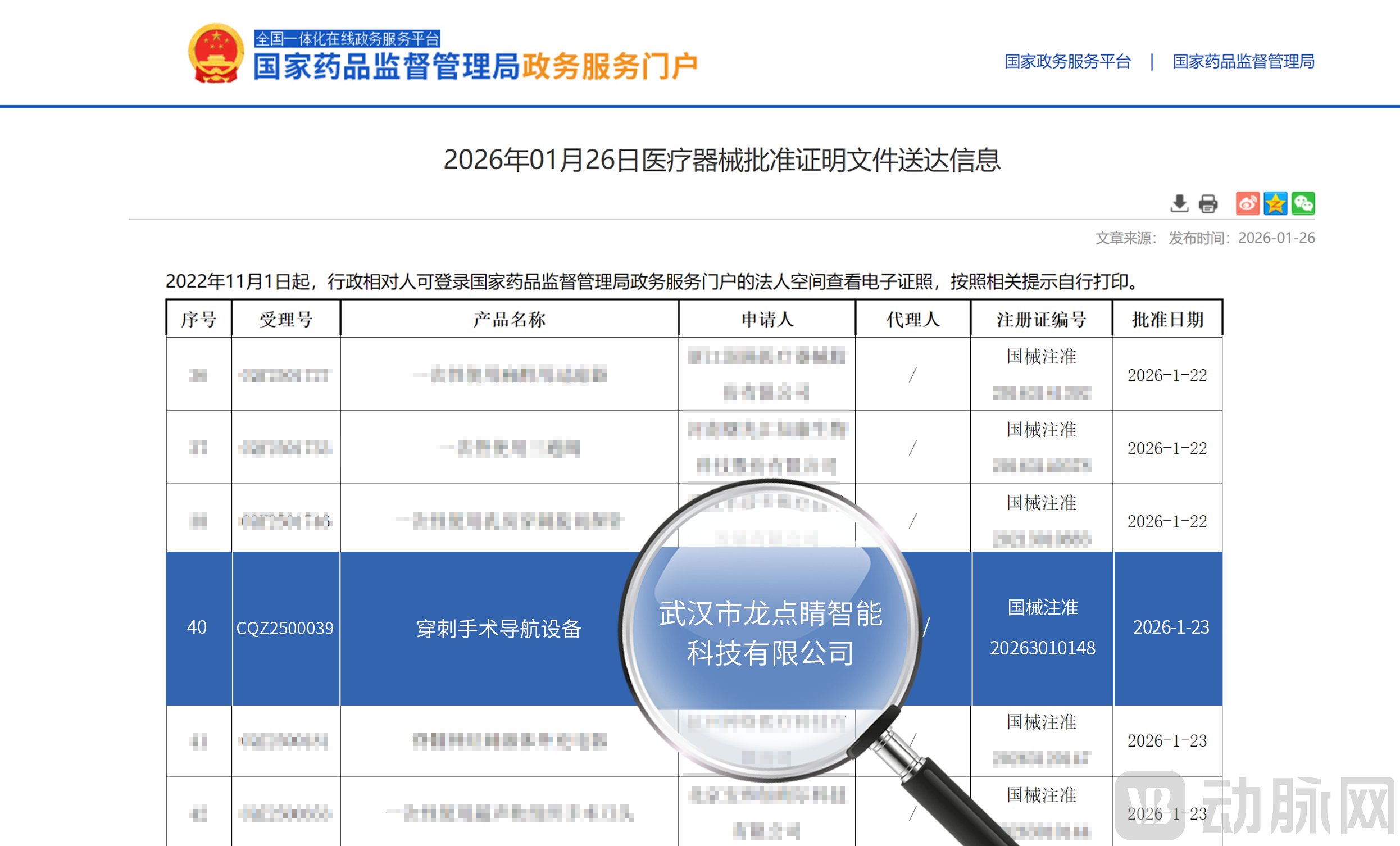
Dragon Dianjing Puncture Surgical Navigation Device Approved by NMPA on January 23, 2026
Previously, nearly 200 AI (including deep learning) medical applications have been approved in China, but the vast majority are concentrated in the disease screening and diagnosis process. NowDragonPuncture Surgery Navigation EquipmentSuccessful market access during the intraoperative phase not only打通了基于AI的“筛-诊-治-防”、“术前-术中-术后”诊疗全流程 but will also drive more intelligent applications serving other diseases into the treatment field, accelerating the commercialization of the entire medical AI track.
Unlike medical AI companies that focus solely on software and algorithms, Infervision believes that "AI empowering hardware" is a crucial route to upgrading products in the treatment field. The cutting-edge technology of the Long Dianjing puncture surgery navigation device serves as the best evidence of AI empowering hardware. As the owner of this Class III medical device registration certificate, Infervision Medical will also redefine its role in intelligent healthcare due to this market access.
Entering the navigation system means that it has successfully transformed from an "AI solutions provider" into a "smart medical device R&D enterprise," leaping into a new market.
Breaking through commercialization in a new environment is certainly not easy, but before Infervision Medical entered, comprehensive deployment at the ecosystem level had already been made.
The instructions for the medical device registration certificate issued by NMPA show that the current application scope of the Long Dianjing puncture surgery navigation equipment focuses on percutaneous puncture scenarios in the lungs and abdomen, closely related to Infervision's previous artificial intelligence ecosystem layout in chest diagnostics.
Traditional Percutaneous Puncture Pathways Have a Series of Flaws. For Example, Doctors Need to Accurately Replicate the "Virtual Angle" from 2D Images in a 3D Human Body While Dealing with Dynamic Interferences Such as Breathing and Body Position, Making It Difficult to Quickly Find an Effective Puncture Angle, Which Greatly Tests the Doctor’s 3D Spatial Imagination.
In addition, after confirming the depth and angle of the puncture needle insertion, the doctor will perform a manual puncture. This process is susceptible to variations in the doctor’s technique and experience, making it difficult to ensure consistency and accuracy. Moreover, when dealing with high-risk lesions (such as those close to blood vessels), errors are more likely to occur, potentially damaging the patient's healthy tissues.
Empowered by AI, Infervision's Dragon Point Precision Percutaneous Surgery Navigation Device can address the aforementioned issues to a certain extent. According to Infervision Medical Technology Co., Ltd., this percutaneous surgery navigation device is designed for complex percutaneous puncture scenarios, providing doctors with precise, intelligent, safe, and convenient navigation for puncture procedures through an electromagnetic navigation + AI solution.
Specifically, the device can help doctors automatically segment key structures such as blood vessels and tissues in patients' CT images, accurately calculate the angle, depth, and needle insertion point of the puncture path, control the error of the puncture target within 1mm, significantly increase the success rate of a single puncture, reduce tissue damage caused by repeated needle insertions, and thereby markedly decrease the incidence of complications such as pneumothorax and hemothorax. In terms of overall surgery duration, the Dragon Focus Puncture Surgical Navigation system can effectively reduce operation time by 62%.
Before Infervision entered the percutaneous puncture navigation track, there were already many surgical navigation systems of various forms in the market. At this juncture, joining the competition, Infervision not only needs to differentiate itself in product form but also achieve significant breakthroughs in practical results.
Therefore, the Long Dianjing puncture surgery navigation device abandoned the idea of single hardware support at the beginning of its development. Instead, it focused on electromagnetic navigation and deeply integrated AI with hardware to form an innovative navigation solution of "electromagnetic navigation guidance + AI."
Traditional CT guidance requires repeated scanning for positioning, with a long preoperative process of positioning, measuring, and confirmation; the optical navigation sensor is usually installed at the tail of the needle, which can only track the posture outside the body. After the needle enters the body, bending and tissue deformation will occur, and the position of the needle tip can only rely on model estimation, making it more difficult to control the error during deep puncture.
Although conventional electromagnetic navigation can achieve in vivo tracking, it often requires preoperative manual marking, manual registration, and other preparatory steps, making the process heavy and efficiency limited. At the same time, it lacks AI-assisted preoperative sensor recognition and automated positioning capabilities, making it difficult to quickly complete the "end-to-end" preparation from imaging to navigation. During the intraoperative phase, traditional CT guidance lacks AI-powered 3D reconstruction and visualization assistance, forcing doctors to constantly switch between 2D images and experience, making it hard to intuitively grasp the spatial relationships between lesions and key structures such as adjacent bones and blood vessels.
In contrast, the value of the electromagnetic navigation + AI solution lies in fully automating the aforementioned "time-consuming and experience-intensive" processes. For instance, AI recognition and registration can reduce manual operations before surgery, significantly shortening preparation time; during surgery, the combination with intelligent 3D reconstruction continuously displays the relationship between the lesion and surrounding anatomical structures, improving observation efficiency and decision-making confidence.
It is worth noting that the value of Long Dianjing's puncture surgery navigation equipment is not only to improve the efficiency of doctors but also to effectively lower the operational threshold of their surgeries, enabling more doctors to perform percutaneous punctures.
Ultimately, the empowerment of AI strengthens the supply side of medical resources, allowing puncture procedures to evolve from "being doable" to "being fast, stable, and easy to promote," thereby enabling more patients to benefit from the increased availability of high-quality surgical medical resources.
Although Infervision gained a first-mover advantage in market access with the first AI-based percutaneous puncture Class III certificate, past experience with AI implementation suggests that scaling up to commercialization still requires overcoming significant challenges.
Currently, Infervision's strategy is to simultaneously develop its own surgical robots and collaborate with existing surgical robot companies, accelerating the exploration of AI integration in surgical robots through a dual approach.
In December 2025, Infervision Medical Technology Co., Ltd. reached a strategic cooperation with Intuitive Fosun. Both parties focused on the key nodes of "preoperative-intraoperative" high coupling in the whole process of surgical diagnosis and treatment, aiming to improve the visualization level and decision support capability of complex surgical operations through artificial intelligence technology, providing doctors with more deterministic preoperative insights, and laying a high-quality data foundation for the precise execution of surgical robot systems.
Infervision Medical Technology Co., Ltd. also has a layout in the consumables sector. According to Infervision, the Long Dianjing puncture surgery navigation device is compatible with mainstream consumables on the market. Due to its unique irregular marker sensor and reusable sensor design, the cost of precise navigation consumables is effectively reduced. It can achieve accurate navigation while significantly lowering the usage cost of consumables, thereby reducing the cost per surgery and alleviating the financial burden on departments and patients in the context of medical cost control.
In addition, the Long Dianjing puncture surgery navigation system itself also achieves scale revenue through traditional medical device charging channels. Recently, the "Guidelines for the Establishment of Medical Service Price Projects for Surgical and Treatment Auxiliary Operations (Trial)" issued by the National Healthcare Security Administration is planning to reclassify the charging methods for surgical robots.
The document pointed out: The pricing project for robotic arm-assisted operations will follow the overall approach of service output-based project initiation. The guidelines focus on the level of participation of surgical robots in operations and their clinical value in promoting precision surgery, with different levels established.Navigation, Participation in Execution, Precise ExecutionThe three pricing items, breaking the boundaries of surgical approaches, application sites, and domestic and international brands, adopt a relatively pure project initiation model, implementing a coefficient-based charging model linked to the main surgery. Surgical robots with higher participation, more comprehensive functions, and more precise execution can obtain higher charging coefficients, guiding medical institutions to prioritize the use of surgical robots in complex surgeries and preventing abuse.
In the specific directory, the file is still mentioned in the first article.Medical 3D Reconstruction Assistance Operation Fee, which means using digital technology, artificial intelligence technology, etc., to construct a virtual 3D model from the patient's imaging examination results, meeting the needs for preoperative planning, guide plate design, surgical rehearsal, and implantable prosthesis fabrication.The set price covers the human resources, equipment operation costs, and basic material resource consumption required for steps such as computational software or artificial intelligence modeling, assisting doctors in pre-simulating surgical procedures and evaluating surgical outcomes, and data processing, uploading, and storage (including digital methods).
Article 11 mentionsSurgical Pathway Navigation Assistance Operation FeeThat is, by integrating technologies such as medical imaging, computer positioning and tracking, and real-time feedback, the surgical path and target are displayed in real time during the operation, providing necessary operational guidance.The set price covers the human resources, equipment operation costs, and basic material resource consumption required for steps such as device preparation, image acquisition and transmission, adjustment, positioning, real-time imaging, guidance, processing materials, and data processing and upload storage (including digital methods).。
The optimization and adjustment of medical insurance charging policies have removed key obstacles for the commercial implementation of AI-guided medical devices, while also providing solid policy support for the large-scale promotion of Infervision's Dragon-Finishing Percutaneous Surgery Navigation Equipment. On one hand, the establishment of charges based on procedural steps affirms the optimization AI brings to each surgical phase, establishing its clinical value. On the other hand, the coefficient-based charging model linked to the main surgery precisely aligns with the clinical-economic value of the Dragon-Finishing equipment in enhancing precision and reducing complications in complex percutaneous scenarios, allowing its clinical advantages to directly translate into reasonable revenue returns. This is expected to accelerate the scaled deployment of the Dragon-Finishing Percutaneous Surgery Navigation Equipment across medical institutions at all levels.
Overall, the leap from AI chest diagnostics to intraoperative navigation has enabled Infervision Medical to break through the industry bottleneck of medical AI being concentrated in the diagnostic stage with its innovative solution of "electromagnetic navigation + AI." Moreover, by controlling consumable costs, strategically coordinating ecosystems, and leveraging policy incentives, it has built a differentiated competitive barrier.
Since settling in Wuhan Economic and Technological Development Zone, Wuhan Longdianjing Company has maintained steady growth. It was successively selected for Wuhan's Start-up Technology Enterprise Incubation Program and recognized as a "Seed Unicorn Enterprise." In 2024, the company secured an angel round investment worth tens of millions of yuan from the Wuhan Puyao Sci-Tech Innovation Fund managed by Yao Li, the district’s investment ambassador. This funding significantly propelled the company’s R&D breakthroughs during its critical growth phase. Entering 2025, the company gained further approval from the Jiangcheng Fund’s Investment Decision Committee, continuing to receive strong capital support. The sustained attention and backing from the capital market fully attest to Longdianjing Company’s technological leadership and growth potential.
In the future, as Infervision deepens its cooperation with partners such as Intuitive Fosun, achieves continuous breakthroughs in self-developed surgical robots, and expands into more puncture scenarios, Infervision is expected to further unleash the value potential of AI and minimally invasive medical integration, securing its position in the emerging surgical treatment market.