

National Healthcare Security Administration Empowers Medical Innovation, Medtronic, MicroPort Medical, and J&F Medical Showcase Products On-Site
On January 22, 2026, according to official news, the National Healthcare Security Administration held the "Price Project Empowering Medical Technology Innovation and Development Sharing Event" in Beijing. Nearly 200 representatives from relevant departments, local healthcare security departments, medical institutions, university associations, investment institutions, and medical device companies attended the event. More than 20 companies showcased dozens of medical devices on-site.
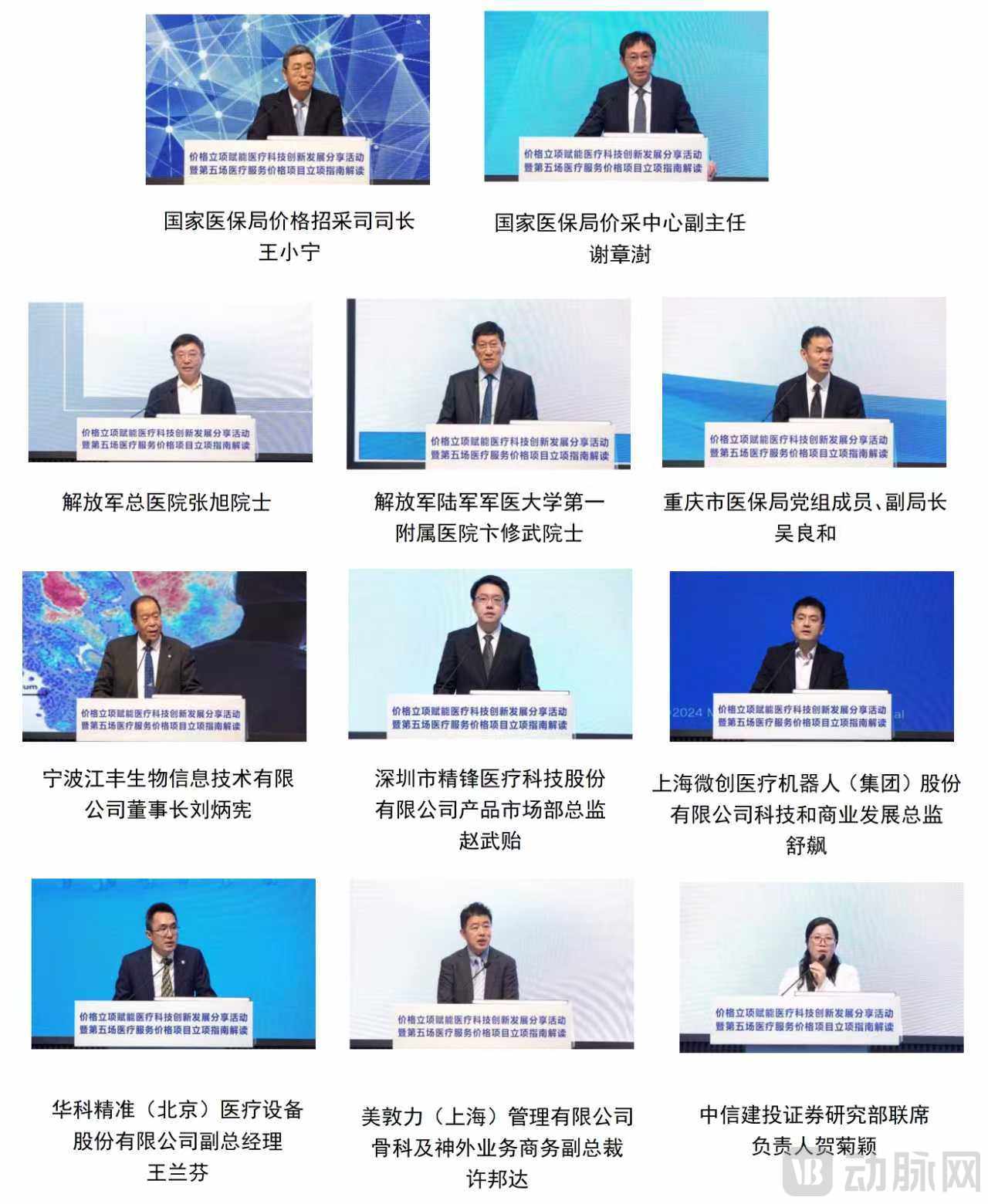
Relevant department heads of the National Healthcare Security Administration provided an in-depth interpretation of pricing projects supporting the scaled application of precision medicine and telemedicine in new scenarios. Academician Zhang Xu from the PLA General Hospital and Academician Bian Xiuwu from the First Affiliated Hospital of Army Medical University respectively introduced cutting-edge research achievements in surgical robots and remote surgery, as well as pathological diagnosis. Enterprise representatives presented products and services related to surgical robots and digital-intelligent pathological diagnosis, while investment institution representatives shared new trends in the medical device investment market.
It is reported that on January 20, the National Healthcare Security Administration issued the "Guidelines for the Establishment of Medical Service Price Projects for Surgical and Therapeutic Auxiliary Operations (Trial)," which standardizes and consolidates existing price projects into 37 items.
According to Xinhua News Agency, this "Project Initiation Guidelines" focuses on cutting-edge achievements in medical technology. It centers around medical science and technology innovation achievements such as 3D printing, trace enhancement imaging, energy devices, intraoperative image guidance, robotic arms, and remote surgery, establishing unified pricing for projects. This initiative standardizes the formation of 37 price items, 5 additional charges, and 1 expansion item, using price setting to lead the upgrading of medical technology and guide the transformation from "traditional treatment" to "precision medicine."
In accordance with the overall approach of project establishment based on service output, the "Project Establishment Guidelines" focus on the level of involvement of surgical robots in operations and their clinical value in promoting precision surgery. Three pricing categories have been established: navigation, participation in execution, and precise execution. These categories break down the boundaries defined by surgical approaches, application sites, and domestic and international brands, implementing a coefficient-based charging model linked to the main surgery. Surgical robots with higher levels of involvement, more comprehensive functions, and more precise execution can achieve higher charging coefficients.
According to research data from China Post Securities, from January to November 2025, the sales volume of surgical robots reached 332 units, a year-on-year increase of 3.75%; the total sales revenue was 2.973 billion yuan, a slight year-on-year decrease of 0.87%. As the largest market segment, laparoscopic surgical robots achieved sales of 119 units and revenue of 1.823 billion yuan from January to November, accounting for 35.8% and 61.3% of the total, respectively.
Orthopedic surgical robots achieved sales of 86 units and revenue of 654 million yuan, with a year-on-year sales growth of 17.81% and revenue growth of 21.62%. Both sales and revenue increased, with the revenue growth rate surpassing the sales growth rate. In terms of policy, the state unified the charging framework for robotic surgeries, and clinical value will be the key to breaking the commercialization ice.
It is reported that the next step for the National Healthcare Security Administration will be to guide the provincial healthcare security bureaus in referencing the "Project Initiation Guidelines" to formulate a unified price benchmark for the entire province. The coordinating regions with price management authority will determine the actual execution price levels by adjusting up or down in reference to the provincial price benchmark.
The National Healthcare Security Administration will also fully complete the preparation of project guidelines, promote the basic unification of medical service price items across China, begin to improve the management methods for newly added medical service price items, explore the implementation of preliminary price approval processes, guide regions in enhancing the quality and efficiency of acceptance and review of new price projects, accelerate clinical transformation, stabilize market expectations, and ensure that the public can access high-quality, efficient, and affordable medical services.