

Provide 24-hour professional speech training support for 27.8 million hearing-impaired individuals! Microgo Technology uses AI speech therapists to fill the gap in home-based speech training.
Language is the wing that allows thoughts to unfold, and the most natural bridge between hearts; every voice carries a unique power and deserves to be heard.
However, not everyone can easily embrace this freedom of expression. China has 27.8 million people with hearing impairments, the largest number of hearing-impaired individuals in the world. Due to their hearing loss, they struggle to complete the natural loop of "listening-imitating-correcting" in language learning as hearing individuals do, lacking effective imitation references and learning feedback. Particularly for those with congenital hearing impairments, the natural process of language acquisition is interrupted as they cannot perceive normal speech input, posing even longer-term and systematic challenges in developing spoken language abilities.
With the advent of hearing-assistive devices such as cochlear implants, an increasing number of hearing-impaired individuals have regained the ability to perceive sound. However, "being able to hear" does not equate to "being able to speak." In practical use, the auditory feedback provided by cochlear implants remains limited and is still insufficient to support users in independently determining whether their pronunciation is accurate or identifying where the problem lies. As a result, spoken language training continues to heavily rely on professional third-party intervention.
In the current hearing-impaired speech rehabilitation system, oral training mainly relies on one-on-one rehabilitation courses conducted offline. Rehabilitation therapists help individuals with hearing impairments establish correct pronunciation methods through touch, demonstration, and repeated correction of sounds. However, this system itself has obvious structural bottlenecks: the number of language rehabilitation therapists in China is less than 10,000.[1], and are mainly concentrated in first- and second-tier cities. The imbalance between supply and demand has directly driven up the cost of rehabilitation. A basic one-month rehabilitation course costs at least 4,000 to 5,000 yuan, which is a heavy burden for most families with hearing impairments.
More crucially, the limited frequency of offline classes is far from sufficient to support the continuous improvement of language skills. For people with hearing impairments, the real challenge is not the few hours spent in rehabilitation centers receiving training, but the ongoing practice required after returning home: due to insufficient auditory feedback, they cannot judge the correctness of their pronunciation by hearing themselves clearly, nor do they know how to make adjustments. Language learning itself heavily relies on high-frequency practice and immediate feedback; without correction, practice may gradually "go off track," not only making efforts twice as hard for half the results but also likely forming new incorrect habits.
Because of this, the home environment has gradually become the weakest yet most crucial link in the hearing-impaired rehabilitation system. How to leverage AI technology to provide low-cost, sustainable, and accessible intelligent oral rehabilitation support for individuals with hearing impairments—filling this long-missing gap—is precisely the core issue that WeGe Technology aims to address.
The starting point of Microgem Technology originated from a large model "Hackathon" competition in 2023. At that time, Li Pengcheng, a hearing-impaired team member who had just been fitted with a cochlear implant, was inspired by his personal experience of incurring rehabilitation costs amounting to tens of thousands of yuan. He came up with the idea of using AI to lower the barriers, and everyone quickly agreed. They developed the first Demo within 48 hours.
With continuous refinement, this idea has eventually evolved into today's MicroG Tech — an artificial intelligence technology company focusing on the "AI + language rehabilitation" direction, and its core product — QueTalk APP — an AI speech training system for the hearing-impaired, enabling them to practice spoken language independently and professionally at home.
The name "Sparrow Talk Training" itself carries the product ideal of Weige Technology: hoping that users can talk naturally, easily, and chirpily like sparrows.
Unlike common spoken language learning or practice applications, QueTalk positions itself clearly from the start: it’s not about chatting with you, but helping you correct your pronunciation.
As an AI speech training system based on large model technology, QueShuo Speech Training attempts to replicate the key capabilities of a speech therapist in one-on-one training, and apply them in a structured and repeatable way to home scenarios:
Phoneme-level Pronunciation Recognition:Break down the user's pronunciation to the phoneme level and compare it with the standard pronunciation one by one;
Error Localization and Cause Explanation:Not only tell users "what went wrong," but also explain "why it went wrong";
Action-Level Correction Guidance:Guide users to adjust their pronunciation methods through specific action recommendations such as tongue position, breath, and resonance.
Design of Visual Feedback:Replace auditory feedback with waveform graphs, lip movement cues, and visual prompts, making "pronunciation correction" visible.
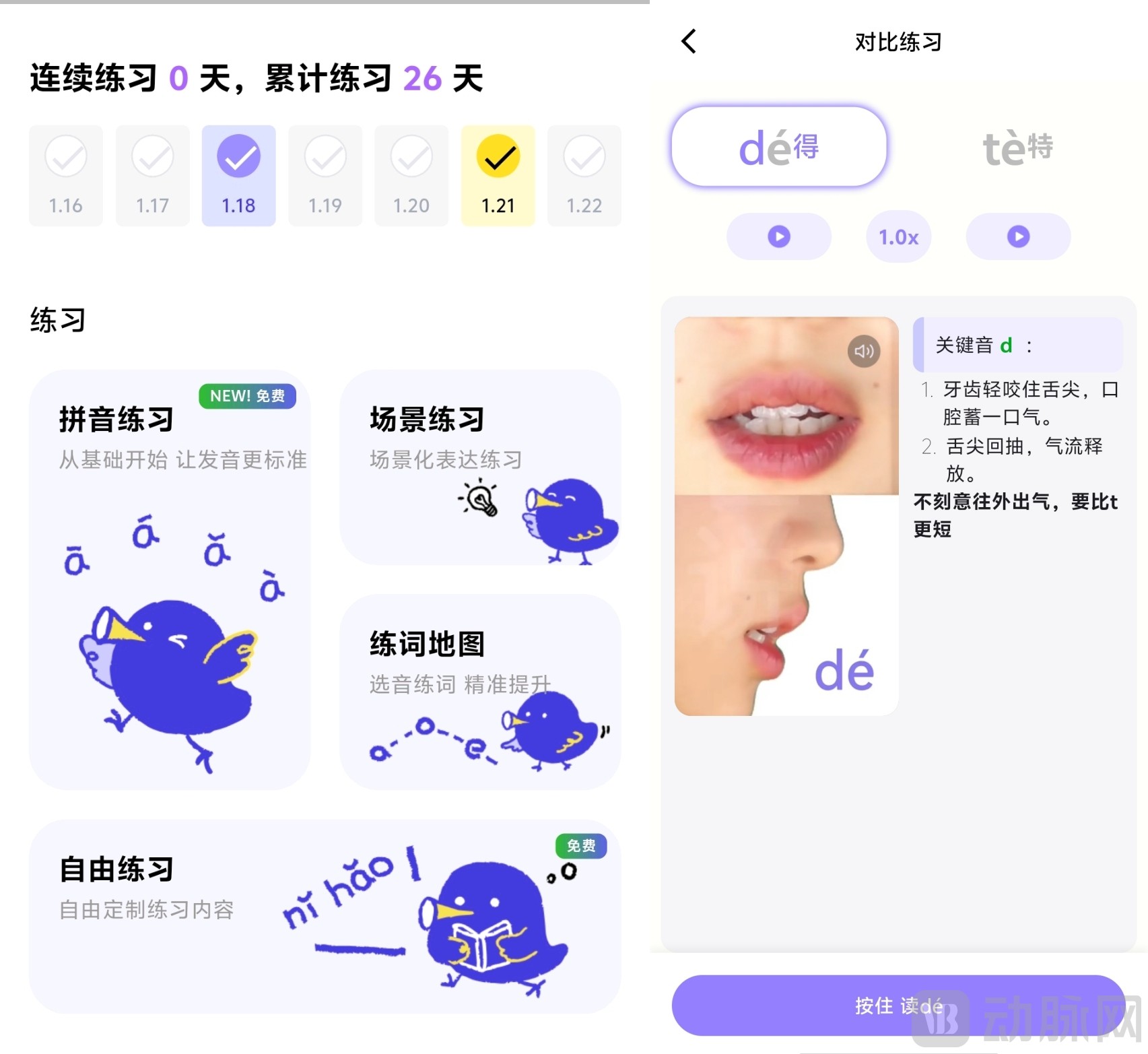
Screenshot of QueShuo Language Training APP

MicroG Tech Team Interviewed for the "SK Social Innovation Challenge" Initiated by SK Group and BottleDream
The hardest part behind this is not the algorithm itself, but how to break down the highly experiential, end-to-end judgment logic of rehabilitation therapists into rules that the model can understand. To achieve this, WeGo Technology continuously communicates with rehabilitation institutions and speech therapists, breaking down the ability to "instantly identify the problem upon hearing" into features that can be recognized by the system.
An interesting observation is that this set of capabilities has not only served the hearing-impaired population. Micro Ge Technology found in their user data that many hearing users preparing for Mandarin proficiency tests have also started using QueTalk for pronunciation correction. This, to a certain extent, verifies the product's universal value in correcting Chinese pronunciation structures — it is not just a simple practice partner, but a "pronunciation coach" with clear standards and precise feedback.
In the view of Microgo Technology, the capabilities at the application layer are not difficult to replicate. What is truly hard to copy is the deep understanding of users accumulated over time, the沉淀of data, and the ability to continuously meet the needs of specific groups. Therefore, rather than emphasizing the sophistication of algorithms, Microgo Technology focuses more on whether the product is genuinely "useful" and whether it can accompany users in completing the tedious yet essential practice over the long term.
This judgment is also reflected in the product concept.
Gao Luyan, co-founder of Weige Technology, told VCBeat that the team does not want to turn Que Talk into a "hearing-impaired version of Duolingo," stimulating usage frequency through gamification, check-ins, or anxiety-driven marketing. Weige only wants to serve users who already have a strong desire to improve their spoken language skills and are willing to invest time in doing so. They do not promote the anxiety of "falling behind if you can't learn," but instead focus on improving users' pronunciation levels.
In its relationship with traditional rehabilitation institutions, WeGo Technology also chooses to "complement rather than replace." In reality, users of QueTalk often receive offline rehabilitation training as well. AI takes on the tasks of high-frequency, repetitive, and standardized training, while rehabilitation therapists can focus their energy on more advanced values and scenarios such as emotional understanding, individual difference assessment, and directional guidance.
This restrained and pragmatic approach has also earned WeGrowth Technology recognition in multiple social innovation and AI startup scenarios—In December 2025, at the "SK Social Innovation Challenge" organized by SK Group in collaboration with BottleDream, WeGrowth's language training solution stood out among 263 participating teams to win the first prize. Co-founder Gaolu Yan also ranked fourth in CCTV's "Win with AI+" 2025 China AI Startup Top Ten Entrepreneurs selection.
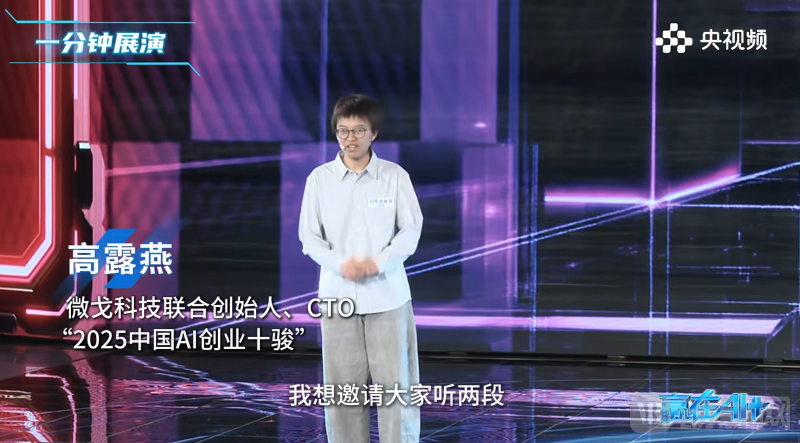
Co-founder Gao Luyan Participates in CCTV's "Win with AI+"
In the view of Microgo Technology, the significance of AI does not lie in creating miracles, but in enabling access to professional capabilities that were once difficult to obtain, at a lower cost and with higher frequency, for those who truly need them. If the technology can ultimately allow more hearing-impaired individuals to practice at home with peace of mind and gradually build their communication skills, then its value may have already transcended commercial interests themselves.
References:
[1] "Expert Discussion | The Development Process and Current Status of Speech Disorder Rehabilitation Treatment in China", Chen Renji, Chinese Journal of Audiology and Speech Rehabilitation Science