

SuperDimension Pharma Files IPO Prospectus: Driving Preclinical Drug Discovery with Data Science

Hyper-D
Innovative Drug Developer
Recently, the Center for Drug Evaluation (CDE) of the National Medical Products Administration (NMPA) released the “Guiding Principles for the Clinical Development of Anti-tumor Drugs with Clinical Value Orientation (Draft for Comments)”. As indicated by the guidelines, regulatory policies for innovative drugs are tightening to address domestic issues such as target clustering, the proliferation of “Me-too” drugs, low-level duplication, and a lack of genuine innovation, thereby compelling the industry to transition toward “Me-better” development.
Higher-quality and more innovative drugs will be the mainstream of future R&D. Among these, the greatest challenge lies in original innovation. Only by actively leveraging new technologies to accelerate drug development and address critical pain points in pharmaceutical research can China’s drug R&D industry achieve leapfrog advancement. However, the integration and convergence of new technologies remain exceptionally difficult, and significant unresolved challenges persist in their industrial application.
How can these challenges be overcome? With these questions in mind, VCBeat had the honor of interviewing Dr. Qin Bingjie, Co-founder and CEO of Beijing Hyper-D Technology Co., Ltd. (hereinafter referred to as Hyper-D), to see how Hyper-D addresses these issues.

VCBeat: Could you briefly share your experience prior to founding the company?
Dr. Qin: From 2003 to 2019, I was engaged in innovative drug research and development at the Academy of Military Sciences. During this period, I pursued my doctoral degree through a joint training program between the Academy of Military Medical Sciences and the University of Paris VII. At the Academy of Military Sciences, my research primarily focused on medicinal chemistry, while at the University of Paris VII, I specialized in computer-aided drug design (CADD). These 17 years of academic and professional experience laid a solid foundation for my entrepreneurial endeavors.
VCBeat: Your previous research focus was primarily in pharmaceutical sciences, while the other co-founder, Dr. Cao Chenlei, has a background entirely in computer science. How did two individuals with completely unrelated professional backgrounds meet and decide to co-found a startup together?
Dr. Qin: The story between Dr. Cao and me is quite interesting. Dr. Cao holds a Ph.D. in cryptography and coding from Beijing University of Posts and Telecommunications, has participated in several major national special projects, and has prior entrepreneurial experience. During his tenure at Datang Telecom, he guided the company to achieve its first breakthrough in the field of AI.
Logically speaking, professionals from such disparate academic backgrounds rarely cross paths. Ever since I left the Academy of Military Sciences, I have been deeply interested in AI-driven drug discovery, recognizing it as the technological frontier of the future. Consequently, I joined the AI department of Yuanqi Zhiyao (the predecessor of Hyper-D). Upon joining, I discovered that my team members primarily came from backgrounds in computational chemistry and bioinformatics. Given our shortage of expertise in computer and data sciences, we were urgently seeking a seasoned professional with extensive experience in computational science and strong interdisciplinary capabilities to join us.
Coincidentally, Dr. Cao was also exploring new opportunities in pharmaceutical R&D. At the time, there were very few reputable companies in China dedicated to this field, which ultimately brought us together in 2019. Back then, Dr. Cao was employed at Datang Telecom, and our offices were located just across the street from each other, allowing us to exchange ideas two or three times a week. At that time, Yuanqi Zhiyao and Genki Forest were under the same corporate umbrella. Whenever Dr. Cao came over for discussions, he could always take the opportunity to freely sample Genki’s new products and help refine the user experience. Alongside our cross-disciplinary exchanges, these interactions brought a great deal of joy and camaraderie to our collaboration.
During that period, we delved deeply into numerous scientific challenges in the field of drug discovery. He asked me about pharmaceutical knowledge, and I inquired about his expertise in algorithms. Two months later, I asked him, "Would you like to join me and give it a try?" He noted that applying AI to cryptographic code analysis was difficult to translate into practical applications and offered limited contributions to humanity. He believed that although AI-driven drug discovery posed greater difficulties and challenges, its extraordinary social significance made it a field truly worth dedicating oneself to. Overall, the disciplinary gap between the two fields was substantial, and the initial team integration was extremely challenging. Nevertheless, driven by our shared ideals and unwavering dedication to this field, we established the research team and technological framework for Hyper-D.

VCBeat: You just mentioned that the interdisciplinary crossover is quite significant. Specifically, what cross-disciplinary technical teams has Hyper-D assembled?
Dr. Qin:Our technical team integrates multidisciplinary experts in medicinal chemistry, computational chemistry, mathematics, biology, and computer science. Half of our members possess overseas academic and professional backgrounds, with over 70% holding Ph.D. or Master’s degrees. Leveraging AI technology to explore the molecular universe, we have developed an innovative drug discovery and optimization system based on molecular graph structures. Integrating core capabilities such as virtual screening of drug molecules, structural optimization, and druggability assessment, the system is dedicated to enhancing the efficiency and success rate of drug discovery, shortening R&D timelines, and reducing development costs and risks.
VCBeat: Against the backdrop of such a high-barrier, interdisciplinary landscape, what specific features does Hyper-D's molecular characterization system possess?
Dr. Qin: Drug molecules occupy an infinite chemical space. To identify the druggable space within this vast chemical landscape, the key lies in how to "view" this chemical universe—that is, the multidimensional representation of chemical space. Traditional approaches rely on a few simple features handcrafted by human experts to characterize chemical space, resulting in indistinct representations and a lack of discriminative power.
The molecular representation system independently developed by Hyper-D comprehensively integrates relevant mathematical theories such as group theory, matrix theory, and topology. By training a molecular feature extraction model on a billion-scale library of synthesized compounds, and while ensuring the accuracy of molecular feature extraction, it maps graph-structured raw molecular information into a high-dimensional manifold space to obtain deep molecular representations. During the screening process, using the deep representations of known hit molecules for a specific target as an anchor enables precise localization of the corresponding bioactive chemical space region. Subsequently, combined with ADMET model evaluations, this approach yields PCC drugs that possess both high potency and favorable drug-like properties.
Hyper-D’s molecular representation system is characterized by extensive coverage, high resolution, independence from human expert experience, target- and property-based clustering capabilities, and the ability to explore uncharted chemical space when integrated with reinforcement learning techniques.
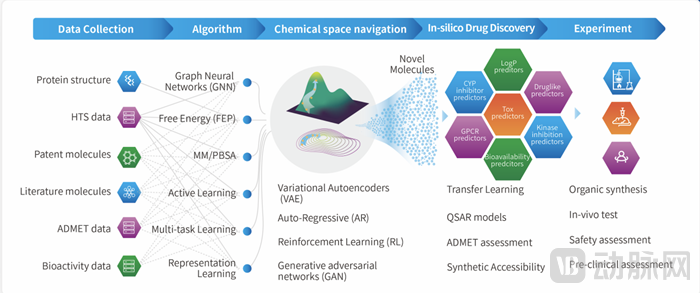
Hyper-D Intelligent Drug Design Workflow

VCBeat: Are there currently many similar companies?
Dr. Qin: In reality, while these technologies may sound "high-end and sophisticated," they actually involve a "grueling, labor-intensive, and unglamorous" undertaking. Based on publicly reported literature and news, to my knowledge, no similar enterprises domestically or internationally have yet achieved commercial-scale implementation of these technologies. These technologies require the integration of multidisciplinary expertise. We assembled a team of five or six PhDs from diverse specialties, and by pooling the entire company's resources, it took us over seven months to complete the initial version. With no prior experience to draw upon, we started from the foundational level, coding line by line. Only after tens of thousands of iterative revisions and trial-and-error cycles were we able to successfully build this system.
In my view, this is not an industry issue, but a scientific one. Few companies are willing to tackle scientific challenges, which is also our core competitive advantage.
VCBeat: How is Hyper-D currently expanding its market? Which institutions or enterprises has it partnered with?
Dr. Qin: We pursue market expansion through two approaches: proactive outreach and inbound partnerships. During our initial phase in early 2020, we proactively approached companies with pharmaceutical R&D needs and aligned research focuses, initiating on-site visits to explore collaboration opportunities. Today, numerous companies have sought us out based on our reputation and proactively initiated partnerships. We have already undertaken over 10 projects, and our team’s project intake capacity is nearly saturated. Consequently, many inbound projects are currently facing scheduling backlogs, and we are actively recruiting to scale up our team.
In terms of collaboration, we have established partnerships with multiple institutions and enterprises, including the Academy of Military Medical Sciences, Beijing Institute of Materia Medica (Peking Union Medical College), Qilu Pharmaceutical, Jingdan Biotech, Guangwu Biotech, and Lugang Biotech.
VCBeat: So, how long exactly is the delivery timeline for such a project?
Dr. Qin:Starting from when the client company provides us with a target and we initiate data research and project approval to begin timing, until we deliver the physical compound, the entire cycle takes less than two months. Regarding intellectual property protection, we provide the client with exclusive target protection, committing to refrain from developing any projects against the same target within the timeframe mutually agreed upon by both parties.

VCBeat: What is Hyper-D's current overall strategic layout?
Dr. Qin:In the early stage, we will primarily focus on pharmaceutical research technical services. Through collaborations with pharmaceutical companies and research institutes, we will provide screening and optimization services from hit compounds to candidate compounds, ensuring that 100% of the intellectual property (IP) belongs to the client. In the medium term, we will gradually expand into collaborative drug development. For specific projects, we will engage in joint development through technology or capital equity contributions, with the IP jointly owned by both parties. In the long term, our strategy will center on our proprietary pipeline. We will transfer drug IP to pharmaceutical companies, with 100% of the IP remaining wholly owned by our company prior to any transfer.
VCBeat: So, what are Hyper-D's main requirements currently?
Dr. Qin: The company was established in May 2020. After receiving a 10 million RMB angel investment from Chunxin Changying in August, our primary focus has been on team building and technological R&D.Following preliminary project refinement, we have validated the feasibility and commercial value of our technology platform. Moving forward, our primary objective is to expand the R&D team, establish Hyper-D’s in-house chemical synthesis and biological evaluation laboratories, steadily advance our proprietary drug pipeline, and build a closed-loop system for intellectual property generation.
VCBeat: Finally, could you please share the meaning behind the name “Hyper-D” and your vision for the company’s future development.
Dr. Qin: “Hyperdimensional” is a term in computer science that refers to employing mathematical methods to observe and comprehend the world from ultra-high dimensions. “Pharma Insight” represents the cognition and deep understanding of the essential nature of pharmaceuticals. We aim to leverage new technological means to explore deeper knowledge in the pharmaceutical field at ultra-high dimensions, transcend the constraints of human expert experience, and forge a new pathway for innovative drug discovery and development.
Though the path ahead is long and challenging, perseverance will lead us to our destination. With unwavering commitment, a promising future awaits, and we are fully confident in this endeavor. The company is dedicated to becoming a globally leading innovative drug incubator, leveraging data science as its cornerstone, and providing high-quality preclinical programs and compound resources to our extensive network of partners.