

Boston Scientific Launches Upgraded Visual-ICE Cryoablation System in China for Interventional Oncology

Boston Scientific
Medical Device Manufacturer
NANJING, July 16, 2021 /PRNewswire/ -- Today, at the 2021 Annual Conference of the Interventional Physician Branch of the Chinese Medical Doctor Association (CCI 2021), Boston Scientific (NYSE: BSX) officially announced the launch of the updated Visual-ICE Cryoablation System* for the interventional treatment of solid tumors. The Visual-ICE Cryoablation System, with its precise control over the ablation zone, flexible and customizable probe placement protocols, and i-thawTMand Fast-ThawTMThe helium-free heating function and user-friendly software platform empower physicians to address key technical challenges in tumor cryoablation, offering cancer patients in China a broader range of treatment options.
“We are delighted to see Boston Scientific China complete the integration of BTG’s interventional oncology business. BTG’s globally renowned Galil cryoablation system and its flagship product, Visual-ICE, have officially joined Boston Scientific, enhancing our interventional oncology solutions and reinforcing Boston Scientific’s leadership strategy in specialized therapeutic segments,” said Zhang Jun, President of Greater China at Boston Scientific. “Looking ahead, Boston Scientific will continue to accelerate the introduction of innovative products and bring cutting-edge global clinical expertise to China, helping to achieve sustained, broad accessibility to innovative medical technologies.”
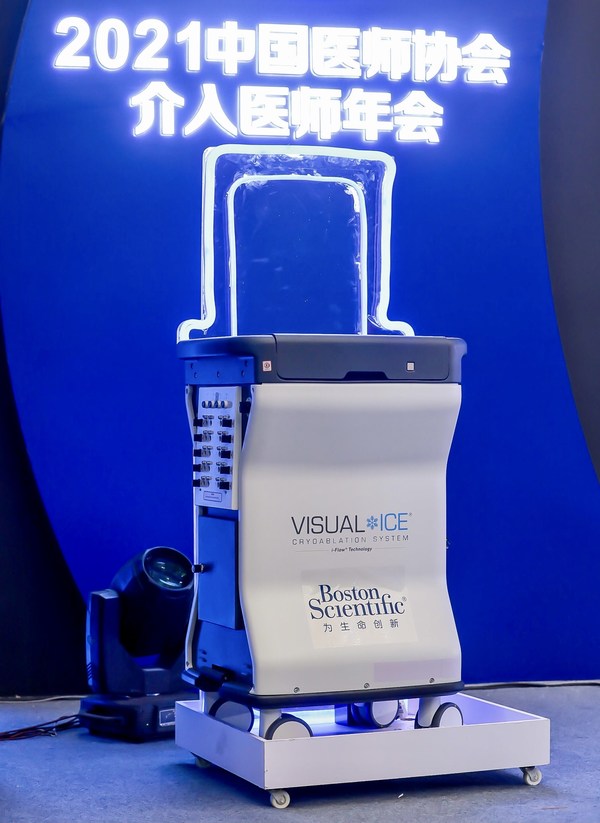
Newly Launched Boston Scientific Visual-ICE Cryoablation System
Addressing Challenges in Cancer Treatment, Cryoablation Holds a Promising Future
The treatment of tumors has long been both a focal point and a significant challenge in the medical field. With advances in medical imaging and the development and widespread adoption of minimally invasive techniques, numerous innovative tumor treatment modalities have continuously emerged. Among these, tumor cryoablation technology, which has advanced rapidly in recent years, utilizes the Joule-Thomson effect. By allowing compressed gas to expand rapidly within a cryoprobe to absorb surrounding heat, it rapidly reduces tissue temperatures to extreme lows (-150degrees Celsius), forming ice crystals both intracellularly and extracellularly, causing tumor cell death due to ischemia and hypoxia. Meanwhile, the necrotic tumor tissue remaining in situ after ablation can serve as an antigen, stimulating the host's anti-tumor immune response.
Cryoablation offers multiple advantages, including well-defined ablation margins, minimal pain, a high safety and comfort profile, excellent repeatability, and the capacity to activate the host immune response. It is widely applicable to tumors of varying sizes, including single or multiple lesions, and can be effectively combined with various therapeutic modalities such as surgery, chemotherapy, radiotherapy, and immunotherapy. Whether utilized as a curative or palliative intervention, it plays a pivotal role in the multidisciplinary team (MDT) management of tumors, holding the promise of expanding therapeutic options for patients. Boston Scientific will leverage its globally leading academic expertise, clinical services, and commercial proficiency to build an innovative academic ecosystem rooted in China, thereby advancing the standardization and widespread adoption of tumor cryoablation technology.
Addressing Clinical Technical Challenges, Visual-ICE Newly Upgraded
In previous clinical practice, although cryoablation therapy for tumors has demonstrated distinct advantages, it has also encountered numerous technical challenges. The newly launched Boston Scientific Visual-ICE Cryoablation System represents an iterative upgrade over the previous-generation argon-helium cryoablation product Cryo-Hit, and is poised to deliver new solutions to these industry challenges.
First, for large irregularly shaped tumors or multiple tumors, "conformal ablation" typically requires the overlapping placement of multiple cryoprobes to achieve precise coverage of the tumor region. This necessitates that the device provide an adequate number of probe channel ports. The Visual-ICE system features ten cryoablation probe connection channels (each supporting two probe ports), enabling physicians to implement flexible and customizable probe placement strategies.
Second, tumor locations are complex and highly variable. For tumors adjacent to critical anatomical structures, it is essential to ensure effective tumor coverage while maintaining an adequate safety margin to avoid damaging vital tissues. Visual-ICE provides a 4-point temperature monitoring function that enables real-time, multi-point monitoring of the iceball formation process and tissue temperatures across different regions under ultrasound or CT guidance. Combined with the product’s comprehensive iceball isotherm data, this enhances the controllability and reproducibility of cryoablation, empowering operators to precisely target tumors while effectively protecting the patient’s healthy tissues from inadvertent injury.
Third, cryoablation typically utilizes helium gas for the thawing phase, and the high cost of helium simultaneously increases procedural complexity and patients' medical costs. In contrast, the upgraded i-thaw of the Visual-ICE cryoablation systemTMand Fast-ThawTMThe technology enables the heating process to be completed without helium assistance, while also providing a high-temperature ablation function.
“As a leading global medical technology company, Boston Scientific boasts a comprehensive product portfolio in interventional oncology, encompassing radiofrequency ablation, cryoablation, chemoembolization, and brachytherapy.” Da Bo, Vice President of Peripheral & Interventional Oncology, Urology & Pelvic Health, and Device Services for Boston Scientific China, stated, “We believe that the newly upgraded Visual-ICE will inject new vitality into interventional oncology in China, bringing greater clinical benefits to a wider population of cancer patients.”
*Registration Certificate No.: Imported Medical Device Registration No. 20153011505, Imported Medical Device Registration No. 20203011503
References:
1. Goldberg SN, Grassi CJ, Cardella JF, et al. Image-guided tumor ablation: standardization of terminology and reporting criteria. J Vasc Interv Radiol 2009; 20:S377–390. [PubMed] [Google Scholar]
2. Arnott J Practical illustrations of the remedial efficacy of a very low or anesthetic temperature in cancer. Lancet 1850; 2:257–259. [Google Scholar]
3. Gage AA, Baust JG. Cryosurgery for tumors—a clinical overview. Technol Cancer Res Treat 2004; 3:187–199. [PubMed] [Google Scholar]
4. Callstrom MR, Charboneau JW. Technologies for ablation of hepatocellular carcinoma. Gastroenterology 2008; 134: 1831–1835. [PubMed] [Google Scholar]
5. Mazaris EM, Varkarakis IM, Solomon SB. Percutaneous renal cryoablation: current status. Future Oncol 2008; 4: 257–269. [PubMed] [Google Scholar]
6. McTaggart RA, Dupuy DE. Thermal ablation of lung tumors. Tech Vasc Interv Radiol 2007; 10:102–113. [PubMed] [Google Scholar]
7. Ritch CR, Katz AE. Prostate cryotherapy: current status. Curr Opin Urol 2009; 19:177–181. [PubMed] [Google Scholar]
8. Littrup PJ, Jallad B, Chandiwala-Mody P, D’Agostini M, Adam BA, Bouwman D. Cryotherapy for breast cancer: a feasibility study without excision. J Vasc Interv Radiol 2009; 20:1329–1341. [PMC free article] [PubMed] [Google Scholar]
9. Hui GC, Tuncali K, Tatli S, Morrison PR, Silverman SG. Comparison of percutaneous and surgical approaches to renal tumor ablation: metaanalysis of effectiveness and complication rates. J Vasc Interv Radiol 2008; 19:1311–1320. [PubMed] [Google Scholar]
10. O’Rourke AP, Haemmerich D, Prakash P, Converse MC, Mahvi DM, Webster JG. Current status of liver tumor ablation devices. Expert Rev Med Devices 2007; 4:523–537. [PubMed] [Google Scholar]
11. Hoffmann NE, Bischof JC. The cryobiology of cryosurgical injury. Urology 2002; 60:40–49. [PubMed] [Google Scholar]
12. Mazur P Freezing of living cells: mechanisms and implications. Am J Physiol 1984; 247:C125–C142. [PubMed] [Google Scholar]
13. Privalov PL. Cold denaturation of proteins. Crit Rev Biochem Mol Biol 1990; 25:281–305. [PubMed] [Google Scholar]