

China's First Expert Consensus on Rapid Whole Genome Sequencing for Critically Ill Neonates with Suspected Genetic Disorders Unveiled at Rare Disease Collaboration Forum
Illumina
Diagnostic Product Developer
BEIJING, July 19, 2021 /PRNewswire/ -- Hosted by the BingTong Challenge Foundation and under the guidance of the Chinese Alliance for Rare Diseases, the annual rare disease conference, "2021 Rare Disease Collaboration and Exchange Conference," was held in Beijing. Experts, enterprises, charitable organizations, and patients gathered to pool their wisdom and jointly explore advancements in rare disease diagnosis, treatment, reimbursement, and services. Among the sessions, at the special forum co-hosted by the Children's Hospital of Fudan University (National Children's Medical Center) and Illumina, titled "'Na Han': Pooling Wisdom to Explore the Truth,"Officially announced in ChinaFirst《Expert Consensus on Rapid Whole Genome Sequencing for Genetic Diseases in Critically Ill Neonates》, bringing new approaches, new standards, and new guidelines to the development of pediatric rare disease diagnosis and treatment facilitated by genetic sequencing.
Distinguished guests, including Prof. Zhou Wenhao, Vice President of the Children’s Hospital of Fudan University (National Children’s Medical Center); Prof. Wu Bingbing, Deputy Director of the Center for Molecular Medicine; Prof. Luo Feihong, Department of Endocrinology, Genetics and Metabolism; Prof. Wang Dahui, Department of Orthopedics; Ms. Wang Yi’ou, Founder of the Beijing Disease Challenge Foundation; Ms. Chen Yiwei, Founder of the public welfare platform for genetics and rare disease science popularization “Pea Sir”; and Mr. Wang Biao, Marketing Director for Greater China at Illumina, attended the symposium to discuss practical advances in the diagnosis and treatment of rare diseases.
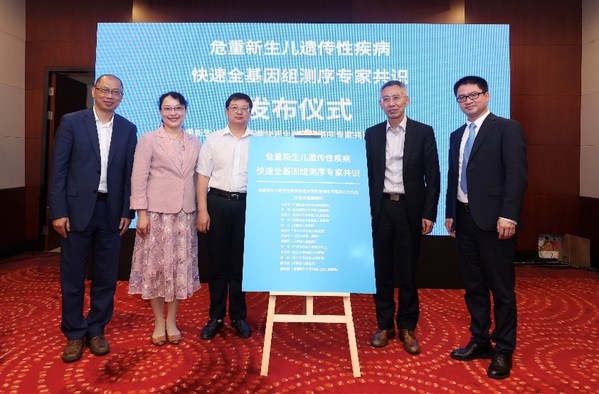
《Expert Consensus on Rapid Whole-Genome Sequencing for Genetic Disorders in Critically Ill Neonates》 Release Group Photo. From left to right: Mr. Biao Wang, Prof. Bingbing Wu, Prof. Feihong Luo, Vice President Wenhao Zhou, Prof. Dahui Wang
80% of Rare Diseases Are Genetic: A Life-or-Death "Gamble" to Find the Cause
What is the relationship between rare diseases, genes, and heredity? There are nearly 7,000 rare diseases worldwide, approximately 80% of which are genetic disorders caused by genetic defects.[1]. However, since the human genome contains approximately 3 billion base pairs, rare diseases caused by genetic defects are not only highly diverse but also extremely rare. Consequently, most physicians lack relevant diagnostic experience, leaving the diagnostic journey for rare disease patients shrouded in uncertainty and fraught with obstacles. Data shows that, globally, each rare disease patient consults an average of 8 physicians.[2], experienced 3 misdiagnoses, average time to diagnosis exceeds 7 years[3]。
Children are disproportionately affected by rare genetic diseases, with approximately50% of rare disease patients begin suffering from the disease in childhood, and 30% of children with rare diseases die before the age of five.Rare diseases of unknown etiology, such as neurological abnormalities, complex congenital heart disease, metabolic disorders, recurrent severe infections suggestive of immunodeficiency disorders, and severe coagulation dysfunction, are common disease categories among critically ill pediatric patients. The early symptoms of these conditions are often atypical, and conventional diagnostic workups typically require multiple and repeated examinations. This process is not only time-consuming but also inflicts suffering and imposes a heavy financial burden on both the affected children and their families.
Contrasting with the diverse and complex clinical manifestations of rare genetic diseases is a shortage of relevant medical resources. A 2018 survey report revealed that nearly one-third of physicians are unfamiliar with rare diseases.[4]。andMeanwhile, novel diagnostic approaches for rare diseases, represented by Whole Genome Sequencing (Whole Genome Sequencing) technology, have brought hope to the arduous diagnostic journeys of rare disease patients, while simultaneously placing higher demands on clinicians and healthcare institutions. Currently, rapid genomic testing for rare diseases in China lacks corresponding clinical guidelines, novel testing technologies have not yet been widely implemented and standardized, and the number of clinical centers capable of conducting such tests is severely insufficient. This has become a major bottleneck hindering China's efforts to accelerate the development of rare disease diagnosis and treatment.
Rapid Whole Genome Sequencing“Definitive Diagnosis”: Consensus Drives an End to the Diagnostic Odyssey for Rare Disease Patients
With the advancement of gene sequencing in molecular diagnostics, the hereditary "book of life," filled with "codes," is being gradually "deciphered." Consequently, genetic testing is playing an increasingly pivotal role in the diagnosis of genetic disorders. Clinical practice has demonstrated that applying existing genetic diagnostic technologies to critically ill pediatric patients, establishing rapid diagnostic workflows, and promptly identifying the underlying etiology can secure a wider therapeutic window for these children. This approach guides physicians in formulating targeted treatment decisions, provides prognostic assessments, and helps avert severe adverse outcomes to the greatest extent possible, holding profound significance for the clinical management of affected children and their families.
To make genetic diagnostic technologies faster and more accurate, while ensuring standardized reproducibility for precise replication by a broader range of clinicians,Deputy Director Zhou Wenhao and Deputy Director Wu Bingbing of the Children's Hospital of Fudan University, and others from across ChinaThirteen experts from 11 hospitals summarized clinical practice experience, engaged in repeated discussions, and jointly authored China's first *Expert Consensus on Rapid Whole-Genome Sequencing for Genetic Diseases in Critically Ill Newborns* (hereinafter referred to as the "Consensus").
Introduction of Vice President Zhou Wenhao“The development of this consensus represents the collaborative efforts of numerous medical institutions and relevant experts across China, providing a comprehensive summary of the clinical practice of rapid whole-genome sequencing (WGS) for genetic diseases in critically ill neonates. Furthermore, the consensus highlights that WGS can be applied to high-incidence fields of genetic diseases, including the respiratory, neurological, metabolic and internal homeostatic, immunological, and hematological systems, offering substantial practical value for clinical guidance. I believe that the publication of this consensus will have a profoundly positive impact on alleviating the diagnostic and therapeutic challenges faced by numerous children with rare diseases and their families across China.”
Deputy Director Wu Bingbing stated:“Leveraging the rapid, comprehensive, and accurate advantages of whole-genome sequencing (WGS) in diagnosing critically ill neonates, this consensus has, for the first time, established operational guidelines for rapid WGS, covering target populations, implementation workflows, specific clinical responsibilities during the sequencing process, molecular biology laboratory requirements, and genetic data analysis protocols. Conventional genetic testing typically takes 4–8 weeks and cannot meet the urgent need for rapid and definitive diagnosis in critically ill neonates. In contrast, by establishing standardized rapid implementation protocols, rapid WGS can shorten the turnaround time from testing to verbal report to 7–10 days, thereby providing a basis for clinical precision treatment decisions and improving neonatal prognosis.”
Pool Collective Wisdom, Jointly “Address” Rare DiseasesMulti-Stakeholder Collaboration to Advance Rare Disease Diagnosis and Treatment
In recent years, with growing attention to rare diseases, it has become evident that there is substantial room for improvement in the diagnosis, treatment, coverage, and support services for these conditions.Ms. Yiou Wang, Founder of the Beijing Illness Challenge Foundationstated: "Compared to common diseases, rare diseases face significant challenges right from the initial diagnostic stage. Diagnosis is the first step in clinical management and a critical milestone that guides the entire therapeutic pathway. To truly address and improve the current landscape of rare diseases in China requires a comprehensive approach spanning multiple domains, including disease diagnosis, drug research and development, clinical trials, cost burden, reproductive health, mental well-being, and social employment. This is a long and arduous endeavor, which cannot be accomplished without the concerted collaboration of multiple stakeholders, including the government, enterprises, experts, and society at large."
Long dedicated to nonprofit science popularization on rare diseasesMs. Chen Yiwei, Founder of "Wandou Sir"Emphasized: "The true significance of the concept of 'rare diseases' does not lie in highlighting the scarcity of cases, but rather serves as a reminder that the consequence of overlooking 'rarity' is a massive unmet medical need. Through my long-term engagement in genetic counseling and public science outreach, I have witnessed too many families navigate a circuitous path right at the diagnostic stage. After shuttling between multiple hospitals, undergoing numerous repetitive tests, and exhausting their energy and finances, they often fail to receive a definitive diagnosis, with some families even giving up entirely. In reality, identifying the problem from its genetic root cause at the very beginning is not only of immense benefit to the affected children and their families, but also a crucial step in alleviating the social and healthcare burden."
As a leader in the field of genomic sequencing, Illumina is committed to partnering with multiple stakeholders to advance the diagnosis and treatment of rare diseases.Mr. Biao Wang, Marketing Director, Greater China, Illuminastated: “Rapid whole-genome sequencing (WGS) is currently one of the key diagnostic tools for rare and genetic diseases, and has transformed the lives of countless patients and their families worldwide. Rare genetic diseases have long been a strategic focus for Illumina both globally and in China. We aim to collaborate extensively with diverse stakeholders, pool collective expertise, and harness the power of genomics to continuously advance the diagnostic and therapeutic landscape for rare diseases in China, enabling more patients and families to avoid the arduous journey of seeking medical care, achieve early diagnosis, and access superior treatment regimens.”。”
[1]Xuan Jianwei, Sun Qiao. Discussion on Applicable Models and Reference Standards for Payment Thresholds in Pharmacoeconomic Evaluation of Rare Disease Drugs in China[J]. Journal of International Pharmaceutical Research, 2019(9).
[2]Liu R. Umbilical cord blood stem cell transplantation for lysosomal storage diseases in children[J]. Chinese Journal of Clinical Practitioners, 2020(7):764-767.
[3] National Organization for Rare Diseases, Global Genes Project.
[4]Medical Circle: "2018 China Rare Disease Survey Report" Released: 33% of Physicians Unfamiliar with Rare Diseaseshttps://www.sohu.com/a/224604173_377326