

Bioray Biotech Announces Preliminary Data from Multicenter Clinical Trial of Gene Therapy for β-Thalassemia and Submits IPO Prospectus

BRL Medicine
Cell and Gene Therapy Drug Developer
SHANGHAI, July 20, 2021 /PRNewswire/ -- Recently, byJoint Logistics Support Force of the PLA No.No. 923 HospitalandBRL Medicine Inc.The jointly conducted clinical study "Safety and Efficacy of Autologous Hematopoietic Stem Cell Transplantation with γ-Globin Reactivation for the Treatment of Severe β-Thalassemia" has once again reported positive news,Another Pediatric Patient Cured of Thalassemia Through Gene Editing, to date, three pediatric patients have become transfusion-independent with the help of gene editing technology.Next, this research project'sThe age range of eligible subjects will be further expanded to35years of age, is expected to benefit the "most challenging patient cohort" in the field of thalassemia transplantation -- older patients and those unable to find a compatible donor match.
Guangxi Has Approved Gene Therapy`Rescue and Treatment`Three pediatric patients
This clinicalThe trial isMulticenter clinical trial, successively conducted at Xiangya Hospital of Central South University andConducted at 923 Hospital.On July 22, 2020, BRL Medicine reported that the project conducted in collaboration with Xiangya Hospital of Central South University has achieved preliminary efficacy. Following treatment, the two patients have achieved transfusion independence, and with a follow-up period now exceeding one year, their total hemoglobin levels remain within the normal range.. Currently, BRL Medicine is vigorously advancing the new drug application process, striving for early market approval to benefit a broader population of patients with severe thalassemia.
The clinical trial results from Hospital 923,Brought more encouraging findings to the research team.. BecauseThanks to the close collaboration of the hospital's pediatric team, none of the three pediatric patients developed infections following transplantation. Wang Li, Director of the Department of Pediatrics at the hospital, explained that pediatric medication differs from that for adults; dosages must be calculated based on body weight, and the complications also differ. Only through meticulous precision in every detail can the children successfully navigate numerous critical challenges, such as infection, drug toxicity, hematopoietic reconstitution, and immune reconstitution...Critical hurdle.
Gene Therapy Poised to Play a Major Role in the Treatment of Inherited Blood Disorders
Hematopoietic stem cell transplantation is currently the only curative treatment for severe thalassemia. For patients, the path to a cure lies in finding a matched donor; however, not everyone is fortunate enough to find one. Now, a new path has emerged before them—correcting their own defective genes.
No.Prof. Zhang Xinhua, Department of Hematology, 923 HospitalIntroduction,The major globin chains that constitute human hemoglobin undergo a remarkable switch around birth -- during the fetal stage, they consist of α-globin and γ-globin chains, which shortly after birth transition to α-globin and β-globin chains. Therefore, for β-thalassemia caused by β-globin gene defects, reactivating the postnatally "silent" γ-globin gene to restore fetal-like hematopoietic characteristics can achieve therapeutic objectives.
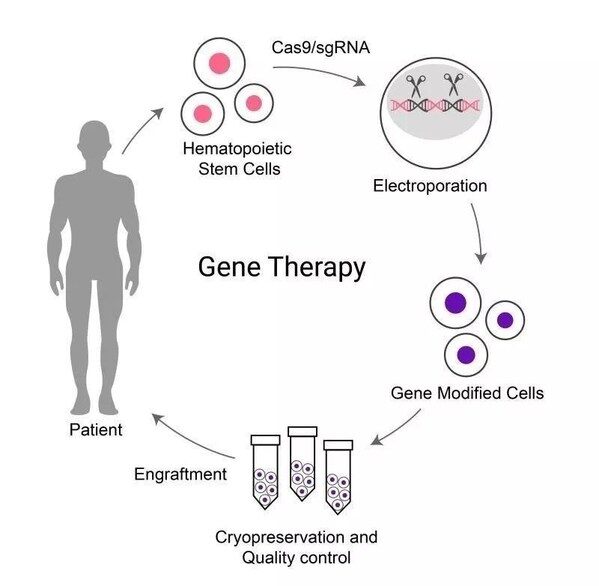
Principles of Gene Therapy
This operation functions on a "switch" mechanism, reactivating the γ-globin gene that is naturally silenced after birth to compensate for the nonfunctional β-globin gene. This requires the application of gene editing technology.
The CRISPR/Cas9 "gene scissors" technology currently applied in this project was invented by two female scientists from France and the United States, enabling site-specific cleavage of DNA. At these cleavage sites, scientists can precisely modify an organism's DNA, rewriting the code of life. These two scientists were awarded the 2020 Nobel Prize in Chemistry for this breakthrough. In its official award citation, the Nobel Committee stated, "The CRISPR/Cas9 gene scissors have revolutionized molecular life sciences, potentially making the human dream of curing genetic diseases a reality."
Gene Editing Holds Promise for Older Patients to Bid Farewell to ThalassemiaAnemia
According to the recently published *China Thalassemia Blue Book (2020)*, as of April 1, 2021, fewer than 4,000 hematopoietic stem cell transplants for thalassemia had been completed nationwide, with the majority being HLA-identical sibling transplants.
Zhang Xinhua noted that fully matched hematopoietic stem cell transplantation has become highly mature and achieves a high success rate. However, the success rate is closely correlated with patient age—the younger the patient, the higher the success rate. Conversely, factors such as multiple prior blood transfusions, iron overload, and prolonged organ dysfunction lead to a corresponding decline in success rates. Therefore, most hospitals performing transplants prefer to accept pediatric patients under 10 years of age. Haploidentical transplantation, however, carries risks such as graft rejection, and can only be performed by transplant teams with extensive clinical experience and a long track record in hematopoietic stem cell transplantation for thalassemia. Consequently, its clinical implementation has progressed slowly, resulting in a relatively low number of completed cases.
In 2010, Guangxi launched 《Guangxi Thalassemia Prevention and Control Plan》 and implemented the “Zero Birth” program for severe thalassemia. After a decade of concerted efforts, the birth rate of fetuses with severe thalassemia has been significantly reduced.
Over the past decade, the government has achieved remarkable results by simultaneously drastically reducing the birth rate of children with severe thalassemia and vigorously advancing transplantation therapy for the disease. However, patients with thalassemia born before 2010 are now over 10 years old, and as they age, the difficulty of achieving a cure continues to increase. “In other words, the straightforward cases have essentially been treated. We need to find a viable pathway for the older pediatric patients and those unable to locate suitable donors,” said Professor Zhang Xinhua of the 923rd Hospital. Gene editing technology has opened a new avenue for these patients. The current phase of this project targets patients aged 5 to 15, while the next phase will expand the upper age limit to 35.
"Gene therapy is, after all, a completely novel approach," Professor Zhang Xinhua candidly stated. "What unforeseen consequences gene editing might ultimately bring remains truly unknown at present. Therefore, the follow-up period for these cases will span several years."
Focused on the Gene Field, BRL Medicine Continuously Breaks Through and Upgrades
In previous studies, the scientific team at BRL Medicine has consistently achieved a series of breakthrough advances in the development of gene editing tools and gene therapy for thalassemia. This project utilizes gene editing technology to reactivate fetal γ-globin expression to compensate for defective β-globin, and holds strong potential to become one of the curative treatment options for thalassemia patients.
The pharmaceutical sector, represented by gene and cell therapies, is facing unprecedented opportunities and stands as a major breakthrough direction for the industry over the next decade. BRL Medicine has consistently dedicated itself to developing innovative gene therapeutics. Since its inception, the company has established an international strategy of "Rooted in China, expanding globally, and benefiting patients worldwide" to meet the rapidly growing healthcare markets in China and abroad, bringing hope to those in urgent need of revolutionary gene therapies. BRL Medicine possesses differentiated competitive advantages in product pipeline selection and technology platforms. Focusing on its core pipeline product—gene therapy for β-thalassemia—the company has overcome industry barriers by comprehensively mastering gene editing technologies while deeply understanding hematopoietic stem cell (HSC) editing strategies. Through continuous process optimization, key challenges associated with gene-edited HSCs during treatment have been effectively resolved.
Some content is sourced from the Nanguo Morning Post app, written by reporter Zhang Ruofan.