

Why is JD Health the key to making AI truly useful and implementable in healthcare scenarios?

JD Health
Internet Medical and Health Service Platform Provider
Is AI in healthcare a practical assistant or a decorative "vase" that looks good but lacks utility? Is it a powerful tool for improving efficiency, or a dangerous blade hiding risks? These are not new topics, but they have recently sparked renewed concentrated debate online.
It is obvious that many hospitals, restricted by various internal and external factors, struggle to achieve large-scale implementation of AI applications in the short term, making the aforementioned controversial conclusions lack sufficient empirical support. For leading companies deeply engaged in the industry, leveraging technological exploration and flexible scenario applications might provide more definitive answers.
On January 17, 2026, Jingdong Health launched new AI products and solutions again at the 2026 Doctor's Grand Ceremony and Intelligent Healthcare Conference: "Zhiyi," an evidence-based medicine AI tool for doctors, the upgraded hospital large model product "JD Zhuoyi 2.0," and an AI-driven clinical nutrition standardized full-process management solution.
In recent years, Jingdong Health has gradually established a closed-loop service covering multiple specialties, including "medical treatment, testing, diagnosis, and medication," with service content and processes that possess stronger medical professional attributes. As a series of new products are implemented, Jingdong Health is comprehensively showcasing the application results of medical AI, highlighting the positive value of cutting-edge technology.
Currently, Internet healthcare has ended the extensive development stage dominated by traffic expansion and entered a period of competition focused on quality and professional depth.
After years of refinement and accumulation, Jingdong Health has built up an integrated online and offline closed-loop service model covering medical care, testing, diagnosis, and pharmaceuticals, with services extending far beyond the single scope of online consultation.When users seek help from Jingdong Health, they not only receive answers from doctors but also gain access to a personalized solution that connects physical products and services, covering the entire process of "prevention, screening, diagnosis, treatment, and rehabilitation."On this basis, Jingdong Health continues to improve the professionalism and service quality of medical services.
Over the past year, Jingdong Health has carried out multi-dimensional in-depth cooperation with several top hospitals in China, which is one of its important measures to enhance the professionalism of medical services.
Specifically, Jingdong Health is strengthening cooperation in areas such as telemedicine, at-home rapid testing, smart outpatient services, and medical science popularization with Shanghai Children's Medical Center affiliated with Shanghai Jiao Tong University School of Medicine, Beijing Children's Hospital affiliated with Capital Medical University, Union Hospital affiliated with Tongji Medical College of Huazhong University of Science and Technology, Renmin Hospital of Wuhan University, and Shandong Mental Health Center.
Public hospitals are the backbone of China's medical service system, and the top-tier public tertiary hospitals represent the comprehensive strength in medical technology and scientific research. Collaborations with numerous top hospitals have first driven the iterative upgrade of Jingdong Health’s services, strengthening its closed-loop service capabilities in medical care, testing, diagnosis, and pharmaceuticals.
Taking the at-home rapid testing as an example, Jingdong Health has upgraded and launched the "Hospital Testing Service" based on its previous collaboration with numerous third-party medical testing institutions. This service is now available in 16 cities including Beijing, Shanghai, Tianjin, Chongqing, and Nanjing, with nearly 30 tertiary or higher-level public hospitals providing the service. Among them, Jingdong Health and Beijing Ditan Hospital have introduced intelligent testing projects relying on the "JD Healthcare AI" large model product. This initiative deeply integrates the high-quality medical resources of Ditan Hospital's national medical center with Jingdong Health’s digital and intelligent service capabilities, further enhancing the construction of an AI-powered closed-loop service for medical treatment, testing, diagnosis, and medication.
"Hospital Testing Services" Extend the Service Radius of Partner Hospitals, While Jingdong Health Enhances Its Professionalism Through the Diagnostic and Treatment Capabilities of Public Hospitals.
Relying on collaborations with top hospitals, academic societies, and associations, JD Health has also achieved significant results in specialized discipline development and medical quality management. In November 2025, the "Expert Consensus on Quality Management Elements for Internet Hospitals (2025 Edition)" (hereinafter referred to as the "Consensus"), initiated by the China Hospital Association and jointly compiled with the participation of JD Health and other parties, was released to promote the transformation of internet healthcare from scale expansion to quality enhancement.
Specifically, in terms of disease diagnosis and treatment, the Medical Quality Management Committee of JD Health Internet Hospital has formulated 52 new standardized diagnosis and treatment pathways for diseases in 2025 based on an in-depth analysis of online consultation situations. Currently, a total of 317 standardized diagnosis and treatment pathways for diseases have been published.
For medical AI, medicine comes first, and AI comes second. Only by solidifying professionalism and medical quality can AI avoid going "off track" and truly achieve safe and reliable technical empowerment.
Recently, OpenAI officially entered the healthcare sector by launching ChatGPT Health for general users and "OpenAI for Healthcare" for medical institutions. It also acquired the health tech company Torch to further advance its healthcare AI products.
Looking globally, healthcare has become a battleground for AI. However, it needs to be emphasized that,AI technology must not only overcome core challenges in medical applications related to efficiency and accuracy, but also achieve deep adaptation and practical validation across diverse application scenarios.
Against this backdrop, the core advantages of JD Health have become increasingly prominent: with continuous enhancement in the breadth, depth, and professionalism of services, AI has been scaled up across various application scenarios, moving towards "Full-scenario AI+".
In 2025, Jingdong Health released the "AI Jingyi" product system, which currently includes more than ten types of professional service intelligent agents such as AI doctors Dawei and Xiaowei, AI nutritionist Xiaojing, and AI pharmacist Xiaofang, along with over 1,500 expert doctor intelligent agents from more than 400 top-tier hospitals across China. During the same period, the Jingyi Qianxun large model was upgraded to version 2.0. Through multimodal perception and deep retrieval technologies, it integrates authoritative guidelines, real-time literature, and real-world data to build a dynamically updated evidence-based database, providing precise decision support for the "AI Jingyi" system.
As the core service role of "AI Jingyi," the AI doctor "Dawei" has received a satisfaction rate of over 98%, with a specialist follow-up visit rate exceeding 40%, becoming a key node connecting users with professional services.
In addition, for specialized disease scenarios, Jingdong Health collaborates with multiple top-tier hospitals to build vertical large models. AI achieves full-process reasoning from diagnosis, imaging interpretation to treatment recommendations, enhancing clinical efficiency. For example, the clinical nutrition large model co-developed by the First Affiliated Hospital of Wenzhou Medical University and the National Health Commission Key Laboratory of Clinical Nutrition and Intervention, in collaboration with Jingdong Health, establishes a "Nutrition Evidence Database" and a "Nutrition Typical Case Library," ensuring that the output nutritional solutions are both authoritative and practical. It can also complete full-process automated handling, reducing the clinical workload.
Clearly, AI has evolved from a mere auxiliary tool in the past to a core technological driver that permeates the entire chain of screening, diagnosis, treatment, management, and research. As of now, Jingdong Health's AI tools have assisted doctors in managing over 10 million patients, with a repeat issue resolution rate exceeding 90%, and an increase in diagnostic efficiency by over 50%.
In 2026, Jingdong Health's AI application scenarios further expanded — the AI evidence-based tool "Zhiyi," designed for doctors, was released at the Doctor's Grand Ceremony.
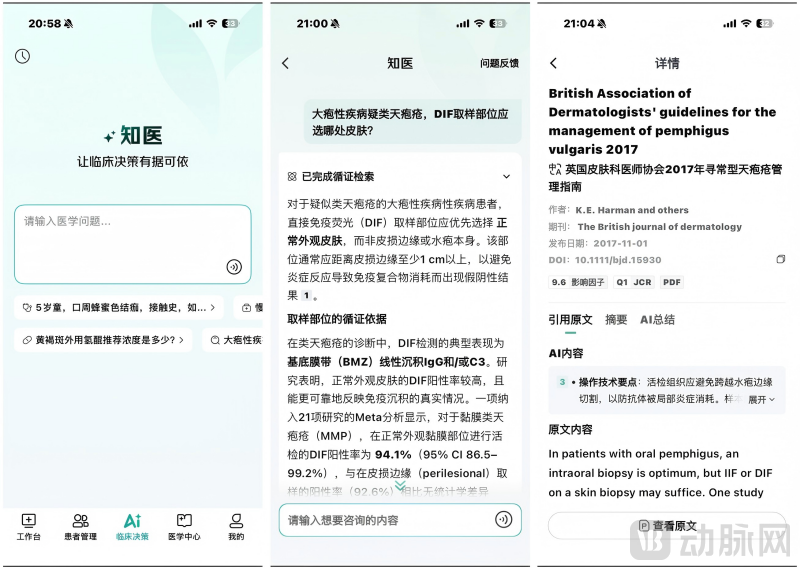
Jingdong Health's Newly Released AI Evidence-Based Tool "Zhiyi"
"Zhiyi" deeply integrates tens of millions of global authoritative medical literature and guidelines, focusing on two core scenarios: clinical decision support and scientific research academia. When doctors face complex cases in clinical diagnosis and treatment and need to quickly confirm authoritative evidence, or when research projects require finding cutting-edge global evidence for topic establishment, "Zhiyi" can rapidly filter and integrate massive amounts of information, directly outputting structured, actionable evidence-based conclusions.
In the past year, OpenEvidence from the United States has gained global popularity, covering approximately 40% of practicing physicians in the U.S. "Zhiyi" is an AI tool tailored to the actual working environment of doctors in China, making it more suitable for Chinese doctors and can be regarded as the "Chinese version" of OpenEvidence.
It is worth mentioning that "Zhiyi" will be integrated into the JD Doctor APP, and will be open to all doctors for use, regardless of whether they have already joined the Jingdong Health platform.
AI, repeatedly tested in diverse real-world scenarios, not only further verifies the reliability of the technology but also lays the foundation for creating deeper social value.
If products based on advanced technology cannot systematically address industry pain points, their sustainability will be greatly reduced.In the past, the reason why the "medical AI useless theory" existed was that some medical AI products, despite performing well in technical parameters, were disconnected from the complex policy environment, payment mechanisms, and other practical constraints of the healthcare system, making it difficult for them to generate sufficient social and commercial value after implementation.
Although OpenEvidence's experience in technology and functionality can be benchmarked, the healthcare service model, payment methods, and even the physician labor system in the United States differ significantly from those in China, making its business model impossible to directly replicate.
How to avoid AI becoming a "castle in the air"? This is a question that starts with technology but goes beyond technology itself.In response, Jingdong Health provided its own answer.
In January 2025, Jingdong Health released the large-scale model product "JD Health Medical Excellence" for full-scenario applications in hospitals. To date, it has been implemented in major hospitals across multiple provinces and cities, including Beijing, Shanghai, Tianjin, Zhejiang, and Jiangsu.
"Jingdong Health's Zhuoyi" includes several major modules: a personal medical care管家 for patients, a digital avatar for doctors, and a future digital hospital for医疗机构. After a year of practice, the digital doctors of "Jingdong Health's Zhuoyi" have covered 57 clinical departments and more than 4,300 doctors; after implementation, they have improved doctors' efficiency by 30% and saved patients more than 1 hour of medical care time; within 7 days after the consultation, 43.63% of patients continued to interact with the hospital, and between 7 to 14 days, 15% of users completed follow-up appointments and prescription renewals through the system.
"JD Health's Zhuoyi" initially helped hospitals build an efficient and continuous closed-loop medical service, promoting the transition from single medical treatment to long-term health management.
OneAll along, medical AI has focused on solving problems such as improving doctors' efficiency, enhancing patient experience, and balancing resource allocation. Addressing these issues is undoubtedly important and will inevitably be a long-term ongoing process.
However, it is also important to recognize that changes in the macro environment, such as socio-economic factors and healthcare policies, may present new challenges to the healthcare service system.For example, with the implementation of policies such as pharmaceutical centralized procurement and reform of medical insurance payment methods, the market structure inside and outside medical institutions is being reshaped: the accessibility of novel specialty drugs within hospitals is somewhat restricted, while the market outside hospitals is more flexible in responding to the diverse medication needs of the public. However, how to ensure compliance and close integration of the medication processes both inside and outside medical institutions has become a new challenge to be addressed.
In response to new challenges, Jingdong Health unveiled the upgraded "JD Medical Excellence 2.0" at the Digital Intelligence Healthcare Conference in January 2026.Compared with 1.0, it is not simply about conducting Q&A or system upgrades, but focuses on three major scenarios: clinical nutrition, weight management, and pharmaceutical services. It integrates the supply chain advantages of JD Health to allow true AI to play a systematic role.
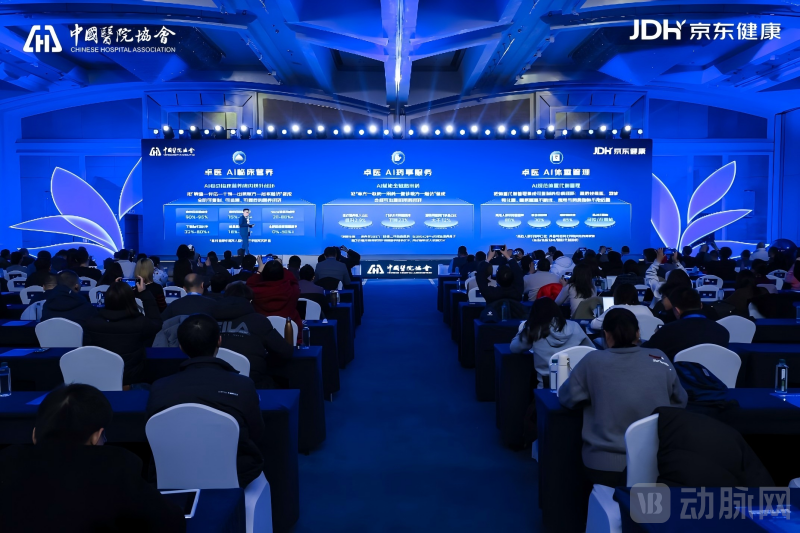
Jingdong Health Upgrades and Releases "JD Medical Excellence 2.0"
For example, "AI + Clinical Nutrition" is based on guideline consensus and medical record data, helping medical staff efficiently complete screening, assessment, diagnosis, and treatment, while also conducting stratified interventions and closed-loop tracking for patients. It balances the scalability and personalization of services, and patients can also have a variety of specialized medical food options.
"AI + Pharmacy Management" improves pharmacist efficiency through AI prescription review and intelligent medication planning, while打通院外供应链通道,支持多渠道取药与7*24小时用药指导。
"AI + Weight Management" uses AI to take over high-frequency basic tasks from medical staff, connects in-hospital and out-of-hospital data, enables patient stratification intervention and continuous home management, and provides emotional support to enhance patient engagement.
In the view of Cao Dong, CEO of Jingdong Health, healthcare is not a "technology show" or a "concept discussion." The underlying logic of healthcare has always been clear: focusing on patient safety and accessibility, physician efficiency and professionalism, and hospital management and development.
If JD Health has already accumulated substantial practices in areas such as patient safety and healthcare accessibility, as well as improving doctors' efficiency and professional empowerment, the launch of JD Health's Zhuoyi 2.0 extends this logic to the level of hospital management and development, systematically unlocking the application value of AI.
The debate in the industry about AI in the medical field will continue.Companies like Jingdong Health are continuously validating the positive value of AI through practice, and more importantly, promoting the practical implementation of "AI+" solutions.
During this Digital Intelligence Healthcare Conference, the First Affiliated Hospital of Wenzhou Medical University, the National Health Commission Key Laboratory of Clinical Nutrition and Intervention, and Jingdong Health jointly released the "AI-Driven Standardized Full-Process Management Solution for Clinical Nutrition," which will be rapidly implemented.
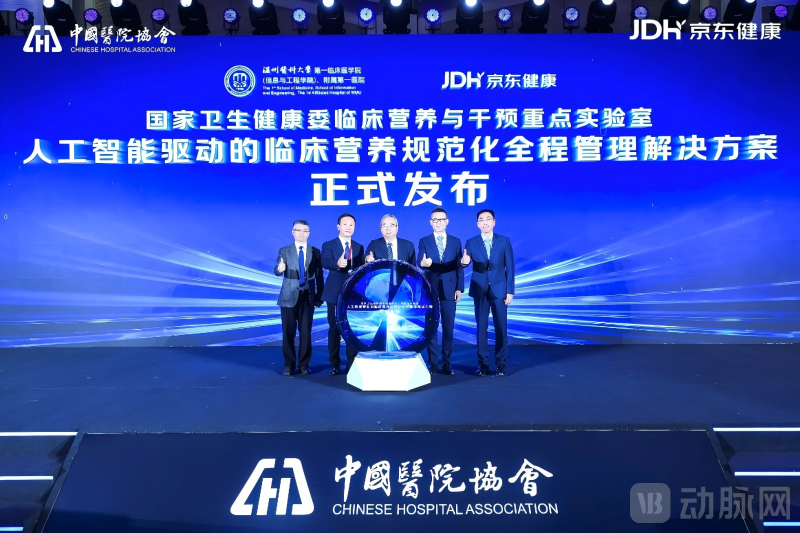
"AI-Driven Standardized Full-Process Management Solution for Clinical Nutrition" Released
Behind the plan lie many long-term challenges in clinical nutrition management: heavy workload and low efficiency of professionals make it difficult to scale services; insufficient manpower often leads to templated services with a lack of layered, precise management; patient follow-up is hard to conduct in depth, with low compliance, non-closed-loop data, and difficulty in quantitatively assessing intervention outcomes.
The demand for precise nutrition management among patients is becoming increasingly urgent: critically ill and specific chronic disease patients urgently need personalized nutritional support to improve prognosis, while postoperative and cancer patients hope to enhance treatment tolerance and reduce complications through specially formulated medical foods; specific chronic disease groups and home rehabilitation populations expect to access nutritional services and products through standardized and convenient channels.
In recent years, national policies have continuously supported the construction of clinical nutrition departments, and the number of domestically approved special medical foods has also grown rapidly.The clinical nutrition department of hospitals, as a key link connecting supply and demand, is expected to more accurately and on a larger scale meet patient needs under the dual empowerment of AI technology and an efficient special medical food supply chain.
Previously, Jingdong Health and the First Affiliated Hospital of Wenzhou Medical University had already collaborated through "JD Zhuoyi" to create an AI-driven patient service system and a "clinical nutrition + specialized medical food" network, serving over 4.7 million patients, with the model and efficiency proven.
At the aforementioned conference, Jingdong Health also signed agreements with multiple nutritional health brands to jointly build an "AI + Clinical Nutrition Supply Chain Ecosystem." By integrating high-quality nutritional product resources and supply chain service capabilities within the industry, the initiative aims to打通从个性化营养方案制定到精准营养产品配送的全链条供给通道.
This ecological co-construction model synergizes with AI clinical nutrition solutions, jointly building a clinical nutrition service capability that combines "standardized diagnosis and treatment with precise supply."
Currently,"The AI-driven Standardized Whole-process Management Solution for Clinical Nutrition" Has Reached Scale-up Conditions and Will Be Promoted to Medical Institutions in More Regions Across China, Empowered by Jingdong Health's "AI + Supply Chain" Dual Support, Allowing High-quality Clinical Nutrition Resources to Benefit More Patients.
The trend of AI empowering healthcare is irreversible, and as this technology gradually becomes an indispensable part of the healthcare service system, leading platforms like Jingdong Health have already seized the opportunity for industry development.