

World's First "No Thermal Damage" Short-Pulse Thulium Laser Lithotripter: FU GUANG DE KANG's Breakthrough in Minimally Invasive Surgery
FU GUANG DE KANG
High-end laser medical equipment and配套耗材 suppliers
"We hope to use the 'Lucky Light' to bring health to humanity." Li Xiangjun, co-founder of Nanjing FU GUANG DE KANG Medical Technology Co., Ltd. (hereinafter referred to as "FU GUANG DE KANG"), explained the meaning behind the company's name during an interview.
FU GUANG DE KANG was founded in 2025 in the Nanjing Medical Device Industrial Park, targeting the significant market for the domestic production substitution of high-end laser medical equipment from the very beginning.Its globally pioneering, independently developed product —— Short Pulse Thulium Solid-State Laser Therapy Machine (SP-Tm:YAG), can achieve "Non-Thermal Damage Photomechanical High-Efficiency Powderization Lithotripsy", solving the long-standing problems of soft tissue thermal damage risk and low efficiency of powderization in laser lithotripsy surgeries in urology."
1From "Photothermal" to "Photomechanical": Solving Thermal Damage Challenges with Short-Pulse Thulium Lasers
In China, the total number of urological surgeries for stones, benign prostatic hyperplasia, and tumors exceeds 2.5 million annually. More than 20% of complex stone surgeries face increased risks due to prolonged operation times (exceeding the 90-minute safety window). Laser lithotripsy is one of the most common minimally invasive procedures, with postoperative ureteral stricture being a recognized risk. Research published in the Chinese Medical Journal shows that the incidence of ureteral stricture after holmium laser lithotripsy is significantly higher compared to pneumatic lithotripsy.
"Heat injury is the main cause of this complication," explained Li Xiangjun. The traditional holmium laser works by breaking up stones through a photothermal effect, a process that inevitably generates heat and may damage surrounding soft tissues. For impacted stones or complex kidney stones, prolonged surgical time further increases the risk of thermal injury and can even lead to more severe complications such as infection.
To address this clinical pain point, FU GUANG DE KANG developed the SP-Tm:YAG laser therapy machine using a different technical approach——Photomechanical Lithotripsy. Its principle does not rely on continuous heating, but ratherBy releasing ultra-short pulses of high-power laser, mechanical stress is generated near the stones to crush them., thereby significantly reducing the generation and accumulation of heat at the source.
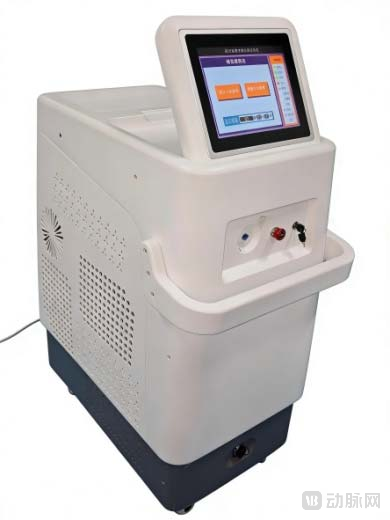
SP-Tm:YAG Laser Treatment Machine Source: FU GUANG DE KANG
The key lies inThe core parameters achieve a perfect integration of "narrow pulse width, high pulse power, and low energy," akin to a surgical knife possessing the qualities of being "sharper, faster, and safer."Li Xiangjun explained: "The pulse width of our laser is extremely short, far below the response time for human tissue to absorb the laser and generate thermal effects, which avoids heat accumulation in principle."
Specifically, compared with traditional lasers at wavelengths of 2.12μm (high lithotripsy efficiency but severe thermal damage) or 1.94μm (good pulverization but low efficiency), the device utilizes a wavelength of 2.01μm, pulse power >100kW, and a water penetration depth of 0.2mm. These parameters achieve optimization and balance over existing solutions while maintaining high-efficiency pulverization lithotripsy with nearly negligible thermal effects.
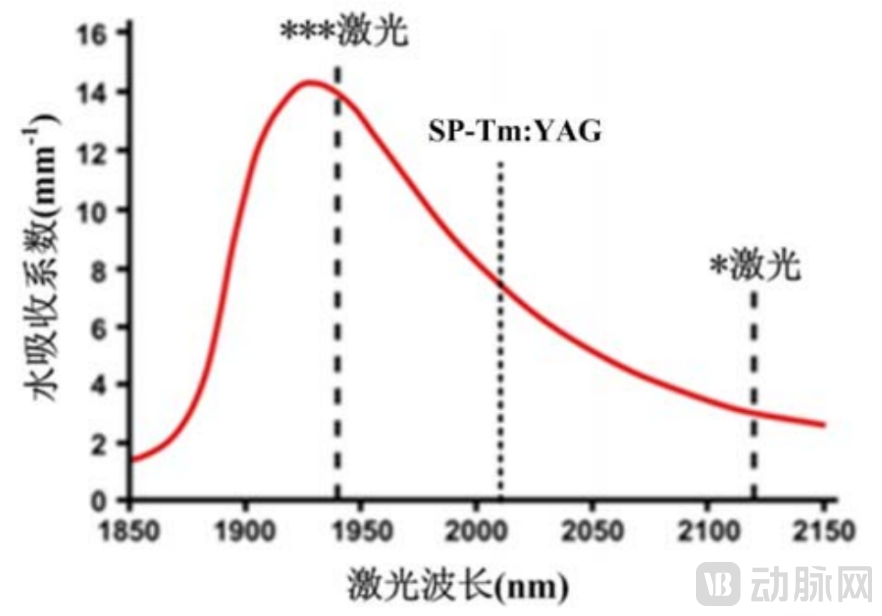
Comparison of Water Absorption Coefficients of Different Lasers Source: FU GUANG DE KANG
In vitro tests show that SP-Tm:YAG lithotripsy is highly efficient, capable of crushing stones into fragments small enough to be easily expelled through the gap between commonly used flexible ureteroscopes and their sheaths. No thermal damage was observed even after continuous application on biological tissues for 10 minutes. This indicates that, clinically, it can reduce the complexity of intraoperative stone retrieval, simplify surgical procedures, and fundamentally lower the risk of ureteral stricture.
In addition to the innovative principles, the product design closely aligns with the actual operational needs of hospitals. The equipment adopts a modular design, allowing a single host to support various urological surgical modes such as lithotripsy, transurethral resection and vaporization of the prostate, and tumor ablation. Doctors can simply switch between modes on the operating interface without needing to change devices.
"This means that the hospital can achieve the functions that might have required multiple specialized devices in the past, with just the procurement cost of a single device, directly improving the utilization and economic benefits of the equipment," said Li Xiangjun.
For doctors, a safer and more convenient operating platform reduces the learning curve, and its "no thermal damage" feature is particularly valuable when dealing with impacted ureteral stones. Doctors can adopt the "in-situ lithotripsy" approach, avoiding the traditional method of pushing the stone back into the kidney for further treatment, thereby better protecting ureteral function.
2Fifteen Years of Scientific Research Accumulation, Deep Integration of Industry, Academia, Research, Medicine, and Engineering
The technical core of FU GUANG DE KANG originates from the team's long-term scientific research accumulation. Dr. Du, the company’s technical director, has over fifteen years of in-depth experience in the specific field of short-pulse thulium solid-state laser sources. He has accumulated a series of achievements, including 16 invention patents, more than 30 SCI papers, and the Second Prize of the National Technology Invention Award, providing foundational support for engineering transformation.
The reliability of the product is attributed to the cross-disciplinary integration of the team. The R&D team also combines laser technology experts with clinical medicine experts, forming a "industry-university-research-clinical-engineering integration" model.
This model ensures that innovation remains aligned with clinical essence: Core technology is introduced from the Chinese Academy of Sciences for secondary development, while closely collaborating with experts from multiple top-tier hospitals. Genuine surgical needs, operational habits, and risk feedback are deeply integrated into product design, making FU GUANG DE KANG's product development pursue technological advancement while emphasizing reliability, ease of use, and clinical value in the operating room environment.
3Chinese Laser Equipment Breakthrough: Towards Precision, Minimally Invasive, and Intelligent Development
Global Laser Medical Market in a Key Period of Steady Expansion and Accelerated Structural Adjustment
However, the market exhibits distinct structural characteristics: the high-end market has long been dominated by international brands. Companies such as Lumenis, Cynosure, and Alma Lasers have captured significant shares in the high-end treatment equipment sector due to their deep technological expertise and strong brand influence. In contrast, products from Chinese domestic enterprises have predominantly concentrated in the mid-to-low-end market segments and are currently in the process of domestic substitution.
However, this pattern is approaching a crucial turning point. In 2024, the Ministry of Industry and Information Technology (MIIT) and the National Health Commission (NHC) jointly launched a project to promote the application of high-end medical equipment, providing a critical platform for clinical access and promotion of domestically produced high-end laser devices.
The trend of technological evolution is also clear. Laser medical technology is moving towardsMore precise, more specializedThe direction of development. The differences in demand for laser equipment among different departments are becoming increasingly evident, with specialized requirements for device parameters in departments such as urology, gastroenterology, and otorhinolaryngology. For example, when dealing with vascular-rich tissues, doctors may need to emphasize parameter settings related to coagulation functions; whereas, when handling stones, more attention is given to the efficiency of stone fragmentation.
IntelligentizationIs another direction worth paying attention to. Some companies have begun to explore integrating functions such as image guidance and real-time monitoring into laser systems, improving the precision and safety of surgeries. However, the clinical value and practicality of such functions still require more validation.
Li Xiangjun specially mentionedPortabilityTrend: "As laser devices continue to shrink in size, portable laser medical equipment will become more suitable for use in grassroots medical institutions, which will help high-quality medical resources reach lower-level facilities."
In response to this market environment, FU GUANG DE KANG has formulated a pragmatic development path. Initially focusing on the field of urology, which has clear demands and high acceptance of innovation, the company establishes clinical advantages and reputation by relying on its "no thermal damage" technology. On this basis, through modular design, the verified technology platform is extended to related fields such as hepatobiliary surgery and gastroenterology, forming a multi-department minimally invasive surgical solution driven by core laser technology.
To support this strategy, the company is advancing a new round of financing, planning to introduce strategic investors with medical industry resources or established market channels. The focus will be on preparing for product clinical trials, obtaining key medical device registration certificates, and early overseas expansion, accelerating product implementation and market growth.
With the continuous advancement of policies supporting domestically-produced high-end medical devices and the growing clinical demand for precise minimally invasive surgeries, FU GUANG DE KANG's technology innovation, which is oriented towards solving specific clinical problems, may find its place in the development of China-produced high-end medical equipment. The ultimate value will be reflected in patients experiencing safer surgeries and achieving better treatment outcomes.