

Dialogue with AIMINGMED: Reducing Drug Sensitivity Testing from 21 Days to 7 Days, Bringing Automated Organoid Drug Sensitivity Testing to Frontline Hospitals

AIMINGMED
Organoid Technology Developer
In 2025, CAR-T therapies, both in vivo and ex vivo, will undoubtedly be the most prominent segment of the biopharmaceutical industry. In this field, organoid technology is becoming an essential "standard" tool for CGT companies to accelerate R&D.——"In China, we have reached out to and served multiple CGT companies. Whether considering the characteristics of CGT therapies or the construction of toxicology and pharmacology models, these enterprises are more inclined to embrace organoids," said Dr. You Mingliang, founder of AIMINGMED, in an interview with VCBeat.
Organoids: Three-dimensional cell cultures formed in vitro using adult stem cells, pluripotent stem cells, or tissue progenitor cells, which possess the structural and functional characteristics of organs. Through extracellular matrix and specific growth factor induction, cells undergo self-organized differentiation to form spatial structures containing various organ-specific cell types. These organoids exhibit self-renewal, self-organization, and genetic stability. Compared with traditional 2D cells, 3D cells are closer to the true morphology of cells and can better simulate complex structures and functions, providing a more precise and reliable experimental model for disease research, drug development, and clinical diagnosis and treatment.
The characteristics of CGT therapy, such as targeting and immunogenicity, are difficult to accurately simulate in traditional animal models. For enterprises themselves, the insufficient reliability of data extrapolation to clinical trials will lead to a high failure rate in the later stages, forming pressures on R&D costs and efficiency. Organoids can achieve high-throughput drug screening, personalized efficacy prediction, and clinical patient selection, helping companies conduct secondary validation and elimination of pipelines at an early stage. At the same time, withThe FDA and NMPA are imposing increasingly stringent safety requirements on CGT drugs, necessitating that companies provide more comprehensive toxicity data (on-target/off-target) as crucial evidence chains and supplementary materials for IND submissions.
Dr. You Mingliang pointed out: "The current demand in pharmaceutical R&D is not conceptual, but rather seeks solutions with clear cost calculations and regulatory concerns." This also explains why organoid services are rapidly transitioning from early-stage research tools to becoming indispensable 'infrastructure' in the biopharmaceutical industry and its supply chain.
Founded in 2020, AIMINGMED is a research and development-oriented medical technology enterprise with organoid technology as its core. It independently develops reagents, consumables, equipment, software, and other products across the entire organoid industry chain. Integrating R&D, production, scientific research services, and medical testing, the company supports precision oncology and new drug screening. Recently, VCBeat specially invited Dr. You Mingliang, founder of AIMINGMED, and Dr. Shen Chongyang, co-founder, for an in-depth dialogue on the automation and digital iteration of organoids.
1Data Model Improves Success Rate, Launches Vascularized, Immune Cell Co-culture Organoids
Not chasing the trend, but building the runway before the trend takes shape.
In 2020, You Mingliang and Shen Chongyang successively returned to China from the National University of Singapore, Singapore Cancer Science Institute, and Yale University in the United States, where they had long been deeply engaged in the fields of stem cells and 3D cell culture. You Mingliang and Shen Chongyang found that the application of 3D cells and organoid models in the biopharmaceutical industry chain is still in its infancy, with no regulations or guidelines recommended globally. The two quickly reached an agreement, believing that organoids would be a game changer in early-stage research and development and precision medicine.
Unlike pure technology-driven Biotech, since its inception, AIMINGMED has positioned itself as a "precision medicine company," using automation and digitalization to address the efficiency pain points in the industrialization of organoids. The name "Aiming" conceals strategic ambition — it both "targets" precision medicine and declares in the "present continuous tense" that this transformation is happening now. The red target at the center of the logo is ingeniously designed in the shape of an organoid, symbolizing a direct hit from pharmaceutical R&D to precision medicine.
During its development, AIMINGMED targeted the three major pain points in the industry application of organoid technology—productization, automation, and digitalization—and achieved a comprehensive iteration of the product chain based on underlying technological innovation.
The current lack of versatility in 3D cell culture reagents and consumables leads to low success rates in organoid modeling and significant batch-to-batch variation, severely restricting commercial implementation. AIMINGMED attempts to replace "uncontrollable craftsmanship" with "computable certainty," transforming culture media from consumables into a standardized, replicable industrial product.
Specifically, AIMINGMED has built a medium algorithm platform that includes data verification and feedback design. The underlying logic of this "3D cell mathematical model" completely changes the traditional "trial-and-error" R&D approach – through continuous sequencing tests and data feedback, the model automatically optimizes the composition ratio of the medium, enabling the expansion rate and yield of organoids to achieve an industrial-level leap.
"The mindset driven by demand and empowered by algorithms runs through AIMINGMED's product system." Shen Chongyang emphasized, "AIMINGMEDMedium Average ExperienceMore than 10 version iterations, each upgrade is the optimal solution derived from data models, rather than a accumulation of lab experiences.
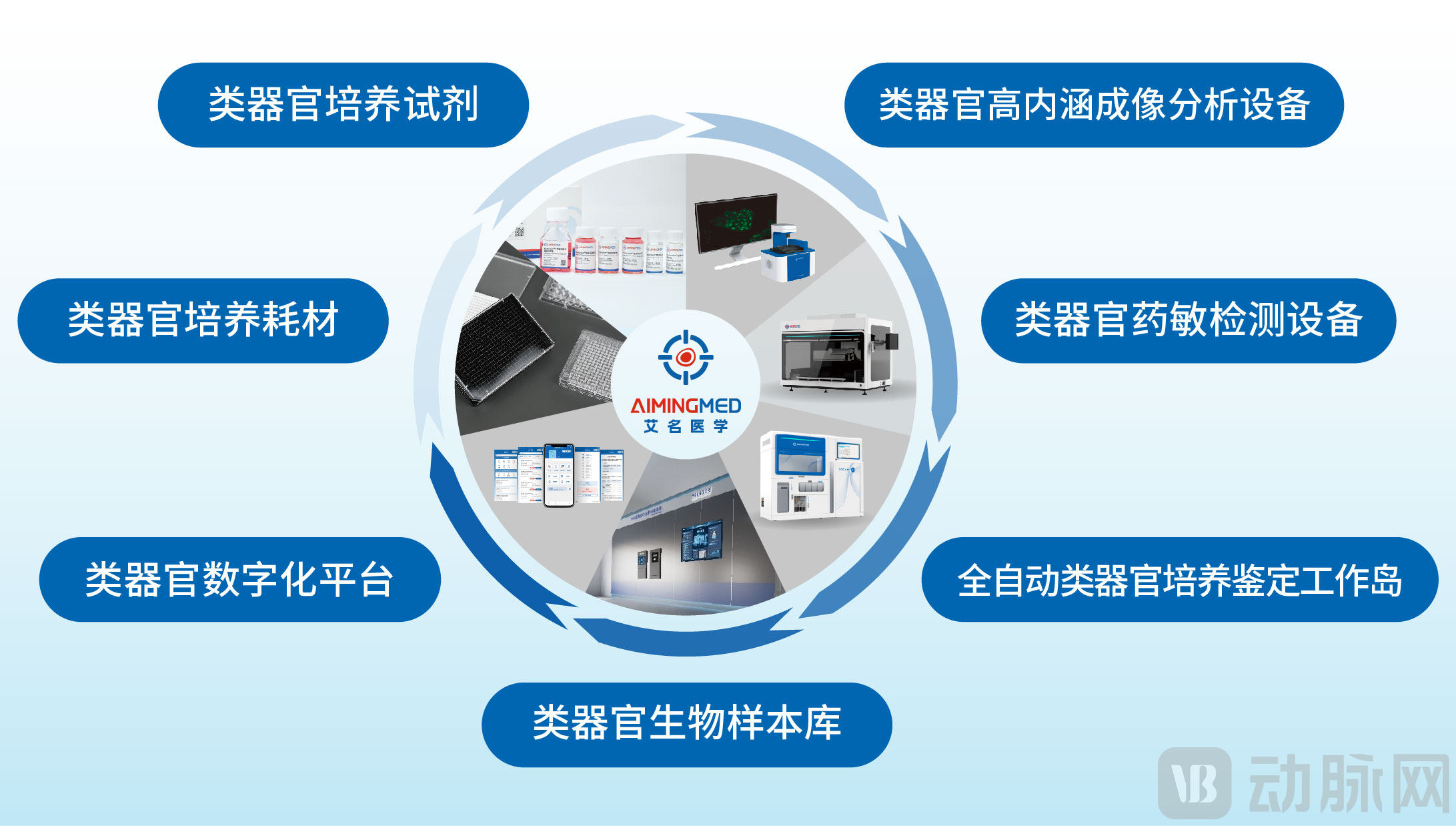
Specifically, the self-developed MasterAim®Tumor Organoid Culture System, with costs only 5%~50% of competitors, a 30% higher success rate in model establishment, and an accuracy rate more than double. Currently, there are 25 tumor organoid culture kits and 17 normal mouse tissue organoid culture kits. In terms of consumables, self-developed Signoid.®Organoid chips enable high-throughput cultivation of organoids with uniform size; self-developed ProPEG.®The composition of the hydrogel has been determined, which can replace the existing animal-derived matrix gel, enabling mass production with more stable quality between batches.
But what truly establishes AIMINGMED's moat in technical services is its precise grasp of customer needs and industry pain points.
Dr. Shen mentioned —— Through in-depth communication with the front line, the current organoid industry chain faces two core demands: the lack of vascularization leads to the inability to simulate the real drug delivery and metabolic microenvironment; the absence of immune cells makes the in vitro evaluation of immunotherapy lack empirical and pathway basis. Therefore, AIMINGMED has taken the lead in launching vascularized organoids and immune cell co-culture organoids, as well as a product matrix of iPS organoids covering seven major systems: liver, kidney, intestine, brain, heart, lung, and blood vessels.
2China's First Fully Automatic Organoid Culture and Analysis Device Reduces Drug Sensitivity Testing from 21 Days to 7 Days
Organoid Drug Sensitivity Testing (PDTO) is an important tool for personalized cancer treatment. However, at the current application level, there are still many challenges in promoting its use — patients hope to get results the day after submitting samples, yet laboratories require a culture period of 14-21 days; doctors want to evaluate the full range of chemotherapy, targeted therapy, immunotherapy, and radiotherapy options simultaneously, but companies can only offer two single models: targeted therapy and chemotherapy; it is difficult for hospital laboratories to allocate a professional team of more than 15 people for drug sensitivity projects, which happens to be the minimum culture unit for most organoid companies.
In fact, the three-layer dilemma is the link disconnection between clinical application needs and the application end of cutting-edge technologies:OperationThe golden window period for patients waiting for chemotherapy usually does not exceed 7-10 days, yet the traditional organoid culture process often takes up to three weeks, causing the clinical value to plummet during the prolonged wait; the cost structure presents significant challenges—5A technical team of about 10 people, complex manual operations, and high reagent consumption keep labor costs and testing fees excessively high. "Unless these three layers of challenges are overcome, organoids will forever remain in scientific research and development, unable to become a clinical tool for large-scale application," You Mingliang pointed out incisively. "This is not a problem that can be solved by technological iteration but requires a reconstruction of the production method."
AIMINGMED's answer is the Organoid Systematic Culture and Analysis Robot-AI (OSCAR-AI). AsChina's First Fully Automatic Organoid Culture and Analysis Equipment (Drug Sensitivity Workstation),OSCAR Builds Systematic Solutions through Automation, One-stop Integrated Cultivation, and Rapid Preparation of Minute Samples.
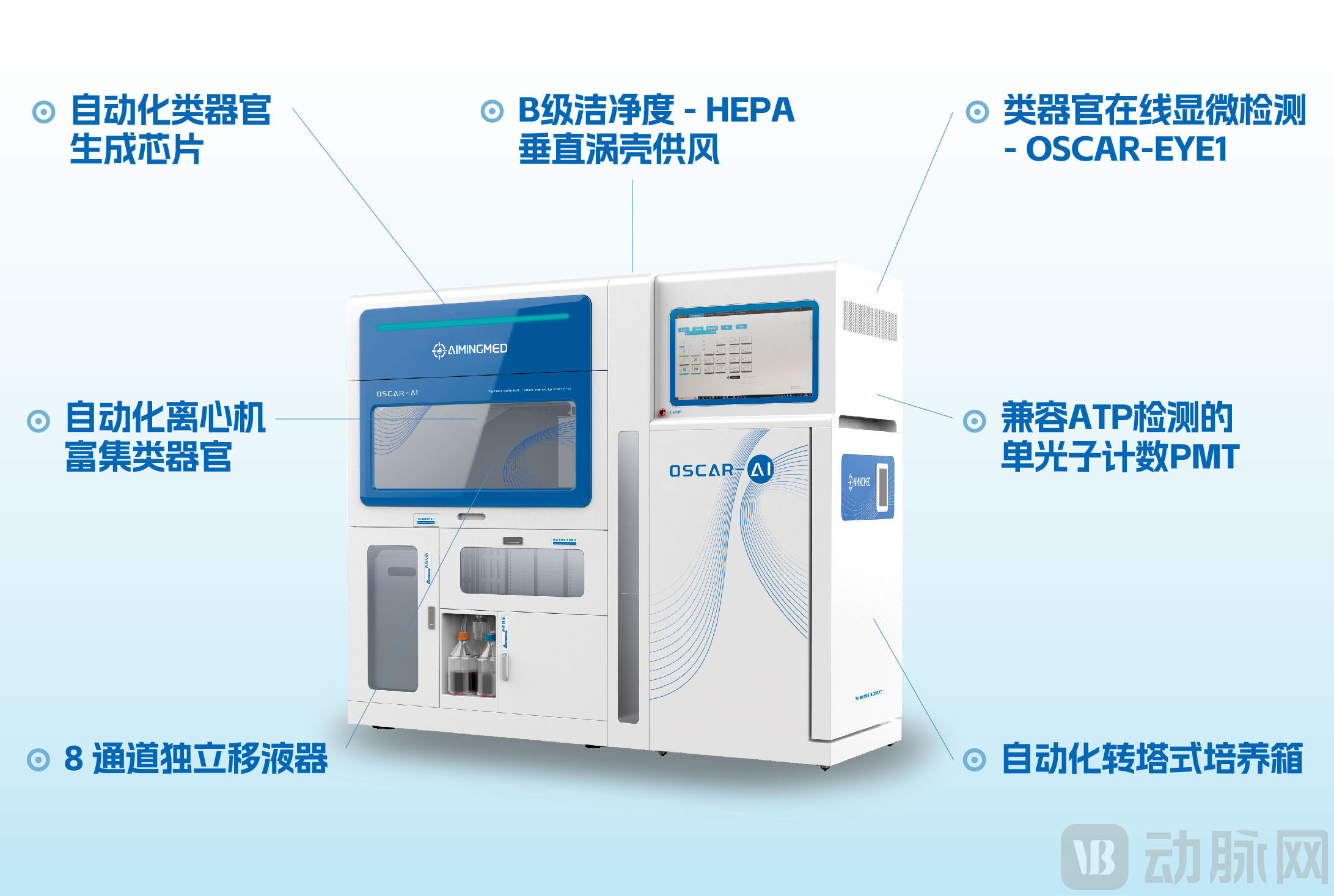
The core breakthrough of OSCAR lies in the rapid preparation of trace samples: with only 10 microliters of puncture tissue, the microfluidic chip module can automatically generate 200-300 homogeneous organoid microspheres within 5-7 days. The drug sensitivity report cycle is compressed to 7-9 days, which is more than twice as fast as traditional methods. In clinical settings, this means that postoperative patients can obtain personalized medication plans before their first chemotherapy.
More crucially, there is a significant reduction in manpower and costs.Shen Chongyang emphasized that the essence of a systematic solution is to encapsulate operations previously dispersed among 15 individuals into the algorithm and culture system of a single device. By integrating iterative improvements in culture media and algorithmic validation models, the system has undergone over 10 version upgrades, enabling the integrated organoid amplification efficiency to reach industrial standards. The device also supports "three-mode integration" – capable of high-throughput production of microsphere organoids while being compatible with 3D cell culture, 2D cell culture, and iPS cell induction differentiation, achieving seamless transitions from research to clinical applications.
From a business model perspective, the gross margin of manually operated organoid services is less than 30%, and it is difficult to achieve scale, high-throughput, and short-term cultivation. Automated equipment, on the other hand, reduces labor costs by 80%, increases testing throughput more than tenfold, and the gross margin is expected to exceed 60%. In particular, it makes it possible for hospital laboratories to independently conduct tests—standardized operations eliminate the need to build an expensive technical team, truly breaking through the ceiling of the in-hospital drug susceptibility testing market.
It is reported that AIMINGMED's OSCAR has entered the top three hospitals in China and is co-building standardized laboratories with regional organoid centers, accelerating clinical implementation.
3Digitization, Real-time Monitoring, and Miniaturized Desktop: The Future of Organoids
In AIMINGMED's development blueprint, organoids are not the endpoint, but a biological mine for data production.
The data dilemma in traditional cancer treatment lies in "sparsity": one patient corresponds to only one medication regimen at a single point in time, forming a single data point. However, organoid drug sensitivity testing can evaluate dozens of drugs simultaneously, generating a multidimensional response matrix. —— You MingliangDiscussing: "This is not only about efficiency improvement,"But rather an exponential growth at the data level."
Through three dimensions, AIMINGMED is gradually building a tumor organoid model library, improving data utilization, and hoping to create a digital tumor organoid model.(Digital Tumor Organoid Models (DTOMs) Model Library. For example, for specific patient populations, combining organoid drug sensitivity data.Deep sequencing of the genome, transcriptome, and proteome forms highly valuable insights for pharmaceutical companies.R&D Data Assets; Deeply Collaborate with Hospitals to Build Personalized Patient Profiles, Integrate Individual Patient Information, and Form a Positive Cycle of Data-Application-Feedback-Strengthening, Driving Organoids towards Automation and Digitization through Continuous Iteration.
At the same time,AI capabilities have been embedded in hardware products. The OSCAR fully automatic organoid culture and analysis equipment integratesHigh-throughputAIVisual Recognition Module, automatically judge the growth status and drug sensitivity of organoids through image algorithms, replacing the repetitive labor of experimenters under the microscope. "High-content screening of 2D cells is already very mature; we are breaking through the real-time dynamic recognition of 3D organoids," said You Mingliang. "This module has been patented, with unified standards and traceability, which will provide a digital evidence chain for subsequent report materials."。”
"AI applications in the medical field should follow the 4D standards: Digital, Deplicable, Detectable, and the most challenging, Definable," explained You Mingliang.“Doctors dare to useThe premise of AI is that it can provide an evidence chain like clinical guidelines, rather than black-box decision-making.”
Furthermore, AIMINGMED, as an important industry partner, participated inQueensland University of Technology (QUT) Led "Microphysiological Systems Technology Training Center (MiPSET)". The project was selectedAustralian Research Council (ARC) 2025 Annual Industrial Transformation Training Center (ITTC) Project List. AIMINGMED is the only Chinese company selected and one of only two institutions in Asia to be chosen (the other being a Japanese company).
Looking to the Future, Shen ChongyangIt was emphasized that the future of organoid chips needs to further integrate with clinical demands, such as the need for miniaturized, desktop-level devices; multidimensional integration of multi-omics data and metabolic analysis; and the clinical gaps in real-time monitoring and dynamic evaluation. "In the more distant future,"Organoids need to move from 'centralized services' to 'point-of-care testing' in hospitals, and eventually become a routine diagnostic and treatment item," You Mingliang concluded.