

Lighting Crossover Temperature Control: Why Did This Pharmaceutical Cold Chain Company Raise 116 Million Yuan in Series A Funding?

Ember
Temperature Control Product Developer
Most pharmaceutical products (including drugs, vaccines, blood products, and biological samples) need to be kept in specific low-temperature environments throughout the production, processing, storage, transportation, distribution, and retail stages, with the pharmaceutical cold chain being the core guarantee for maintaining these low-temperature conditions.
With the expansion of the pharmaceutical cold chain scale driven by favorable policies and technological advancements, as well as the increase in pharmaceutical consumption due to rising healthcare demands, the pharmaceutical cold chain market size is growing rapidly. Taking China as an example, the "Biomedical Cold Chain" research report from VCBeat shows that: the market size of China's biomedical cold chain industry grew from 16.3 billion RMB in 2018 to 27.5 billion RMB in 2022, with a compound annual growth rate (CAGR) of 13.97%. In the next five years, the market size of China’s biomedical cold chain industry will grow at an even faster pace, with a CAGR of 17.75% during 2023-2027, and is expected to reach a peak of 61.451 billion RMB by 2027.
While the pharmaceutical cold chain market is growing, it also faces some pressing issues that need to be resolved: The pharmaceutical cold chain industry has long been plagued by high resource consumption and low stability. According to statistics from ASHP, losses in the pharmaceutical industry due to failures in global pharmaceutical cold chain systems amount to approximately $35 billion annually, not including the direct impact on public health. In terms of material wastage, a WHO survey indicates that single-use cold chain packaging constitutes a major part of medical waste.
Opportunities and challenges coexist, precisely reflecting the current state of the pharmaceutical cold chain industry. Driven by its original mission to "explore how temperature control technology can be used to save lives," Ember announced on August 10, 2022, the spin-off and establishment of its healthcare business unit, Ember LifeSciences. This move aims to apply years of accumulated expertise in temperature control technology to the pharmaceutical and healthcare sector, promoting innovation within the pharmaceutical cold chain industry.
In December 2025, Ember LifeSciences completed a Series A financing round of $16.5 million (approximately RMB 116 million). This round was led by Sea Court Capital, with participation from institutions including Cardinal Health and other notable individuals.
The ability to secure financing is attributed to two factors: first, the company has achieved a breakthrough through technological innovation, with its self-developed Ember Cube addressing the high-cost pain point of temperature control technology in pharmaceutical cold chains; second, investors trust the company's growth potential and are optimistic about the prospect of its technology expanding from pilot scenarios to national healthcare networks.
When it comes to the founding of Ember LifeSciences, the跨界background of its founder, Clay Alexander, cannot be overlooked. Since establishing his first lighting design company in 1999, Alexander has深耕the LED lighting industry for decades, securing core patents for the Alexander series of light bulbs and successfully founding and incubating dozens of companies in the same field.
But he still yearned for challenges and breakthroughs, so he turned his attention to the field of temperature control. From inventing the world’s first temperature-controlled mug to growing the company into one of the fastest-growing enterprises globally, Alexander's team has continuously tracked cutting-edge technologies in the temperature control field. Moreover, after realizing the importance of temperature control in other application areas, he set the healthcare sector as the next anchor point.
Alexander leveraged its accumulated core technical principles to develop thermoelectric cooling technology, breaking through the bottlenecks of insufficient temperature control precision and high energy consumption. It also collaborated with Cardinal Health, a leader in the medical and healthcare distribution field, to launch Ember Cube, the world’s first self-developed cloud-connected transport box, in February 2022. This invention marks Ember's official entry into the healthcare sector.

Founder Clay Alexander (Image source: company's official website)
After the official establishment of Ember LifeSciences, in order to strengthen the professional image of the R&D team and enhance industry recognition, Alexander hired Brian Bejarano, a veteran of the healthcare industry, as the company's President and General Manager. Prior to this, Brian Bejarano worked at Cardinal Health for 27 years, holding several key positions. Notably, he served as the Operations Head of the Specialty Pharmaceuticals division, overseeing compliance control for vaccines, biologics, and other pharmaceuticals.
From the perspective of industry competition, Ember LifeSciences has clear data support for its performance in the pharmaceutical cold chain sector. According to Tracxn (an overseas business data analytics platform), the company ranks 113th in industry competitiveness among 341 active competitors, primarily competing with companies such as McKesson, Entero Healthcare, and Resilience. Additionally, compared to 14 similarly funded companies, Ember LifeSciences ranks fifth overall.
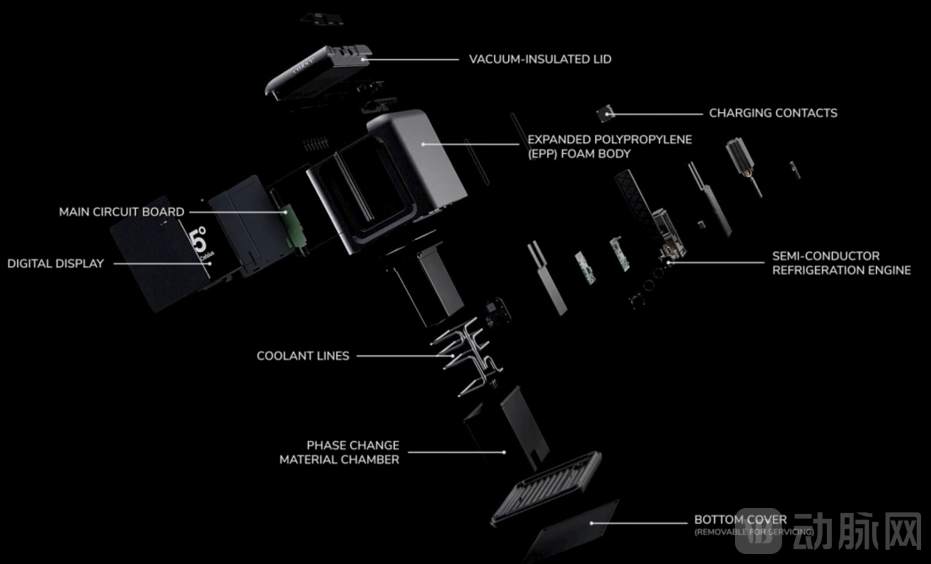
The Ember Cube series of cloud transport boxes, independently developed by the Ember LifeSciences team, have become a crucial stepping stone for Ember's entry into the healthcare field.
The first-generation product, Ember Cube, is equipped with cellular radio and will continuously report a series of data to users during transportation, including the temperature, humidity inside the transport box, as well as the current location. Users can access the Ember LifeSciences cloud software system to monitor in real time via portable devices such as mobile phones and computers. The design team understands that data visualization and process transparency are the core needs of users. The patented technology developed by the team, which integrates GPS positioning tracking and real-time temperature monitoring, serves as a crucial support for promptly detecting temperature fluctuations and providing data backing for drug efficacy.
How to integrate temperature control technology into the transportation process? Ember LifeSciences has provided a clear answer. The Ember Cube is equipped with an active refrigerated cargo hold that utilizes patented core temperature control technology, maintaining the internal temperature of the cargo hold between 2°C and 8°C for more than 72 hours, fully meeting the temperature control requirements for long-distance transportation of environmentally sensitive drugs.
The sender recall technology is an intuitive reflection of Ember LifeSciences' team human-centered design. Ember Cube offers two simple return operations: one is to trigger by clicking the "Return to Sender" button, and the other is triggered when the box lid opens after the Ember Cube reaches its destination. After users receive medical items delivered by Ember Cube, they can choose one of the methods to initiate the return process. Subsequently, its e-ink screen will generate a logistics label and automatically arrange for the carrier to pick up the transport box. Once recovered, the Ember Cube aligns with the charging system under magnetic positioning assistance, completing simple warehousing stacking and charging processes for direct use in the next round of transportation.
Reducing supply chain costs is also the original design intention of the Ember LifeSciences team. Unlike the industry's traditional use of disposable materials such as foam plastics and cardboard to make boxes, the Ember Cube adopts specially customized materials that can be reused hundreds of times, reducing millions of pounds of material waste and 92% of carbon dioxide emissions annually. This achieves sustainable development in both economic and environmental aspects.
Therefore, the debut of Ember Cube has garnered significant attention within the industry, as evidenced by the technology successively winning the Design Innovation Award, the 2023 TIME Best Inventions Award, the 2024 Fast Company World Changing Ideas Award, and the TIME Global Most Influential Award. Fast Company stated that Ember Cube is expected to redefine the standards of the pharmaceutical cold chain industry and lead technological innovation in this field.
The First Generation Ember Cube (Image Source: Company Official Website)
The technological breakthroughs achieved by the Ember LifeSciences team not only address common technical pain points in the industry but also enhance user experience through technical optimization. In 2025, the Ember Cube series will introduce the second-generation cloud transport box, the Ember Cube 2. Building on the configuration of the first generation, this product places greater emphasis on eco-friendly design and flexible customization. The main body of the Ember Cube 2 features a vacuum-insulated payload compartment, equipped with reusable eco-friendly gel packs. Additionally, to meet the needs of different payloads, the Ember Cube 2 offers reconfigurable functionality and multiple size options. The design further optimizes the dynamism and modularity of this next-generation product.
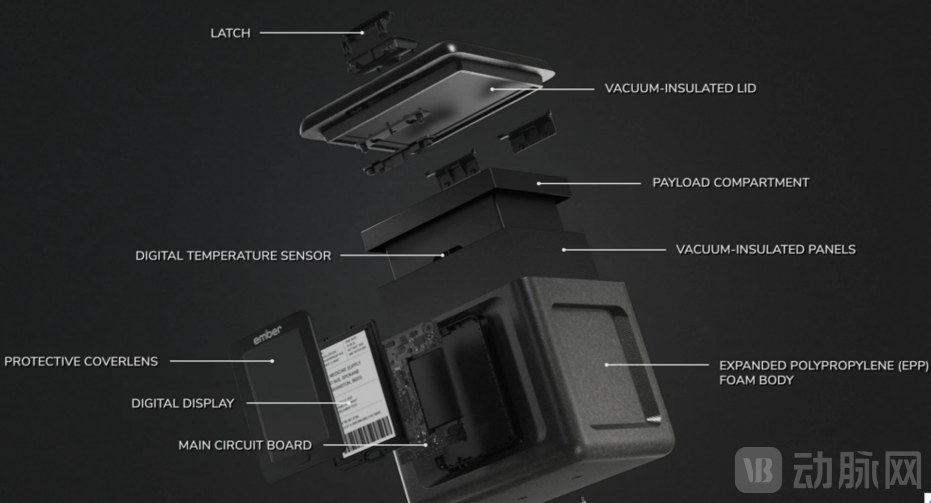
Ember Cube2 (Image source: Company official website)
Unlike the first-generation Ember Cube, which mainly focused on transfer scenarios between stores, the core service targets of Ember Cube 2 remain institutions such as pharmaceutical distributors, specialty pharmacies, infusion pharmacies, and testing laboratories. However, with its modular design and multiple size options, it breaks through the transfer scenario limitations of the first-generation product, meeting the transportation requirements for large quantities of medical supplies across different scenarios.
In the future, the focus of Ember LifeSciences' team will shift to developing more cold chain transportation solutions. Two upcoming products include the Ultra-Cold Cube and the Cryogenic Transport Vehicle. The Ultra-Cold Cube replaces refrigeration materials with dry ice or frozen PCM, combined with patented temperature control technology, effectively maintaining payload temperatures between -20°C and -60°C for over 72 hours. Additionally, the device is equipped with a detachable battery, allowing charging without reliance on fixed large charging equipment. The Cryogenic Transport Vehicle utilizes a solution combining liquid nitrogen and vacuum-insulated chambers, enabling pharmaceutical payloads to remain below -150°C for up to 12 consecutive days. As a result, biologics required for treatments like cell and gene therapies can also become transport targets for Ember LifeSciences.
In summary, Ember LifeSciences, leveraging the founder Alexander and his team's expertise in temperature control, has applied cross-disciplinary thinking to the traditionally energy-intensive pharmaceutical cold chain industry. With the self-developed Ember Cube series of intelligent cloud-based transport boxes, the company not only addresses the core pain points of insufficient accuracy and stability in temperature control but also significantly reduces environmental impact and operational costs through a recyclable design. The success of Ember LifeSciences validates the potential of technological integration under the framework of sustainable development to revolutionize the pharmaceutical supply chain. In the future, with the implementation of ultra-low temperature transportation solutions, Ember LifeSciences is expected to bring temperature control technology to cutting-edge fields such as cell and gene therapies, offering more possibilities for the industry’s development.