

Academician Wang Yongjun of the Chinese Academy of Sciences: Using AI to Crack the "Residual Risk" of Stroke, Silicon-Based Intelligence Empowers Precision Medicine
As artificial intelligence evolves from an auxiliary tool to a core engine driving paradigm shifts, its deep integration with medicine is ushering in a brand-new era of health.
At the 2025 (7th) Health Conference, Wang Yongjun, academician of the Chinese Academy of Sciences and president of Beijing Tiantan Hospital, Capital Medical University, delivered a keynote speech titled "Artificial Intelligence Empowering Future Medicine.", systematically expounded that artificial intelligence will fundamentally reshape the precise path of disease diagnosis and treatment from three levels: practical tools, diagnosis and treatment models, and even the overall ecosystem.
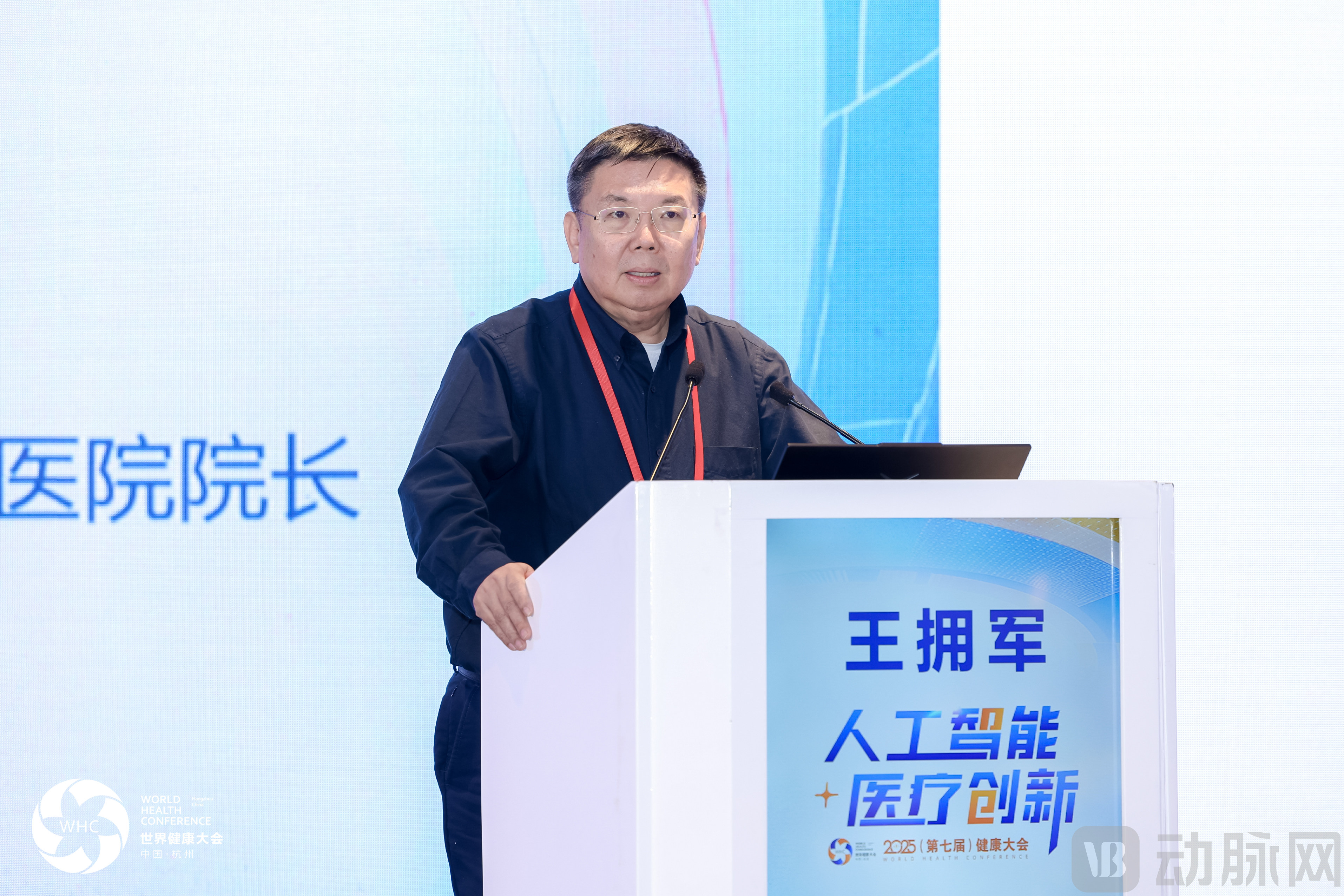 Wang Yongjun, Academician of the Chinese Academy of Sciences, President of Beijing Tiantan Hospital, Capital Medical University
The development of medicine has always been in sync with human technological revolutions. Academician Wang Yongjun began by outlining the profound connection between the evolution of medicine and technological revolutions.
In 1628, William Harvey published "On the Motion of the Heart and Blood," marking the beginning of the anatomical revolution and the start of modern medicine. More than two hundred years later, the Second Industrial Revolution brought about electrification and mechanization, which gave rise to the first batch of modern medical equipment such as X-ray machines and electrocardiographs, allowing doctors to "see through" the human body.
"In the second half of the 20th century, the advent of imaging technologies such as CT, MRI, and ultrasound enabled medical diagnosis to make a leap from macro to micro levels," pointed out Academician Wang Yongjun. These technological revolutions not only expanded the cognitive boundaries of medicine but also reshaped the fundamental model of medical practice.
Today, the fourth industrial revolution —— represented by artificial intelligence, the Internet of Things, and big data —— has arrived. Unlike the steam age, the electrical age, and the information age, the core of this revolution is intelligence, which not only extends the senses and limbs of doctors but also begins to empower their cognition and decision-making.
It is precisely because artificial intelligence has the potential to reshape the medical paradigm that its value has formed a global consensus and rapidly risen to the level of national strategic competition. Academician Wang Yongjun then conducted a detailed analysis of two key international reports, revealing the global strategic layout and competitive-cooperative landscape in this field.
In January 2024, the "AI Empowering Future Healthcare White Paper" released at the Davos Forum presented an exciting vision: the future will see "8 billion doctors," meaning everyone in the world will have their own dedicated AI health assistant. The report predicts that AI willSeven key areas: drug development, simulated clinical trials, patient stratification, medical imaging, personalized treatment, payment optimization, and public health.Reshape the medical system and promote the fundamental shift of the medical focus "from treatment to prevention" and "from hospital to home."
This future-oriented consensus has quickly transformed into specific actions and strategic deployments by major countries. Half a year later, the White House of the United States released an artificial intelligence white paper in July 2024, pushing the competition to a new level. This document clearly positions medical AI as a key area of national strategy and technological competition, proposing three major measures: accelerating the approval process, promoting scientific research innovation, and strengthening technological breakthroughs. It also focuses on advancing three foundational constructions: computing power and data security, interdisciplinary talent cultivation, and cybersecurity protection.
Academician Wang Yongjun pointed out that the strategy proposed in the White House report of "strengthening international cooperation while preventing technology export" reflects the complex landscape of coexistence of cooperation and competition in the global medical AI field. "In this technological race," he emphasized, "China must accelerate the pace of innovation and not be content with just following."
As one of China's top cerebrovascular disease experts, Academician Wang Yongjun took stroke prevention and treatment as an example to deeply analyze the profound challenges currently faced in the medical field.
He systematically reviewed the achievements of evidence-based medicine in the field of cerebrovascular disease: nine major types of therapies, including intravenous thrombolysis, antiplatelet therapy, and intracranial angioplasty, have all received high-level evidence support. Chinese researchers have made remarkable contributions, providing over 40% of the global evidence in the field of intravenous thrombolysis. In terms of antiplatelet therapy, the dual antiplatelet regimen of clopidogrel combined with aspirin discovered by Chinese researchers has become an important standard for secondary stroke prevention worldwide.
However, stroke remains one of the leading causes of death and disability worldwide. Even with the best available medical strategies, patient populations still face significant "residual treatment risks," which are divided into three categories:
● Quality Residual Risk: There is a failure to fully apply treatment methods with substantial evidence in clinical practice. For instance, despite clear evidence of its efficacy, the thrombolysis rate in China remains below 40%.
● Evidence Residual Risk: Treatment methods that should theoretically be effective but lack sufficient evidence-based medical support. For example, intracranial artery stenting, with inconsistent results from four clinical trials, has led to its efficacy still being unclear.
● Unknown Residual Risk: A clinical challenge with unclear root causes and effective therapies. "This is the most stubborn fortress in the medical field, as well as the forefront of innovation."
In response to these three types of challenges, Academician Wang Yongjun depicted how artificial intelligence will pave new paths in healthcare.
The solution for quality residual risks is to build a Clinical Decision Support System (CDSS) centered on artificial intelligence, while promoting the shift of healthcare focus from hospitals to homes.Academician Wang Yongjun proposed the concept of "Family Health Station": By pre-installing AI in wearable devices, health robots, and management systems for home use, it enables health management covering the entire life cycle, truly shifting the focus of medical care from hospitals to families. Hong Kong’s resident health management solutions have already provided a pioneering example.
In response to evidence of residual risks, virtual clinical trials will become the new norm.Creating a virtual patient population through digital twin technology to simulate the efficacy and safety of drugs or medical devices on computers. "This is not just a theoretical concept," pointed out Academician Wang Yongjun. The U.S. FDA and the European Medicines Agency have already issued guidelines for virtual clinical trials, allowing this new trial model to be used in the development of certain medical devices.
For unknown residual risks, big data-driven new drug development will replace the traditional trial-and-error model.By integrating multi-level life data such as genomics, proteomics, and metabolomics, and utilizing artificial intelligence for high-throughput analysis, potential disease targets and drug molecules can be directly mined from massive amounts of information. Academician Wang Yongjun shared: "This approach, which we discussed with *Nature* magazine, is expected to shorten the new drug development cycle from the traditional 17 years to about 4 years."
Based on the above changes, Academician Wang Yongjun proposed an innovative concept——"Silicon-Based Stroke Medicine"。
This is an emerging interdisciplinary field that centers on silicon-based technologies such as computer chips, sensors, and artificial intelligence, deeply integrated with traditional stroke medicine (carbon-based medicine), aiming to achieve early detection, precise treatment, and high efficiency of diseases.
Its application scenarios systematically cover the entire life cycle of health management: achieving stroke risk through wearable devicesEarly Warning; Achieved using AI imaging technologyPrecision Diagnosis; Combining intelligent materials with targeting technology forEfficient Treatment; and complete with the help of rehabilitation robotsIntelligent Rehabilitation. This constitutes a closed-loop management scenario from prevention, diagnosis and treatment to rehabilitation.
However, Academician Wang Yongjun also pointed out that the leap from "carbon-based" to "silicon-based" still faces three major bottlenecks:Technical Timely Response Capability (Timeliness), Absolute Accuracy of Intervention (Precision), and Wide and Fair Accessibility (Accessibility). This is embodied in a series of key issues: How to ensure the biocompatibility of implantable devices? How to build an invincible privacy security barrier in the era of data cloudification? And how to control costs so that the benefits of technology can be extended to all people? The resolution of these issues is the necessary path for "silicon-based medicine" to move from blueprint to reality.
This transformation will also reshape medical education and talent structures. Future medical students must bridge the gap between biology and informatics, mastering the fundamentals of data science and artificial intelligence while excelling in anatomy and pathology. The cross-disciplinary collaboration between "doctors and engineers" will become the norm for medical innovation and clinical practice.
The speech by Academician Wang Yongjun revealed a profound transformation in the medical ecosystem: the exploration of future medicine will be built upon"In Vivo Testing," "In Vitro Testing," and "Computer Simulation Testing"Above the three pillars; the role of doctors will also transition from traditional medical practitioners to planners of comprehensive health and collaborative managers of artificial intelligence. Supported by the Beijing municipal government, the Future Medical Ecosystem Lab established by Academician Wang Yongjun at Tiantan Hospital is a forward-looking layout in response to this trend.
The reconstruction of the ecosystem relies on the collaborative progress of multiple stakeholders:PolicyIt is necessary to build an agile and robust regulatory framework at the level;IndustryNeed to focus on overcoming core technologies and clinical validation;Medical InstitutionNeed to actively embrace process reengineering;AcademiaThey shoulder the mission of cultivating versatile talents and promoting interdisciplinary research. In this round of global competition, regions with advantages in the artificial intelligence industry are expected to seize strategic opportunities.
Looking ahead, when silicon-based intelligence and carbon-based life truly achieve deep integration, healthcare will transcend the traditional "hospital-centric" barriers, evolving into a personalized health companion that is accessible to everyone and available at all times. A more accessible, more predictive, and more personalized health future is being empowered by artificial intelligence, transitioning from vision to reality.