

FlexoLinkAI Secures Tens of Millions in Angel Funding to Advance Sleep Monitoring with Non-Invasive Brain-Computer Interface Technology

FlectoThink
Brain-Computer Interface Field Product Developer
VCBeat has learned that FlectoThink, which aims to build future brain-computer interface (BCI) infrastructure and develop fully flexible smart wearable devices, recently completed an angel round financing of tens of millions of RMB. The investment was backed by market-oriented funds initiated by Zhejiang University Innovation Technology Research Institute Co., Ltd. (abbreviated as "ZJU Innovation Institute"), a platform for the investment and commercialization of scientific and technological achievements at Zhejiang University. The participating funds include Haining Qizhen Yujin Venture Capital Partnership (Limited Partnership) and Shenzhen New Vision Angel Innovation Industry Investment Enterprise (Limited Partnership). Additionally, Beijing Chuangshi Capital, a leading and renowned angel investment institution in Zhongguancun, along with other angel investors from MIT, Stanford University, and UC Berkeley, participated in this round.
Dr. Sun Yu, founder of FlectoThink, stated that the funds from this angel investment round will be allocated to the company's product research and development and the expansion of its commercial market. FlectoThink also plans to partner with more B2B enterprises to develop additional application scenarios, advancing toward the vision of "sleep in service of life" by achieving the goal of improving users' sleep quality through its forehead-patch sleep products.
Over 300 Million People Suffer from Sleep Disorders, Driving a Massive Sleep Monitoring Market
According to the sleep survey results published by the Chinese Sleep Research Society in 2019, the prevalence of insomnia among Chinese adults is as high as 38.2%, with over 300 million people in China suffering from sleep disorders. Sleep problems and improper sleep habits are often associated with various physiological and psychological conditions. Consequently, sleep research holds significant clinical value. According to market projections, by 2025, the overall sleep market size may reach 600–800 billion RMB, while niche segments such as sleep monitoring could reach a market size of 30 billion RMB.
However, existing consumer-grade devices often face various limitations. For instance, consumer sleep monitoring devices typically rely on non-EEG monitoring, which fails to meet the standards of the AASM (American Academy of Sleep Medicine). The data provided is usually non-real-time and cannot facilitate sleep improvement through coordinated environmental adjustments. Furthermore, the data collected by consumer-grade devices often lacks clinical significance. In contrast, medical-grade sleep monitoring devices are often cost-prohibitive, and their stringent operational requirements typically disrupt the patient's natural sleep quality.
In light of this, FlectoThink has launched its own solution, encompassing a range of products including consumer-grade flexible electronic patches (featuring core technology for accurately measuring sleep data via EEG).
Sleep Monitoring as the Core, Multiple Product Pipelines Advancing in Parallel
FlectoThink specializes in the application of non-invasive brain-computer interfaces in the consumer electronics and healthcare sectors, with sleep monitoring as its primary application scenario. By leveraging lighter, thinner materials and advanced algorithms, it enables precise monitoring of users' sleep cycles and sleep architecture.
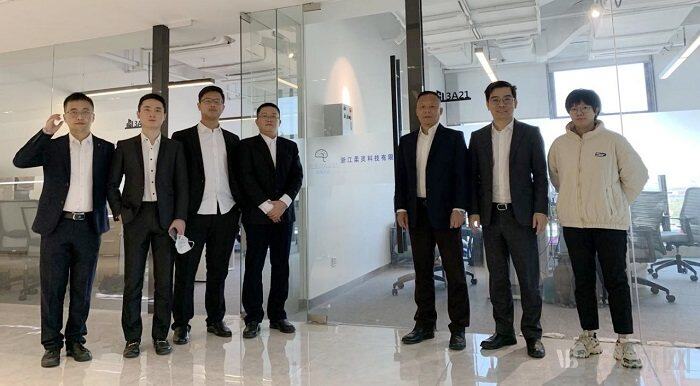
Some members of FlectoThink's early founding team
FlectoThink's capacity to leverage cutting-edge brain-computer interface (BCI) technology for in-depth exploration and pioneering advancements in the sleep domain is attributed to the strength of its team. As a brain-science wearable company operating in the Sino-U.S. BCI sector, FlectoThink maintains laboratories in both China and the United States, focusing on the development of future-oriented, non-invasive human BCI technologies.
The laboratory currently operates in Hangzhou and Shenzhen, China, as well as in the United States. The team brings together world-leading materials scientists, brain-computer interface (BCI) researchers, neurobiologists, and human-computer interaction engineers from top global institutions such as MIT, Northwestern University, the University of Chicago, Tsinghua University, Zhejiang University, and Fudan University. The advisory board features academicians affiliated with Harvard and Stanford University. Currently, the team’s professional and academic background ranks at the forefront globally among non-invasive BCI research teams. Recently, a top-tier international industry expert—a fellow of the national academies of the United States, the United Kingdom, and Ukraine—has joined FlectoThink, providing robust technical support to drive its leapfrog development.
Having assembled a top-tier interdisciplinary R&D team, FlectoThink is continuously expanding its talent pool to include experts in medical big data, medical devices, and related fields. Following the completion of this financing round, FlectoThink plans to recruit more top industry professionals dedicated to the research and development of multi-modal forehead-patch EEG monitoring devices.
FlectoThink has established partnerships with numerous B2B commercial clients. These collaborations encompass partnerships with major medical device manufacturers such as MicroPort, as well as leading intelligent B2B vendors. Through sleep EEG monitoring and seamless interoperability with various B2B devices, FlectoThink modulates the user's sleep environment to effectively regulate and optimize sleep quality.
FlectoThink plans to showcase a highly futuristic intelligent brain-controlled sleep restoration experience to the market at the upcoming Apsara Conference, scheduled for September 15–19 this year, by establishing a Future Smart Living Scene Experience Center in Hall D. On the consumer front, FlectoThink also intends to launch select products via mainstream e-commerce platforms by the end of this year.
In the future, FlectoThink also plans to continue its exploration in the mental health field, launching relevant monitoring products for tracking abnormal psychological fluctuations.
Furthermore, while continuously refining its products, FlectoThink is also actively fostering exchange within the brain-computer interface (BCI) community. The North American BCI community it operates will provide a platform for communication and collaboration among professionals and academic talents from universities across North America who are engaged in this field.
Why Capital Is Bullish on FlectoThink?
The national-level emphasis on the brain-computer interface (BCI) sector has drawn significant attention from the investment community.
Developed countries such as those in Europe and the United States successively launched their own brain initiatives in 2013 and 2014. In 2013, the European Union launched the "Human Brain Project," involving 135 collaborating institutions from 26 countries. China also listed "Brain Science and Brain-inspired Research" as a "Major National Science and Technology Project for 2030" in the Outline of the 13th Five-Year Plan released in March 2016. The China Brain Project is formulated as a 15-year plan (2016-2030), divided into two directions: brain science research oriented toward deciphering the mysteries of the brain and tackling brain disorders, and brain-inspired research oriented toward establishing and developing artificial intelligence technologies.
Amid the rapid development of the brain-computer interface (BCI) sector, Dr. Sun Yu of FlectoThink attributes investors' decision to fund the company to its highly capable team. The team itself has established in-depth exchanges and collaborations with professors and experts from the Division of Sleep Medicine at Harvard Medical School, as well as multiple Class III Grade A hospitals in China. Furthermore, FlectoThink's partnerships with BCI research institutes at various Chinese universities and scientific research institutions are steadily advancing. Currently, FlectoThink holds over 30 hardware and software patents in the fields of electroencephalography (EEG) and electromyography (EMG).
However, capital holds its own strategic perspective on investing in FlectoThink. As the lead investor, the Zhejiang University Innovation Institute, leveraging the platform of the Zhejiang University Brain-Computer Interface (BCI) Research Institute, conducted over a year of close monitoring and in-depth engagement with FlectoThink and the broader BCI industry. Upon validating the technical expertise of the FlectoThink team, it chose to lead the investment. Looking ahead, FlectoThink will integrate with Zhejiang University's premier BCI research platform to fully capitalize on its commercialization capabilities and the synergies with ZJU's foundational BCI research, thereby cementing its leading position in the brain-computer interface sector.