

Medtronic's Hugo Robotic-Assisted Surgery System Makes Debut in Gynecological Procedures

Medtronic
Chronic Disease Medical Device and Therapy Developer
“Each time a disposable surgical instrument is used, with a single click, it costs over 1,000 RMB. I, Wu Mengchao, use manual suturing and charge absolutely nothing.” Wu Mengchao, the father of Chinese hepatobiliary surgery, dedicated 70 years to medical practice and performed more than 16,000 surgeries. Due to decades of gripping surgical scalpels, the fingers on his right hand had long become noticeably deformed, with his fingertips slightly curled inward. It was not until his appearance on the program *The Reader* in 2018 that this secret of the venerable Dr. Wu was finally revealed to the public.

Surgeons: with skilled hands they wrestle with life and death, within a confined operative field they safeguard lives. In the technological era, how can we strike a balance between the arduous demands of prolonged surgeries and the inherent complexities of disease?
Regarding robotic surgery, in terms of mechanisms that enhance the surgeon's capabilities while minimizing device-related adverse effects, are there any established clinical applications? Beyond technological factors, how long will it take for medical robots to achieve widespread adoption?
Recently, medical device giant Medtronic completed six gynecological surgeries, including hysterectomies and myomectomies, for the first time using the "Hugo" Robotic-Assisted Surgery (RAS) system.
On June 22, the Hugo surgical robot was used clinically for the first time, just one month after its initial application in gynecological surgery.
Although the use of medical robots in gynecological surgery is not uncommon, with the da Vinci Surgical System approved by the FDA for gynecological procedures as early as 2005, the American College of Obstetricians and Gynecologists (ACOG) issued a recommendation in 2013: "Avoid the use of robot-assisted laparoscopic surgery for benign gynecological conditions when conventional laparoscopy or vaginal surgery is feasible."
This surgical robot primarily consists of three components: the surgeon console, the patient-side robotic arm system, and the imaging system. At the master console, the lead surgeon operates using hand and foot controls along with a 3D high-definition endoscope. The system translates the surgeon's remote manipulations to the tips of the surgical instruments, synchronizing precisely with the movements of the surgeon's hands.
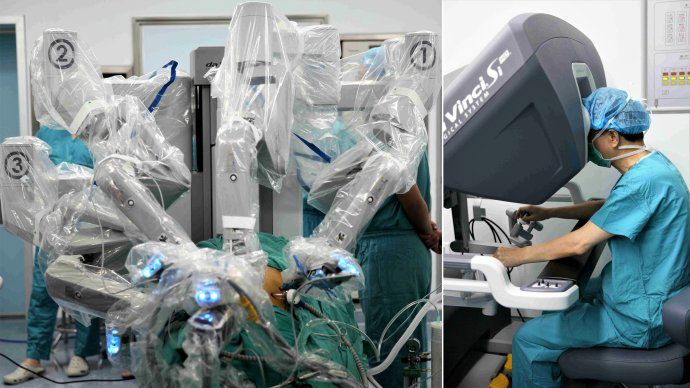
“As an OB/GYN, I hope gynecological surgeries can be less invasive,” said Dr. Carla Peron, Chief Medical Officer of Medtronic’s Surgical Robotics business.
Dr. Zebede, who performed this gynecological surgery in July, said: “The Hugo system brings more comfortable minimally invasive surgery to a broader range of patients, and this inaugural gynecological procedure opens up new possibilities for women’s health.”
Undeniably, minimizing surgical incisions indeed translates to fewer postoperative complications, shorter hospital stays, a faster return to normal activities, and reduced surgical apprehension among elderly female patients. In numerous well-established cases of minimally invasive trocar-based appendectomy in China, patients are able to ambulate on the same day. However, manual puncture by surgeons differs significantly from robotic arm manipulation. The robotic arm lacks the crucial "haptic feedback," rendering the procedure even more challenging than "using an excavator to open a bottle cap."
Compared to traditional laparoscopic surgery, robotic surgery features more flexible "wrists" for tremor reduction, high-definition and stable 3D visualization, more precise dissection and suturing capabilities, and a shorter learning curve, making it widely applicable to delicate surgical procedures.
For example, the most widely adopted da Vinci Surgical System is primarily utilized for prostatectomies and is now increasingly being applied in cardiac valve repair and gynecological surgeries. The Hugo system has incorporated a range of gynecological instruments, enabling minimally invasive surgical interventions for a variety of conditions, including abnormal uterine bleeding, uterine fibroids, and endometrial cancer.
However, high costs have long been a contentious issue surrounding medical robots. In addition to the initial cost, there are also maintenance and repair fees, as well as team training expenses. Who will bear these costs?
Data show that currently 2% of surgical procedures worldwide are performed using surgical robots. Existing cost estimates for hysterectomies performed via different approaches reveal that non-robotic minimally invasive surgery yields an average net savings of $3,269 per case, representing a 24% reduction in costs.
From the perspective of the global competitive landscape, the leader in the medical robotics industry is Intuitive Surgical, with its flagship "da Vinci" surgical robot; since launching the "Hugo" robot-assisted system in 2019, Medtronic has been considered the most "formidable" competitor in the medical robotics sector; in 2021, Johnson & Johnson subsidiary DePuy Synthes announced that its orthopedic surgical robot, VELYS™, had received FDA approval for market launch, rapidly closing the gap.
In contrast, medical robots in China are currently still in the import phase, with certain specialized segments remaining dominated by international enterprises.
Compiled from:https://www.investank.com/news/detail/772141?from_channel_id=56
Leiphone Leiphone(WeChat Official Account: Leiphone)Leiphone
Leiphone original article, unauthorized reproduction is prohibited. For details, seeReprint Notice。