

Academician Wang Jian'an of the Chinese Academy of Sciences: From Tools to Ecosystem, AI Reshapes the Entire Chain of Diagnosis and Treatment for Cardiovascular and Cerebrovascular Diseases
In the era where healthcare and digital technology converge, artificial intelligence is rapidly permeating every aspect of clinical diagnosis and treatment, driving the medical model to shift from experience-driven to a new paradigm of precision intelligence.
At the 2025 (7th) Health Conference,Wang Jian'an, Academician of the Chinese Academy of Sciences and President of the Second Affiliated Hospital of Zhejiang University School of MedicineDelivered a keynote speech titled "Intelligent Technology Innovation and Clinical Implementation for Early Screening and Precision Intervention of Cardiovascular and Cerebrovascular Diseases", systematically showcasing the full-chain empowerment path of AI from early screening, diagnosis, treatment, and rehabilitation to research transformation.
Behind it lies a more profound industry proposition:When AI healthcare moves beyond the initial stage of proof-of-concept, what kind of systematic thinking and ecosystem construction is required to truly integrate into core clinical workflows?
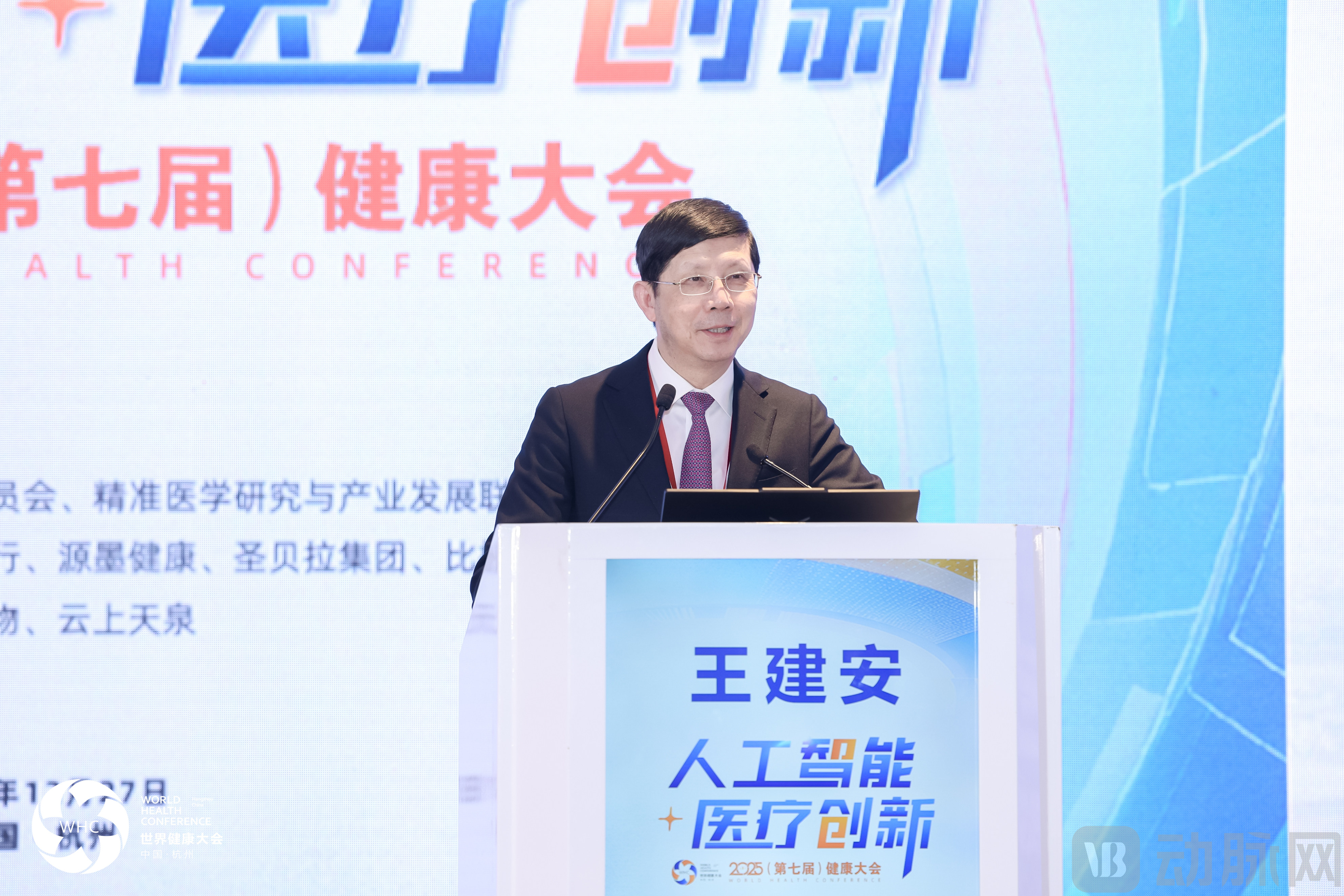 Wang Jian'an, Academician of the Chinese Academy of Sciences, President of the Second Affiliated Hospital of Zhejiang University School of Medicine
1AI Medical Care Should Stick to Problem Orientation, Not Technology First
"Artificial intelligence is reshaping the operating rules of the medical system," Academician Wang Jian'an began by highlighting the core impact of AI in healthcare. However, unlike some technology-driven innovations, he emphasized the "clinical orientation" of AI in healthcare—technology must ultimately serve clinical needs and solve practical problems.
This view aligns with the philosophy of the internationally renowned medical journal *JACC* (Journal of the American College of Cardiology). He cited the perspective from the journal *JACC: Asia*:AI healthcare should adhere to a problem-oriented approach rather than prioritizing technology. At the same time, it is necessary to strictly evaluate and prevent bias, focus on implementation, establish a trust system, and integrate into a broader healthcare ecosystem.
In the view of Academician Wang Jian'an, the core value of AI in reshaping healthcare is reflected in three dimensions: improving diagnostic accuracy, optimizing service efficiency, and amplifying and replicating high-quality resources. The series of practices at Zhejiang University Second Hospital (ZU2H) serve as a vivid example of this concept. Every AI application developed starts with a clear clinical scenario and pursues quantifiable results.
In the diagnosis process, to address the widespread issue of insufficient cardiac ultrasound diagnostic capabilities in grassroots hospitals, the team participated in the development ofThe 985N model can effectively screen for various heart valve diseases by analyzing standard electrocardiograms.The significance of this technology lies in its potential to move some diagnoses that originally required ultrasound equipment into more grassroots medical settings.
In stroke treatment, the time window for traditional intravenous thrombolysis is narrow (usually 4.5 hours), and many high-risk patients cannot be screened in time due to the lack of advanced imaging evaluation capabilities (such as perfusion imaging) at grassroots medical institutions. To address this issue, the team is committed to developing an AI-based assessment tool using non-contrast CT scans to assist thrombolysis decisions without relying on invasive perfusion tests, solving the practical challenges of equipment and technology faced by grassroots hospitals.
More attention should be paid to the construction of the "Pan-Vascular Integrated Early Warning System." Zhejiang University Second Hospital automatically retrieves multi-dimensional patient data through a big data platform and uses AI algorithms to intelligently identify high-risk populations. When the system identifies extremely high-risk patients with a ten-year risk of cardiovascular and cerebrovascular events exceeding 50%, it automatically sends early warnings to the doctor's mobile device and collaborates with community hospitals to form long-term follow-up cohorts.
The value of this model lies not only in technological innovation but also in its reconstruction of the management process for disease prevention., making early screening and early intervention shift from concept to an actionable clinical pathway.
2Breaking Down Department Barriers: Multimodal AI Strengthens the Entire Chain of Diagnosis and Treatment for Pan-Vascular Diseases
In the current healthcare system, while the specialized division of medical disciplines has enhanced professional depth, it has also led to fragmentation in the diagnosis and treatment of vascular diseases. Patients often shuttle between cardiology, neurology, and vascular surgery departments, lacking systematic evaluation and management.
Created by the team of Academician Wang Jian'anChina's First Pan-Vascular Campus, which is an innovation of this traditional model. The hospital integrates the diagnosis and treatment resources for cardiovascular, cerebrovascular, and peripheral vascular diseases, and through a unified data platform and AI analysis system, achieves systematic evaluation and integrated intervention for pan-vascular diseases.
This systematic thinking is also reflected in specific treatment procedures. Taking the highly complex transcatheter aortic valve replacement (TAVR) as an example, Zhejiang University Second Hospital has routinely applied AI-based preoperative simulation technology. By constructing personalized digital models of patients' hearts and rehearsing the entire surgical process in virtual space, doctors can precisely plan valve size and optimal implantation anchoring positions before surgery. This approach also allows for prospective evaluation of risks associated with critical complications such as conduction block and paravalvular leakage.
The value of this technology goes far beyond improving the safety of a single surgery. It directly supports the overall optimization of the diagnosis and treatment process, successfully promoting the implementation of the "Discharge on the Second Day" program. Data shows that approximately 60% of patients can be safely discharged within 24 hours after surgery, significantly reducing the average length of hospital stay.
This proves that the application of AI can redesign and optimize the entire treatment pathway, significantly improving medical efficiency and patient experience while enhancing treatment efficacy, achieving the integration of quality and efficiency.
3From In-Hospital to Out-of-Hospital: How AI Builds a Continuous Health Management Closed Loop?
The end of treatment is not the endpoint of medical service, but precisely the starting point of long-term health management. In response to the systemic shortcomings of "emphasizing treatment while neglecting rehabilitation" in China, Zhejiang University Second Hospital (ZJU-SH) has built a continuous management loop covering both inpatient and outpatient care through a combination of "soft and hard" approaches.
On the "hardware" end, Zhejiang University Second Hospital continuously monitors the electrocardiograms of postoperative patients (such as those who have undergone valve replacement) through wearable devices. The AI backend analyzes data in real time, enabling automatic early warning and timely intervention for risks such as delayed conduction block, providing crucial security assurance for day surgeries and accelerated recovery. This establishes a continuous management loop covering both in-hospital and out-of-hospital care.
On the "software" end, the development of the specialized AI agent "Jack Anxin" represents another pathway for replicating AI medical resources. This exclusive AI agent for heart valve disease can provide services such as diagnostic consultation and follow-up guidance. After being tested with simulated patients, the agent has proven capable of effectively addressing complex consultation needs and is expected to expand into more specialized scenarios in the future. Academician Wang Jian'an revealed that the team also plans to create more doctor AI agents to enable the large-scale replication of high-quality medical expertise.
"The combination of 'hardware + software' is redefining the boundaries of medical services. Traditional medical services were confined within the walls of hospitals, while AI-powered continuous monitoring and intelligent interaction extend professional medical services into patients' daily life scenarios."
4Research Acceleration and Industry Synergy: How AI is Reshaping the Healthcare Innovation Ecosystem?
The value of medical AI is not limited to clinical diagnosis and treatment but also shows potential in driving the research and development of medical devices and promoting the integration of industry, academia, and research. The cases presented by Academician Wang Jian'an reveal two key dimensions of this transformation: disrupting traditional scientific research efficiency and driving "demand-oriented" industrial transformation.
At the scientific research level, traditional clinical studies are constrained by the "human bottleneck" of sifting through massive amounts of data. The team led by Academician Wang Jian'an provides an exemplary model: utilizing AI technology to rapidly and accurately screen 634 suspected patients with cardiac amyloidosis from 60 million data points across 300,000 patients, achieving a specificity rate as high as 99%.
This process compresses what originally required months or even years of manual screening into an extremely short period, not only efficiently building high-quality research cohorts but also essentially freeing researchers from repetitive tasks, allowing them to refocus on scientific hypothesis and mechanism exploration. This marks the entry of clinical research into a new paradigm of "AI-enhanced" studies.
At the industrial transformation level, AI is shortening the path from clinical needs to product implementation. For example, in the development of new materials for heart valves, the team uses AI algorithms to simulate tens of thousands of polymer compound ratios, completing multiple rounds of virtual screening and optimization before physical experiments.
This "tailor-made" R&D approach has significantly reduced trial-and-error costs and cycles, ensuring that products are closely aligned with real clinical needs from the outset. It has also driven a profound shift in medical device development from engineer-led to a dual-driven model based on clinical needs and computational simulation.
All of the above AI practices in diagnosis, treatment, research, and transformation ultimately point to a unified, broader future goal – buildingFull-Vascular Digital Twin SystemAcademician Wang Jian'an explained that this vision aims to integrate individuals' macro clinical data with micro-omics information to construct a virtual vascular model for each individual, dynamically simulating their "biological age" and health status.
This digital twin will become a powerful open platform for scientific research and clinical use, capable of predicting the risk of vascular diseases, simulating the effects of drug or device interventions, thereby advancing healthcare into a truly "predictive, preventive, personalized" new phase.
The practice of Academician Wang Jian'an's team shows that when AI technology is combined with systematic model innovation, the energy it unleashes will far exceed single-point technological innovation. This is not only a sample of intelligent upgrading in the cardiovascular field but also provides a critical practical framework for the entire AI medical industry on how to bridge the gap between "demonstration value" and "clinical value."
As technology matures and policy support strengthens, AI will achieve breakthroughs in more cardiovascular diagnosis and treatment scenarios. From the long-term vision of a full vascular digital twin system to daily monitoring through wearable devices + AI, medical AI is gradually reconstructing the cardiovascular diagnosis and treatment ecosystem.
In the future, only by adhering to the principle of "clinical value first" and promoting the deep integration of technology, clinical practice, and industry, can AI truly empower the healthcare sector and bring benefits to hundreds of millions of patients. As Academician Jian'an Wang said, "AI is not meant to replace doctors but to become a capable assistant, allowing quality medical resources to reach more patients."