

From Research to Clinical Application, Liying Technology's Self-developed Ultrasound/Photoacoustic Open Platform Breaks the Import Monopoly of High-end Instruments
When Chinese universities pay millions of yuan for an imported ultrasound research device, only to still face the困境 of a closed system and lagging service, a domestic substitution process centered on "technological independence and user orientation" is quietly taking place.
High-end scientific instruments are an important support for promoting scientific discoveries and technological innovation. In recent years, with the deep implementation of China's science and technology innovation strategy, the wave of domestic substitution for high-end research instruments has been increasingly surging. However, in cutting-edge research fields such as life sciences, some key research platforms remain long constrained by the monopolistic pattern of foreign manufacturers – not only are equipment procurement costs exorbitant and cross-border communication complex and time-consuming, but there are also multiple restrictions on technical openness and customized services, severely limiting the efficiency and transformation potential of China's independent scientific research innovation.
It is precisely in such industry challenges that Zhejiang Liying Medical Technology Co., Ltd. (hereinafter referred to as "Liying Technology") came into being. Relying on the founding team's cutting-edge technical accumulation in the fields of photoacoustic and ultrasound imaging, Liying Technology, with self-research and integrity service as its foundation, focuses on the three pillars of "top performance, quality assurance, and efficient service," and is committed to providing numerous scientists, physicians, and engineers in the industry with high-performance acoustic research platforms.
Founder of Liying Technology, Lin Li, is a young scientist who returned from studying abroad and devoted himself to industrial transformation.
Dr. Lin Li graduated from the Department of Medical Engineering at the California Institute of Technology in the United States, under the guidance of Professor Lihong V. Wang, a pioneer in the field of photoacoustic imaging and a member of the National Academy of Engineering. He also completed his postdoctoral research in the same laboratory. Dr. Lin has long focused on the development and application of cutting-edge photoacoustic and ultrasound imaging platforms. As the corresponding or first author, he has published 8 papers in Nature and Science sub-journals and has been selected for the 2024 and 2025 list of the world's top 2% of scientists.

Dr. Li Lin, Founder of Liying Technology
Dr. Lin Li's early scientific research work has made a breakthrough improvement in the comprehensive performance of photoacoustic tomography systems, leading to several firsts in this field: structural and functional imaging of the whole rat brain and heart; structural and functional imaging of the human cerebral cortex; high-speed scanning and precise diagnosis of the entire human breast, as well as evaluation of breast cancer treatment. These achievements have set a benchmark leadership role in the field of photoacoustic imaging, opened up multiple research scenarios, and provided technical support for clinical transformation.
In addition to his rich academic achievements, Lin Li also saw the "invisible wall" between academia and industry during his ten-year overseas study journey — technology can only truly realize its value when it is transformed into products and benefits users. Lin Li pointed out, "The integration point of academia and industry lies in 'market-oriented technology productization,' and Zhejiang University is one of the domestic universities with the strongest atmosphere for technology transformation."
Time waits for no one. In 2022, Lin Li accepted the olive branch extended by Zhejiang University and returned to China to take up a position as a doctoral supervisor at Zhejiang University.And ResearcherIn the same year, Lin Li invested all of his relocation allowance to kickstart his entrepreneurial journey. With the support of social resources, he formed a professional team that integrated research and development, production, and sales—comprising talents from backgrounds in acoustics, optics, mechanics, electronics, computing, control, and medicine—and thus, Liying Technology was established.
At the start of their entrepreneurial journey, Liying Technology encountered the harsh winter of the capital market. Lin Li began to realize that the foundation of a company lies in having "an attractive product and market," rather than just "an impressive technology or story." During the lengthy process of clinical transformation, it is essential to pragmatically launch products that meet market demands. Coincidentally, a complaint from a partner at the Second Affiliated Hospital of Zhejiang University made him see an opportunity in the scientific research market—users were struggling with the millions of yuan price tags of imported ultrasound research instruments and the outdated agency service model. By this time, Lin Li’s team had already independently developed a high-speed data acquisition card for photoacoustic imaging, which happened to be the core module for building such an open ultrasound research platform.
"I volunteered at the time and said, give me a few months, and I will do it for you." Lin Li quickly seized this opportunity. At the same time, it also made him realize that although the scale of the scientific research ultrasound market is not as large as that of clinical applications, its demand is clear and can be quickly tapped into. More importantly, clinical users also have related scientific research needs.
Since then, Liying Technology has establishedProduct Development Strategy for Research and Development Technology in the Market: Starting with a high-speed, multi-channel, open research platform that can flexibly serve various acoustic research scenarios, it has achieved functional equivalence and optimization of imported scientific research instruments. Building on this, and guided by core clinical issues, a new generation of diagnostic and treatment technologies has been developed and iterated to complement traditional methods.
In the interview, Lin Li emphasized "openness" and "service" multiple times, opening up software interfaces, control scripts, and raw data to researchers, and supporting in-depth secondary development.This is not only a distinctive feature of its products compared to clinical ultrasound instruments, but also empowers scientific research users to produce high-quality research results and establish a foundation for technological transformation in numerous application scenarios such as biomedical imaging, acoustic sensing research, ultrasound intervention, and non-destructive testing.
InUltra-R256 Ultra-Fast Ultrasound Imaging and Phased Power Ultrasound Integrated PlatformFor example, this device integrates multiple functions such as ultrasound signal generation, acquisition, and data processing, offering advantages like multi-modality, high speed, convenience, and open-source.
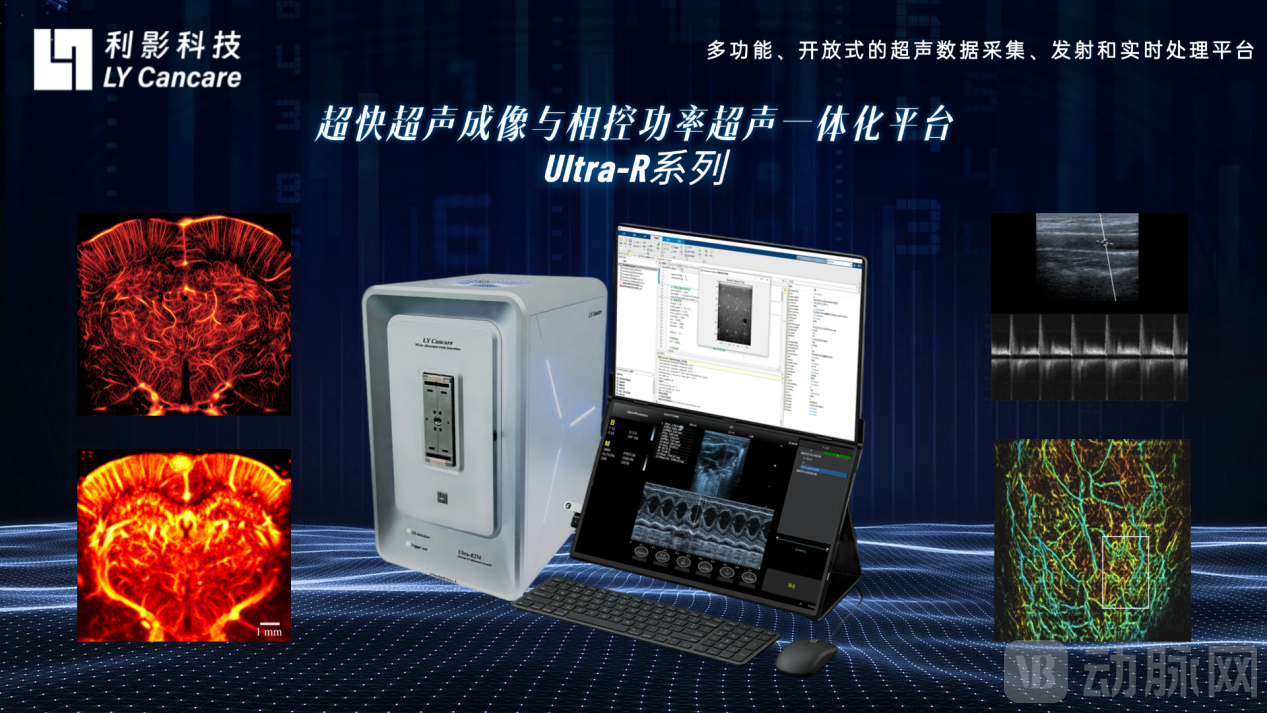
Ultra-R256 Ultra-Fast Ultrasound Imaging and Phased Power Ultrasound Integrated Platform
Ultra-R256 directly benchmarks imported products in performance metrics., with an ultra-high imaging frame rate of tens of thousands of frames per second and high-throughput data transmission speed, supports various imaging modalities such as real-time B-mode, M-mode, ultrafast Doppler, ultra-resolution blood flow, pulse wave Doppler, shear wave elastography, and photoacoustic tomography. Additionally, when equipped with an external power supply, the platform offers high acoustic power output, enabling users to conduct integrated "imaging + intervention" theranostic research.
In addition, Ultra-R256 has special advantages in terms of the platform's ease of use and customization., which not only supports access to raw ADC and RF data under a soft beamforming architecture but also enables real-time image display during data transmission, combining efficient data display, storage, and analysis capabilities. Additionally, for users with different backgrounds, Ultra-R256 provides not only a MATLAB-based programmable operating environment but also a graphical control interface styled similarly to clinical ultrasound software.
In addition to the Ultra-R series, Liying Technology's open ultrasound research platform has further expanded, gradually forming a product matrix, including advancements in technical indicators such as ultra-high frequency and arbitrary waveform."Ultra-S Series——Ultrahigh-Frequency Arbitrary Wave Ultrafast Ultrasound Imaging Platform", integrating the structural, functional, and molecular imaging capabilities of both ultrasound and photoacoustic technologies."Ultra-Photonics Series —— Ultra-Fast Ultrasound and Large-Aperture Photoacoustic Fusion Imaging Platform", as well as focusing on high-power sound output"Ultra-HP Series – Ultra-High Power Phased Ultrasound Module"The above platform can be flexibly adapted to diversified scientific research and engineering scenarios, including small animal and human imaging, ultrasound intervention and treatment, non-destructive testing, ultrasound sensor development, and ultrasound algorithm research.
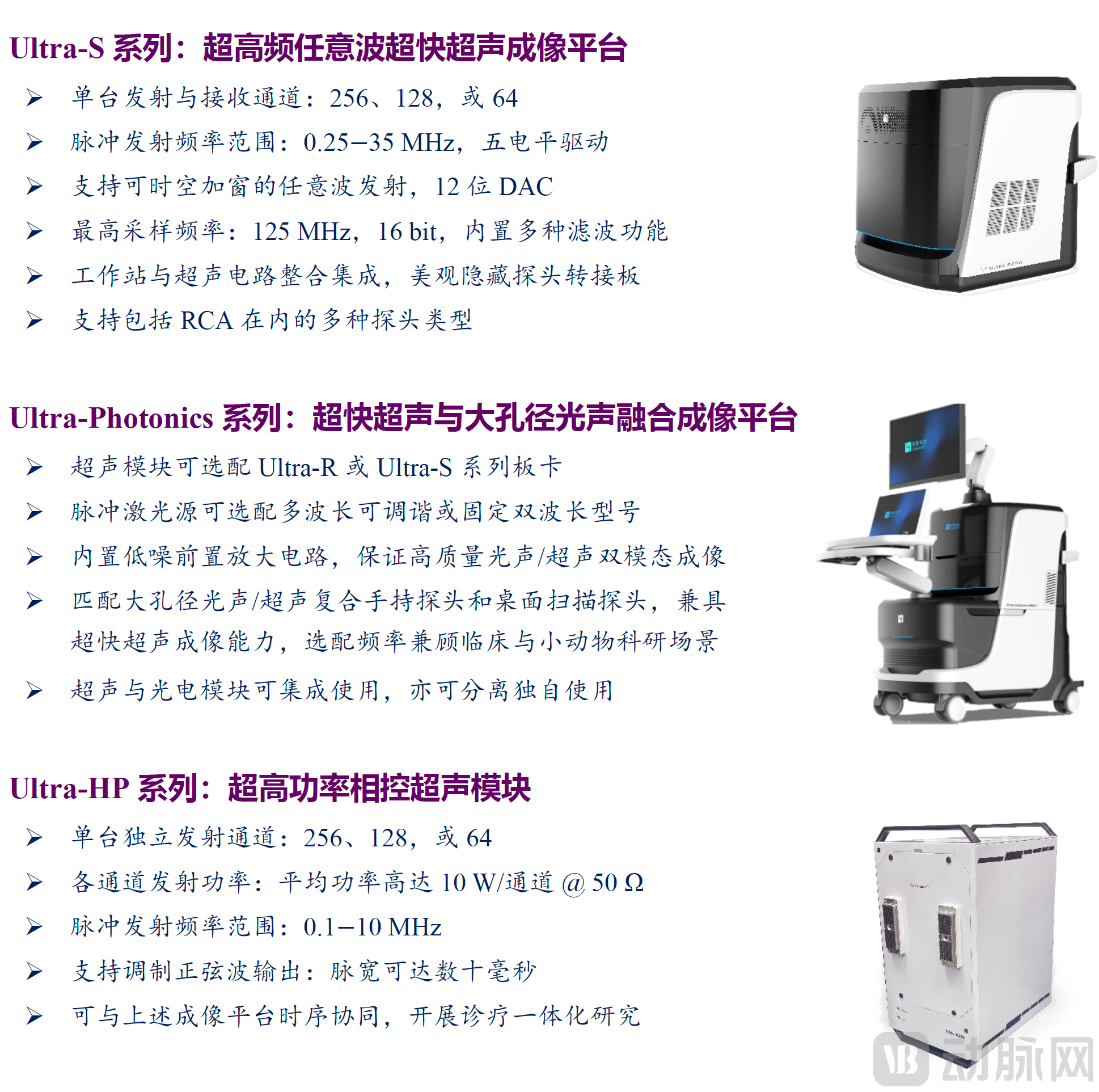
LIYING Technology's Ultrasound/Photoacoustic Research Platform Expanded on the Basis of R Series Technology
More importantly, Liying Technology has achieved full-chain independent research and development in hardware, firmware, software, algorithms, and structure through team efforts and accumulation. While its core indicators and functions are on par with internationally top-tier products, its price is much lower.
At the same time, Lin Li emphasized: "For end users, technology itself is not their core demand, and relying solely on technological advantages is not enough to build comprehensive competitive barriers." In order to better respond to users' personalized research needs, Liying Technology has established a user-centered R&D and service system, providing rapid after-sales response and technical support.
"In the process of serving our earliest two users, after we completed the technical iteration later on, we proactively contacted the users to update their devices free of charge. Satisfying our users is our core pursuit. Only by mastering full-chain independent development capabilities can a company have the conditions to continuously iterate its products." Lin Li shared.
It is reported that within just over a year of entering the market, Liying's scientific research instruments have been delivered to nearly twenty scientific research institutes, hospitals, and enterprises. With their excellent performance and high-quality service, they have gained widespread praise from customers.
Compared with mature B-ultrasound, MRI, and X-ray, photoacoustic imaging has not yet demonstrated "disruptive advantages" in clinical scenarios. Moreover, the implementation of an entirely new medical technology — from research and development, clinical trials, certification acquisition, to promoting expert consensus and establishing a charge catalog — requires years of time and tens of millions of investment, which is typically a difficult and high-risk path for startups. "I hope to gradually complete the iteration and positioning of clinical products through promotion in the biomedical research market."
Despite the current company's product focus being on ultrasound users, Lin Li has never wavered in his firm belief in the clinical value of photoacoustic imaging. He emphasized that photoacoustic imaging...Efficacy Monitoring of Neoadjuvant Chemotherapy for Breast Cancer, Early Diagnosis of Arthritis, and Molecular ImagingThese细分 clinical fields still have enormous potential and irreplaceable advantages. "The key lies in targeting the right needs and developing appropriate products."
In October 2025, the new-generation high-speed dual-modal photoacoustic imaging system independently developed by Lin Li after returning to China achieved significant clinical breakthroughs. In collaboration with the clinical team at the First Affiliated Hospital of Zhejiang University School of Medicine, the system completed clinical testing on 170 patients with breast tumors. The results showed that its diagnostic specificity increased from 22.5% with clinical ultrasound to 75.0%. The relevant findings were published in Science Advances.
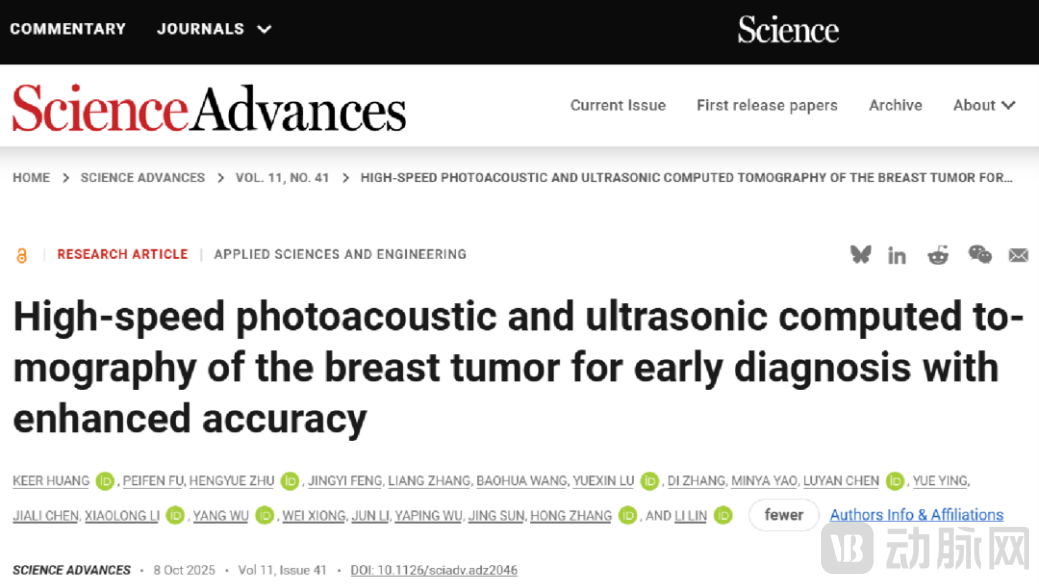
Science Advances 11(41), 2025
Specifically, the system innovatively adopts a design architecture that combines dark-field illumination with large-aperture ultrasonic detection, breakthroughly enhancing imaging depth, speed, clarity, and reliability. It not only enables real-time dual-modal photoacoustic/ultrasound imaging but also completes a full breast scan within 12 seconds, achieving an effective imaging depth of 5 cm and a resolution of 0.2 mm. This is also the underlying technology for Liying Technology's Ultra-Photonics series products after completing system miniaturization.
Since 2015, with the implementation of a series of policies and projects such as the National Key R&D Program's "Basic Research Conditions and Major Scientific Instrument Equipment Development" key special project, the National Major Scientific Instrument Development Project, and the Industrial Foundation Reengineering and High-Quality Manufacturing Development Special Project, China's scientific instrument industry is embracing a historic development opportunity.
The story of Lin Li and Liying Technology is a microcosm of the rapid growth of China's new generation of tech entrepreneurs—they no longer rely solely on papers to define the value of technology. Instead, they integrate elements such as "independence, efficiency, openness, and service" into their daily work, building up the core competitiveness of their team in niche markets by addressing user needs. Meanwhile, with continuous innovation in fundamental technologies and ongoing iteration of engineering systems, Liying Technology is driving laboratory innovations to accelerate their transition into clinical applications, transforming them into pragmatic forces that serve society.