

$865 Million! Pfizer Strikes Again

Cartography
Cancer Treatment Developer
On January 6, Pfizer announced a research and development collaboration with Cartography Biosciences, a U.S.-based immuno-oncology company. The collaboration will focus on the discovery and validation of "tumor-selective antigens." According to disclosed information, the partnership will concentrate on a specific cancer indication, leveraging Cartography’s Atlas and Summit drug discovery platforms to screen and validate candidate targets with high tumor specificity.
In terms of the deal structure, Pfizer will pay Cartography up to $65 million in upfront and research milestone payments, while retaining options for multiple target programs. If all projects proceed smoothly and reach subsequent milestones, the total value of the collaboration could reach up to $865 million.
Dual-Platform Breakthrough: 10x More Open Data, Unlocking 25 Million Potential Target Combinations
Cartography Biosciences, Inc., headquartered in San Francisco, USA, is an emerging biotechnology company focused on cancer immunotherapy. Its core strategy involves mapping high-resolution human cell atlases by utilizing single-cell sequencing, spatial transcriptomics, and artificial intelligence algorithms to comprehensively profile thousands of patient tumor samples and normal tissues.
The reason why Cartography has attracted the favor of giants like Pfizer lies in its unique tumor antigen discovery technology platforms—Atlas and Summit.
Traditional methods for discovering tumor antigens often rely on small-sample cell analysis or single-dimensional data, making it difficult to comprehensively capture the differences between tumor cells and normal cells. This results in either insufficient specificity of the selected antigens (which can attack normal cells and cause side effects) or low coverage (effective only for a small number of patients).
And Cartography'sThe Atlas platform is an integrated proprietary single-cell RNA data and tissue resource library (with a cell count 10 times that of public datasets), containing a healthy reference atlas covering over 1,000 cell types across major human organs., and a tumor atlas characterizing trillions of single-cell data points, combined with targeted algorithms for multi-dimensional screening of safe and effective targets and combinations.Summit Platform Focuses on Multi-Specific Targeting, Identifying 25 Million Potential Surface Target Combinations Through Single-Cell Data to Construct "Synthetic Targets", achieving high specificity of therapy and broad patient coverage, solving the recognition challenge of traditional targets. With the help of these platforms, Cartography can evaluate the expression differences of each antigen in tumors and normal tissues from massive single-cell data, screening out candidate targets that truly "precisely target cancer cells."
In addition to its technology platform, Cartography's pipeline progress has provided solid support for this collaboration. Its core candidate drug, CBI-1214, is a bispecific T-cell engager (TCE) targeting the LY6G6D antigen for the treatment of colorectal cancer patients. LY6G6D is a newly discovered highly specific tumor antigen that is hardly expressed in healthy cells but only in microsatellite-stable (MSS) and low microsatellite instability (MSI-L) tumor cells of colorectal cancer. As the majority of patients are of the MSS/MSI-L type, CBI-1214 has a broad potential beneficiary population. In December 2025, the U.S. FDA approved the Investigational New Drug (IND) application for CBI-1214 and granted it Fast Track designation, meaning Cartography can initiate Phase I clinical trials in the first quarter of 2026. Additionally, the company is developing other antibody-based cancer therapies with the goal of addressing cancer types that currently have limited treatment options.
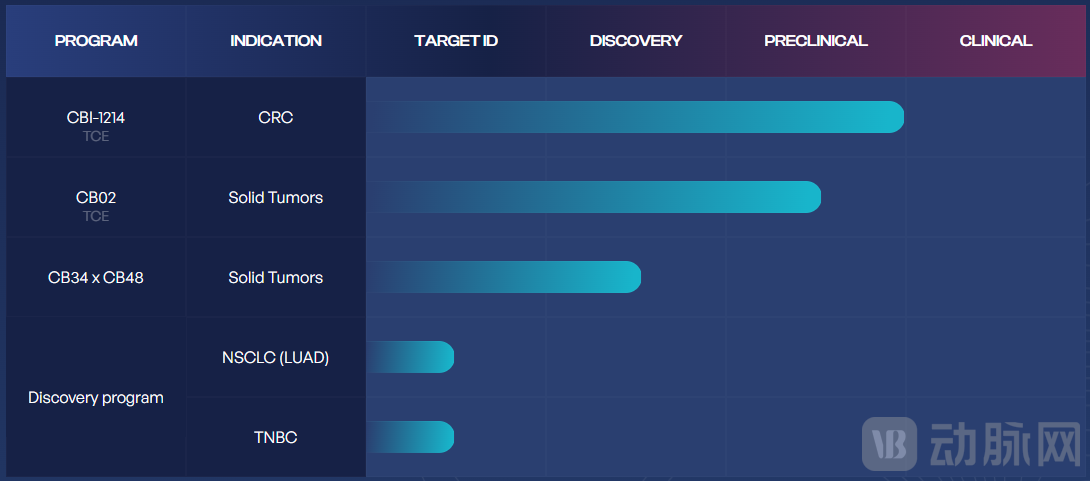
Cartography Pipeline Overview
The evolution at the capital and cooperation levels further outlines the development trajectory of Cartography. In July 2022, the company completed a $57 million Series A financing round led by Andreessen Horowitz and other institutions, laying the foundation for the construction of its technology platform and initial pipeline layout. Following the Series A round, the company advanced both pipeline expansion and external collaborations: in 2024, it reached a collaboration with Gilead Sciences, which paid $20 million upfront, to jointly develop novel anti-cancer therapies targeting triple-negative breast cancer and specific non-small cell lung cancers; in October 2025, Cartography secured another $67 million in Series B financing, co-led by Pfizer's venture capital arm, with the funds primarily used to advance the clinical development of its core candidate drug CBI-1214, as well as to expand innovative projects subsequently identified through the Atlas and Summit platforms.
Against this backdrop, looking back at Pfizer's BD collaboration this time, its logic becomes even clearer. In recent years,Pfizer Continues to Enter the Front End of R&D Through Collaborations in Oncology and Immunology Fields, emphasizing the enhancement of platform capabilities to improve the certainty of target selection. Previously, Pfizer had reached a collaboration worth up to $890 million with Adaptive Biotechnologies, focusing on the layout of autoimmune disease direction through the T-cell receptor discovery engine.
Targeted Therapy Drives Billion-Dollar Market, Antigen Discovery Becomes Key to Breakthrough
Targeted tumor therapy has firmly become the core track of global cancer treatment, with the continuous expansion of the market size confirming its clinical value and commercial potential. According to QYResearch survey data,Global Targeted Cancer Therapy Market Size Reached USD 122.97 Billion in 2024, Expected to Climb to USD 202.72 Billion by 2031During the period from 2025 to 2031, the compound annual growth rate (CAGR) will remain at 7.5%; IQVIA's statistics focus on more cutting-edge fields, with the current global market size for tumor biotherapies such as bispecific antibodies and antigen vaccines being approximately $3 billion. It is expected to exceed $15 billion by 2026, and optimistically, it could reach $40 billion in the future.
Behind the rapid growth of the market, a core bottleneck has always constrained the in-depth development of the industry:The number of highly tumor-specific antigens available for clinical translation is scarce.These antigens must meet the stringent criteria of "low expression in healthy cells and specific expression in tumor cells," making their discovery and validation extremely challenging. Most currently approved tumor-targeted drugs are directed at tumor-associated antigens or gene mutation targets, but they remain limited by a narrow safety window and restricted patient coverage to varying degrees. This structural contradiction directly hinders the broader application of immunotherapy in solid tumor scenarios. Cartography, with its precise tumor-targeting strategy focused on "enhancing efficacy and reducing toxic side effects," squarely addresses the unmet core needs of the market.
Focusing on this core pain point, the field of tumor antigen research and development has formed a clear pattern of industrial division:Multinational pharmaceutical companies, with their mature clinical development systems and commercialization networks, are leading the backend implementation, while the discovery and screening of high-value antigens at the frontend is gradually becoming a core focus for biotech companies.To compensate for the lack of early R&D capabilities, large pharmaceutical companies have strengthened their layouts through business development (BD) collaborations: Roche leverages real-world data to optimize patient stratification, while Merck builds a multi-party collaborative network, both essentially aiming to enhance the certainty and efficiency of antigen discovery. Sanofi's continuous investment in technology pathways such as siRNA targeting mRNA also indirectly reflects leading pharmaceutical companies' long-term emphasis on the fundamental capability of "precise targeting."
Biotech companies have become the main source of antigen innovation, a trend that is particularly prominent in the Chinese market.According to DealForma data, approximately 31% of the innovative drug candidate molecules introduced by large multinational pharmaceutical companies in 2024 come from China. As these pipelines gradually advance to later clinical stages and receive approval for market launch, China's innovative drugs will have the opportunity to share the global pharmaceutical sales market worth $1.6 trillion (2023 data). Their development path, centered on technology platforms, echoes that of international companies such as Cartography and Adaptive Biotechnologies.
From the overall perspective of the industry, as more companies invest in the research and development of tumor antigens, a group of targets with higher tumor specificity is expected to emerge in the next 3-5 years, driving targeted therapy into a more refined stage. However, it should be noted that antigen discovery still has a high technical threshold, and the efficiency of technology transformation and the control of R&D risks remain urgent issues for the industry to address.
For innovation entrepreneurs, investment institutions, and business managers, the deal between Pfizer and Cartography provides a clear signal:Single targets or concepts can no longer sustain long-term value; systematic data platforms centered around highly specific targets are becoming a more definitive competitive factor in the field of targeted cancer therapy.. Against the backdrop of continuously increasing R&D investment and intensifying competition, rational BD cooperation and resource complementation may become crucial pathways to achieving sustainable innovation.