


This article is reprinted from the WeChat Official Account "Hanson Clinical Research".
August 9, 2021 (this Monday),Therapeutic Goods Administration (TGA)Awarded to Merck Sharp & Dohme Corp.Molnupiravira provisional decision, thereby enabling MSD to apply for the registration of Molnupiravir in AustraliaNew Drug Launch。
In the early stage of infection, the virus replicates rapidly, while the host's immune system has not yet had sufficient time to establish an immune defense, thereforeThe optimal time for antiviral drug therapy to inhibit viral replication is within the first few days of infection.. ButMolnupiravir is specifically designed for outpatient use in the early stage of the disease., and as an oral capsule, the eligible patient population will increase significantly.
Molnupiravir is a broad-spectrum antiviral agent targeting RNA viruses. I have discussed it extensively since the beginning of last year and believe that this antiviral small molecule exhibits potent activity against SARS-CoV-2.
Uploaded on June 21, 2021medRxiv、In a clinical trial led by the University of North Carolina (UNC) in the United States, at 3 days post-treatment, the probability of isolating replication-competent virus among patients in the 800 mg molnupiravir group was significantly lower than that in the placebo group (1.9% vs. 16.7%, p = 0.02), which is the gold standard for assessing viral infectivity.After 5 days of treatment, no replicating virus could be isolated from patients in the 400 mg and 800 mg groups., replication-competent virus was isolated from 11.1% of patients in the placebo group (p = 0.03).
2021On August 11, the Max Planck Institute atNature SMEAn excellent article was published detailing the molecular mechanism of action of Molnupiravir, a potentially highly potent antiviral drug.
This study elucidates the mechanism by which molnupiravir induces mutations during viral RNA replication. The active form of molnupiravir is β-D-N4-hydroxycytidine (NHC) triphosphate, which is misincorporated by the viral RdRp instead of cytidine triphosphate or uridine triphosphate as a catalytic substrate.
NHC causes the incorporation of abundant A and G during viral RNA replication, thereby inducing mutations in the RNA product. Structural analysis of the RdRp-RNA complex containing the mutagenic product reveals that NHC can form stable base pairs with G or A at the RdRp active site, explaining how the drug evades proofreading and synthesizes mutated RNA.
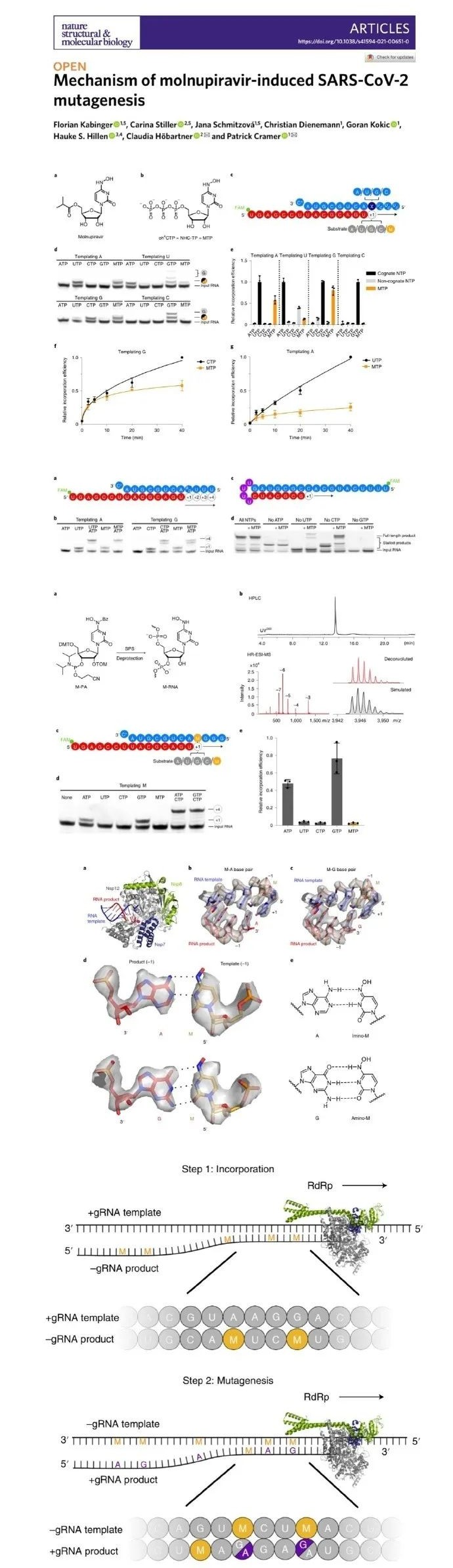
This two-step mutagenesis mechanism may be applicable to various viral polymerases, therefore,Molnupiravir may exhibit broad-spectrum activity against RNA viruses.。
In June 2021, the U.S. Biden administration pledged to purchase 1.7 million treatment courses of molnupiravir, valued at approximately $1.2 billion, if the U.S. Food and Drug Administration (FDA) granted the drug an Emergency Use Authorization.
As early as February 4, 2020, when we were discussing the use of remdesivir for the treatment of COVID-19, we already noted:Antiviral therapy combined with monoclonal antibodies is the ideal approach for treating COVID-19.。
Meanwhile, the challenge faced by the novel coronavirus and other viruses that cause severe pneumonia is:Therapeutic Time Window. That is, the earlier the treatment, the better the outcome.
This also means that,Oral medication required。
And in treatment`Mild to Moderate COVID-19`In terms of monoclonal antibody research and development, three drugs have currently been approved:
A, Regeneron's monoclonal antibody cocktailREGEN-COV;
B, monoclonal antibody co-developed by Vir Biotechnology (US) and GlaxoSmithKlineSotrovimab (VIR-7831) ;
C, Eli Lilly's monoclonal antibodyBamlanivimabwas the first to be approved, but had its Emergency Use Authorization revoked due to variant strains; laterbamlanivimab and etesevimabApproved again, but distribution was suspended again on June 25.
Furthermore, all currently available monoclonal antibodies are injectable formulations, severely limiting their clinical application.
Remdesivir, developed by Gilead, is also an injectable formulation and therefore cannot be used for early outpatient treatment; following Gilead's announcement on July 30, 2021, to discontinue clinical trials of inhaled remdesivir, currentlyThe hope for oral antiviral agents for the early treatment of COVID-19 rests on Molnupiravir.。
With high expectations placed upon it, we wish Molnupiravir a swift market launch.